
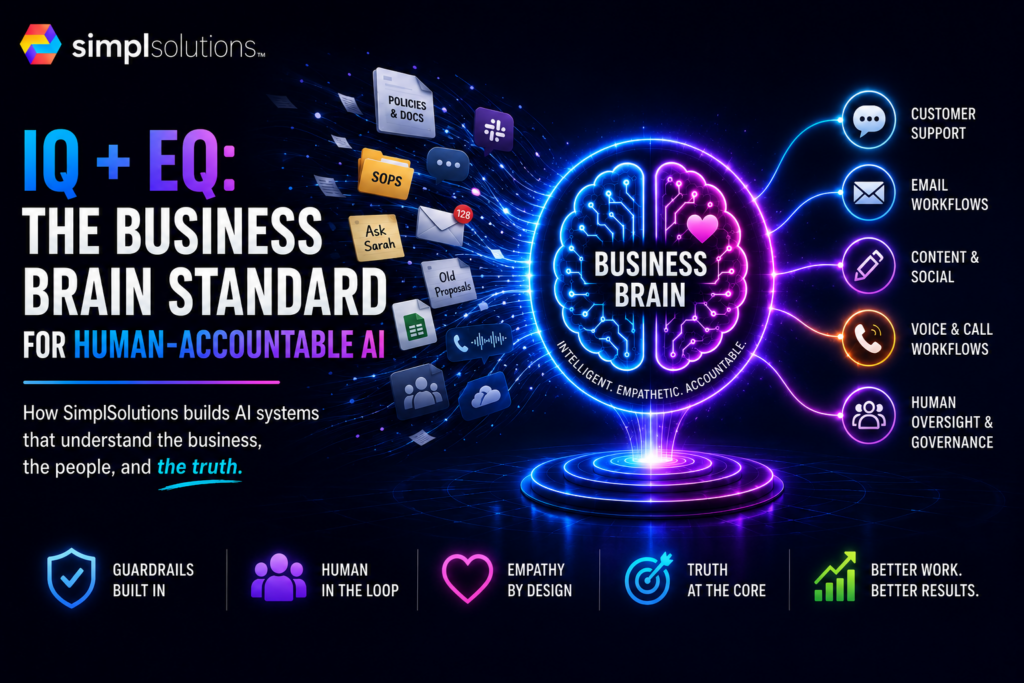
The next phase of business AI will not be won by the model alone.
Models can generate, summarize, classify, retrieve, draft, and reason. That capability matters. But the model is not the business system. It is the engine inside the system.
SimplSolutions sits around the model as the intelligence layer.
In simple terms, the model is the filling. SimplSolutions is the bread.
Real organizations do not operate on information alone. They operate through people, pressure, culture, tone, trust, memory, judgment, relationships, approvals, and context.
That is where EQ matters.
A technically correct answer can still feel wrong if it ignores the human situation around the request. A fast response can still create risk if it skips approval. A polished message can still damage trust if it does not match the organization’s values, voice, or reality.
SimplSolutions is built around the belief that business AI needs more than output. It needs an intelligence layer.
That intelligence layer is the Business Brain: a shared knowledge and execution layer configured around approved organizational knowledge, tone, workflows, decision rules, escalation logic, and guardrails. It can support assistant, content, social, email, voice, training, help, and managed execution workflows from the same foundation.
The goal is not to create more AI noise.
The goal is better organizational intelligence.
SimplSolutions’ operating thesis is simple: the model gives raw capability; the Business Brain makes that capability usable inside a real organization.
the ability to retrieve, reason, classify, summarize, draft, route, and follow workflow logic.
the ability to recognize tone, urgency, frustration, hesitation, uncertainty, sensitivity, and moments that require human escalation.
cultural and contextual intelligence: the ability to fit the organization, audience, environment, and relationship without flattening every business into the same generic AI voice.
truth intelligence: the ability to distinguish what is known, what is unknown, what is inferred, what is source-supported, what needs review, and what should not be claimed.
Together, these layers define the SimplSolutions standard for human-accountable AI.
Most AI conversations still start with the wrong question.
Can the system write a blog? Can it answer a question? Can it draft an email? Can it summarize a document? Can it take a call? Can it generate content?
Those are useful capabilities. But they are not the same as business execution.
Businesses do not run on isolated outputs. They run on context, timing, approvals, routing, trust, memory, tone, and follow-through.
That is why so many organizations try AI and still feel the same operational drag. The tool can produce. The team still has to decide whether the answer is accurate, whether the message is approved, whether the tone fits the brand, whether the workflow requires a person, and whether the next action belongs in email, CRM, support, voice, content, or leadership review.
The output may be faster.
The business is still carrying the coordination burden.
SimplSolutions addresses that gap by treating AI as an operating system problem, not just a generation problem. The real work is not simply getting AI to respond. The real work is building the shared intelligence layer that tells AI what it knows, how it should communicate, what it is allowed to do, when it should stop, and when a human should take over.
It is not another dashboard. It is not just a chatbot. It is not a pile of prompts sitting next to the business.
It is the structured layer above and below the model.
It prepares the truth the model is allowed to reason from.
It decides how that reasoning should be used inside the business.
That is why SimplSolutions is not simply selling access to AI. The model is already becoming widely available. The advantage comes from the intelligence layer that surrounds it.
is the structured layer where organizational truth, workflow logic, brand voice, human judgment, and AI capability meet.
In this white paper, IQ refers to the system’s knowledge-handling and reasoning capability.
For a Business Brain, IQ includes the ability to:
retrieve approved knowledge
understand workflow context
summarize source material
classify requests
identify next steps
apply business rules
follow decision logic
draft useful responses
recognize missing source support
route work to the right channel or person
This is the part of AI most people already understand. It is what allows a system to answer a policy question, summarize a document, draft a response, organize a workflow, or support a team member.
IQ matters because business AI must be useful. It must know where information lives. It must connect the request to the right source. It must understand whether a question belongs to sales, support, operations, marketing, training, leadership, or compliance review. It must avoid making up answers when source support is missing.
But IQ alone does not make AI feel aligned.
A generic AI tool can be powerful in the abstract and still weak inside a specific business because it does not automatically know what that organization actually knows, believes, sells, prohibits, approves, escalates, or cares about. It may know how to generate a response, but it does not know whether that response belongs inside the company’s reality.
That is the difference between model capability and organizational intelligence.
The model can answer.
The Business Brain knows whether the answer should be given, how it should be framed, what source supports it, whether the tone fits the moment, and whether a human should review it first.
IQ gives the system structure. It answers:
What do we know?
What source supports this?
What rule applies?
What workflow does this belong to?
What should happen next?
That is necessary.
It is not sufficient.
EQ refers to the system’s emotional and relational awareness.
For a Business Brain, EQ includes the ability to:
recognize urgency
detect confusion or frustration
adapt tone
preserve dignity
respond with restraint
know when not to over-explain
know when reassurance matters
know when to slow down
know when to escalate to a human
This is where business AI starts to feel less mechanical and more aligned with the organization it represents.
People do not want to feel processed.
Customers, employees, parents, residents, patients, clients, franchisees, operators, and partners all bring more than a question into a conversation. They bring pressure, skepticism, uncertainty, history, expectations, and emotion.
An IQ-only system may treat every interaction as a neutral information request.
An EQ-aware system recognizes that the human situation changes the response.
A frustrated customer does not need the same tone as a casual website visitor. A worried parent does not need the same pacing as a procurement officer. A skeptical buyer does not need hype. A team member anxious about AI does not need to be told to “embrace innovation.” They need to understand that AI is there to remove repetition, not authority.
EQ does not mean pretending the system is human. That usually makes things worse.
EQ means the system is designed to communicate with enough awareness to reflect the organization’s best human standards.
In voice workflows, this becomes even more important.
Voice carries signals text often hides: pace, hesitation, stress, anger, confusion, urgency, and emotional weight. A voice system that ignores those signals is not really listening. It is just transcribing.
SimplSolutions treats voice, email, support, content, and customer-facing communication as trust-sensitive workflows. Routine work can be supported by AI. Emotional, urgent, complex, sensitive, or high-risk situations should route to humans.
That is not a limitation.
That is judgment.
AI handles repetition. Humans keep authority.
There is a third layer that belongs in this conversation: CQ, or cultural intelligence.
IQ helps the system know.
EQ helps the system respond.
CQ helps the system fit the people, organization, and operating environment.
Culture does not only mean nationality or ethnicity. In business, culture can mean organizational culture, professional culture, regional expectations, school-district norms, franchise standards, customer community, leadership style, or the internal language a team has built over years.
A school district does not communicate like a restaurant group. A municipal office does not communicate like a med spa. A founder-led small business does not communicate like a national franchise. A support team does not need the same rhythm as a sales team. A board-facing explanation needs different restraint than an internal operations note.
A Business Brain should understand that different groups define “professional,” “helpful,” “urgent,” “clear,” and “respectful” differently.
That does not mean stereotyping users. It means respecting context.
For example:
A superintendent may need board-safe language, parent sensitivity, privacy-aware framing, and clear human oversight.
A franchise operator may need consistency across locations without sounding cold or overly corporate.
A small business owner may need direct operational help without enterprise jargon.
A support lead may need escalation discipline more than clever language.
A sales lead may need follow-up that protects reputation and does not feel automated.
A marketing lead may need content that scales without losing brand voice.
A property manager may need a guest-facing answer layer that knows when to escalate.
CQ prevents AI from flattening every organization into the same voice.
That matters because culture is not decoration.
Culture is how trust travels.
The strongest AI systems are not the ones that sound the most confident. They are the ones grounded in the cleanest truth.
Truth intelligence, or TQ, is the layer that helps the system distinguish between what is known, unknown, inferred, outdated, contradicted, unsupported, sensitive, or approval-dependent.
This matters because AI systems do not become useful by guessing harder. They become useful when they are grounded in accurate source material, honest rules, clear ethics, real operating context, and reviewable boundaries.
Better grounding creates better inference.
Poor grounding creates confident noise.
For business AI, bad input is not only bad data. It can also be:
outdated policies
conflicting SOPs
fake proof
unsupported marketing claims
unclear approval rules
unethical decision logic
incentives that reward the wrong behavior
leadership language that does not match actual operations
customer promises the organization cannot honor
a culture that says one thing and does another
That is where AI ethics becomes practical.
If an organization trains AI on distorted information, the system will reflect the distortion. If leadership wants the system to sound ethical while the underlying rules reward behavior the organization would not publicly defend, the system is being asked to perform a lie.
That does not create alignment.
It creates theater.
A Business Brain can only represent an organization honestly if the organization is willing to define the truth honestly.
This is why SimplSolutions emphasizes source-grounded answers, guardrails, approval loops, human-in-the-loop review, and clear unknown-answer behavior.
Sometimes the most intelligent response is:
“I do not have enough source support to answer that.”
“This requires human review.”
“This is outside the approved workflow.”
“This should be escalated.”
“This claim needs verification before public use.”
That is not a failure.
That is intelligence with guardrails.
The Business Brain is SimplSolutions’ practical implementation of the intelligence layer.
It is designed to sit both below and above the model.
Below the model
the Business Brain creates the grounding layer. It organizes what the organization knows, what it believes, what it has approved, what workflows exist, what source material is authoritative, what claims are allowed, what tone fits the brand, and what information is missing or uncertain.
Above the model
the Business Brain creates the orchestration layer. It decides how the model’s output should be used: whether to answer, draft, summarize, route, escalate, ask for review, pause, or refuse. It also controls tone, channel behavior, approval logic, escalation rules, and human-in-the-loop checkpoints.
That is why the Business Brain is the bread in the sandwich.
The model may be the most visible ingredient, but the intelligence layer is what holds the system together.
Without the bottom layer,
the model lacks business truth.
Without the top layer,
the model lacks business judgment.
Without both,
the organization gets output without control.
With both,
the organization gets governed intelligence.
The Business Brain is designed to centralize organizational knowledge, align communication, support workflows, and coordinate AI-assisted execution across approved channels.
The Business Brain can support multiple SimplSolutions modules from the same foundation:
SimplAssist
the internal assistant and knowledge hub that helps teams access approved information, SOPs, FAQs, policies, workflows, and source-grounded answers.
SimplContent
content drafting and content systems built around approved voice, source material, SEO and LLM readability, review boundaries, and claims discipline.
SimplSocial
social planning and drafting connected to shared brand knowledge, campaign priorities, approval workflows, and platform-aware communication.
SimplMail
governed email drafting, inbox logic, outbound pacing, response classification, routing, and human approval before sensitive or reputation-impacting communication.
SimplVoice
inbound and outbound voice workflow support with escalation logic for urgent, emotional, complex, sensitive, or high-risk situations.
SimplAgency
managed execution for organizations that need SimplSolutions to help operate the system across approved workflows rather than simply configure tools.
Training, curriculum, help, and role-play support
internal enablement materials, AI adoption training, objection practice, support education, and scenario-based learning that help people use AI responsibly.
The value is not that each module “uses AI.”
The value is that each module can operate from the same intelligence layer.
That is how an organization avoids five different tools giving five different answers in five different voices.
Shared intelligence beats scattered automation.
The SimplSolutions approach can be understood as a practical operating pattern.
Capture the Truth
The system starts with approved organizational knowledge: documents, policies, SOPs, FAQs, brand standards, workflows, historical decisions, templates, service rules, voice guidance, and decision logic.
The question is not “What can AI generate?”
The question is “What truth should the system be allowed to use?”
Normalize the Truth
Source material is organized, clarified, and reviewed for contradictions, missing information, outdated rules, unsupported claims, and approval needs.
The goal is not to force certainty. The goal is to distinguish what is known, what is unknown, what is inferred, what is single-source, and what requires review.
Add IQ
The system is configured to retrieve information, classify requests, summarize context, apply rules, draft responses, identify next steps, and support the workflow.
IQ turns the truth layer into usable operating knowledge.
Add EQ
The system is configured to recognize tone, urgency, confusion, frustration, skepticism, sensitivity, and moments that require a different response pattern.
EQ helps the system protect the relationship, not just complete the task.
Add CQ
The system is adapted to the organization’s culture, audience expectations, channel norms, and communication environment.
CQ keeps the system from sounding generic.
Apply Guardrails
The system is bounded by what it can say, do, send, publish, route, approve, or escalate. Guardrails define the safe operating zone.
Guardrails are not cosmetic policy language.
Guardrails are what make AI deployable.
Keep Humans in Authority
High-risk, unclear, emotional, public-facing, regulated, compliance-sensitive, or reputation-sensitive work remains subject to human review.
The system supports judgment.
It does not replace it.
A Business Brain should improve through a disciplined loop:
Truth → Context → Inference → Action → Feedback → Updated Truth
Truth
Context
Inference
Action
Feedback
Updated Truth
That loop is the difference between static automation and governed intelligence.
If the truth layer is weak, inference weakens.
If context is missing, action becomes generic.
If feedback is ignored, the system drifts.
If ethics are not encoded, influence becomes misaligned.
If humans do not review high-risk outputs, trust erodes.
The goal is not to make AI “act human.”
The goal is to make AI operate with enough organizational intelligence that humans can trust it in the right workflows.
That means the system must know when to answer and when not to answer. It must know when to continue, when to pause, when to ask for review, and when to escalate.
This is the practical standard for business AI:
source-grounded enough to be useful
emotionally aware enough to protect trust
culturally aware enough to fit the audience
governed enough to be deployed
restrained enough to avoid overreach
flexible enough to support real workflows
human-accountable enough to earn adoption
That is the Business Brain standard.
Influence is a sensitive word in AI.
Used carelessly, it can imply manipulation. That is not the SimplSolutions framing.
Better influence should mean the ability to communicate in a way that is more truthful, more relevant, more useful, and more context-aware.
Better connection should not mean pretending AI is human. It should mean the organization can show up consistently across more moments without losing its voice, values, or judgment.
When IQ, EQ, CQ, and TQ work together, the system can:
answer with more accuracy
communicate with more care
preserve organizational culture
adapt to audience context
reduce repetitive burden
support faster routing
protect trust
escalate sooner when needed
avoid unsupported claims
help teams act from the same source of truth
That is how AI becomes useful inside a business.
Not because it replaces people.
Because it helps the organization remember what it knows, communicate how it means to communicate, and act within the boundaries it claims to believe in.
Influence is only useful when it is earned through clarity, relevance, restraint, trust, and truth.
A common mistake is treating AI ethics as a checklist at the end of the build. That is backwards.
Ethics shape the operating system.
They determine what the system is allowed to say, what it must refuse, what it must escalate, what it can automate, what requires approval, and what should remain human-owned.
For SimplSolutions, ethical AI is not abstract branding. It shows up in practical operating rules:
Truth
use approved source material, not guesses.
Governance
define what the system can and cannot do.
Approval
keep humans in control for public, risky, sensitive, or high-impact outputs.
Escalation
route emotion, urgency, complexity, uncertainty, or risk to people.
Restraint
do not automate what should not be automated.
Consistency
preserve the organization’s voice and values across channels.
Evidence
avoid unsupported claims, fake proof, invented outcomes, or exaggerated certainty.
This posture matters because AI amplifies whatever operating logic it is given.
If the operating logic is clear, honest, and accountable, AI can support a calmer business.
If the operating logic is messy, contradictory, or unethical, AI will scale the mess.
Automating chaos just creates faster chaos.
Business AI is moving past the question of whether a model can generate output.
That part is already here.
The better question is whether the organization can build an intelligence layer that makes AI truthful, useful, emotionally aware, culturally aligned, operationally safe, and human-accountable.
That requires more than a model.
It requires a Business Brain.
A serious business AI system should be able to answer these questions:
What source supports this answer?
What workflow does this request belong to?
What is the system allowed to do here?
What tone fits this person and moment?
What cultural or organizational context matters?
What claim requires proof before public use?
What action needs approval?
What situation should trigger escalation?
What should remain human-owned?
If an AI system cannot answer those questions, it may still generate output.
But it is not yet operating as a governed intelligence layer.
The future of business AI belongs to organizations that can combine capability with context, speed with restraint, automation with accountability, and intelligence with truth.
That is the standard SimplSolutions is building toward.
The model gives AI its capability.
The Business Brain gives that capability a business system to live inside.
SimplSolutions is the intelligence layer below the model and above the model.
Below the model, it grounds AI in truth, approved knowledge, organizational context, workflows, policies, and source material.
Above the model, it governs how AI behaves through orchestration, guardrails, tone, approvals, escalation logic, channel rules, and human accountability.
That is the bread in the sandwich.
The model is powerful, but it is not enough by itself. Without the intelligence layer beneath it, the model does not know the business. Without the intelligence layer above it, the model does not know how to act responsibly inside the business.
The Business Brain gives the model structure, memory, voice, workflow logic, guardrails, emotional awareness, cultural fit, and human accountability.
IQ helps the system know.
EQ helps the system respond.
CQ helps the system fit.
TQ keeps the system honest.
Together, they turn AI from a generator into a governed extension of the organization’s best thinking.
That is the difference between automation and intelligence.
And that is the standard businesses should demand from AI systems now.
Start with one workflow. Build the Business Brain around that. Stabilize it. Then expand.
Contact Us