
Turn your best practices into a Business Brain your teams can use every day
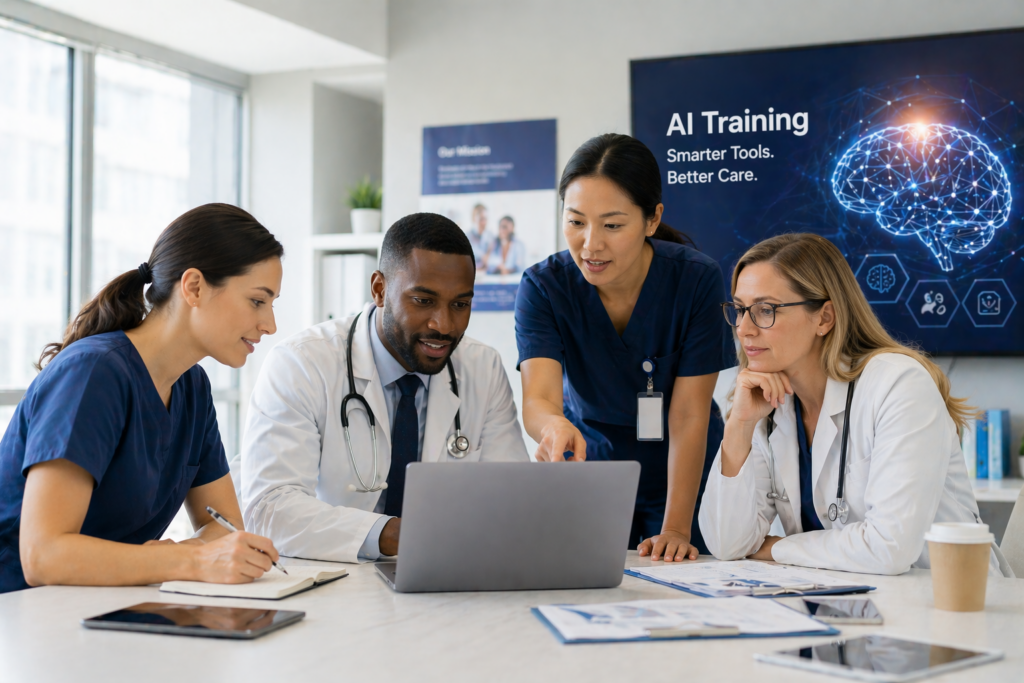
Training breaks when knowledge stays trapped in binders, slide decks, scattered documents, and the heads of your best people.
SimplSolutions helps healthcare organizations convert their standards, workflows, talk tracks, and institutional knowledge into an AI-powered Business Brain that teams can actually use in the flow of work. Then we help layer on structured training, coaching support, interaction tracking, and curriculum systems so learning becomes measurable, repeatable, and scalable.
Simpl is not generic AI.
Simpl is your operating model, your language, your standards, and your escalation logic—deployed with guardrails and human oversight.


Healthcare teams are being asked to deliver more consistency, faster onboarding, better communication, and stronger patient experiences across more locations and more staff turnover.
In Southern Orthodontic Partners’ Treatment Coordinator initiative, the stated goal was roughly 80% standardization of the TC function across their organization to improve case acceptance, patient experience, and operational consistency, while still balancing practice and clinical autonomy. Their rollout mapped training across the full new-patient workflow, including intake, exam, financial presentation, pending, observation, starts, and analytics.
That is the real opportunity:
not replacing people, but making sure the right knowledge shows up consistently, at the right moment, across the organization.

We organize your SOPs, workflows, training materials, scripts, standards, FAQs, and approved internal knowledge into a staff-facing AI system your team can use as an always-available resource.
Instead of digging through files, staff can ask questions in plain language and get answers grounded in your business rules and approved materials.
In the SimplSolutions white paper, this model is described as creating a single point of truth for SOPs, policies, training content, brand standards, compliance procedures, and institutional knowledge.
Once the Business Brain is live, it can become more than a reference layer. It can support modular learning, scored content, coaching reinforcement, and usage visibility.
Southern Orthodontic Partners’ training materials for the Madison platform outline weekly skill focus modules, module scoring, duration tracking, progress tracking, and correlation between training engagement and case acceptance. They also describe tracker utilization, dashboard visibility, and KPI review rhythms tied to accountability and course correction.
This helps turn knowledge access into a more structured enablement system instead of a one-time information dump.
The next stage is deeper curriculum infrastructure: testing, assessments, formal learning paths, and LMS-ready modules.
That means your teams do not just have access to knowledge. They can be trained against it, coached against it, and evaluated against it.
That means your teams do not just have access to knowledge. They can be trained against it, coached against it, and evaluated against it.
Most healthcare organizations do not need more documentation. They need a better way for teams to actually use the standards, workflows, and approved guidance they already have. A Business Brain makes critical knowledge easier to find, easier to reinforce, and easier to apply in the flow of work.
Help staff and managers find the right information in the moment, so daily questions do not keep slowing down execution or pulling leaders into the same repeated explanations.
A centralized Brain helps reduce drift by anchoring answers in approved materials, communication standards, and operational workflows.
Staff should not have to dig through disconnected files to find the right answer, and managers should not have to answer the same questions over and over when the organization already knows the answer.
Training is more valuable when it does not stop at content access. By supporting reinforcement, coaching, tracking, and structured learning, a Business Brain creates a path toward training that is more measurable, repeatable, and scalable.
Healthcare groups need to preserve quality while scaling.
This helps organizations:
This is a strong fit for organizations trying to balance consistency, autonomy, accountability, and operational clarity.

AI can be useful in healthcare, but only when it supports the people responsible for training, decision-making, and day-to-day execution.
SimplSolutions is built to help teams access approved knowledge, reinforce workflows, and reduce repetitive friction without taking judgment out of human hands. In healthcare settings, that distinction matters. Teams still need clear ownership around exceptions, escalation, review, and higher-stakes decisions.
This creates better access to knowledge, stronger reinforcement, and clear human responsibility where it matters.
Your materials consistently describe a model of one centralized Brain with modular capabilities layered around it, rather than disconnected point automations.
The brand posture across your docs is clear: guardrails, escalation logic, approval loops, and disciplined execution over hype.
This is about operational clarity, not novelty.
The system is not limited to Q&A. It can become the foundation for curriculum, onboarding, coaching, and measurable enablement.
If your organization already has the knowledge, workflows, and standards, the next step is making them usable at scale.
SimplSolutions helps healthcare organizations deploy AI-powered Business Brains with guardrails, human oversight, and a pathway into measurable training infrastructure.