
For the last few years, most of the AI conversation has centered on the model. That made sense. The model was the breakthrough everyone could see, test, compare, argue about, and love or hate. Bigger context windows, faster responses, stronger reasoning, more modalities, lower cost, all of those advances moved the market forward.
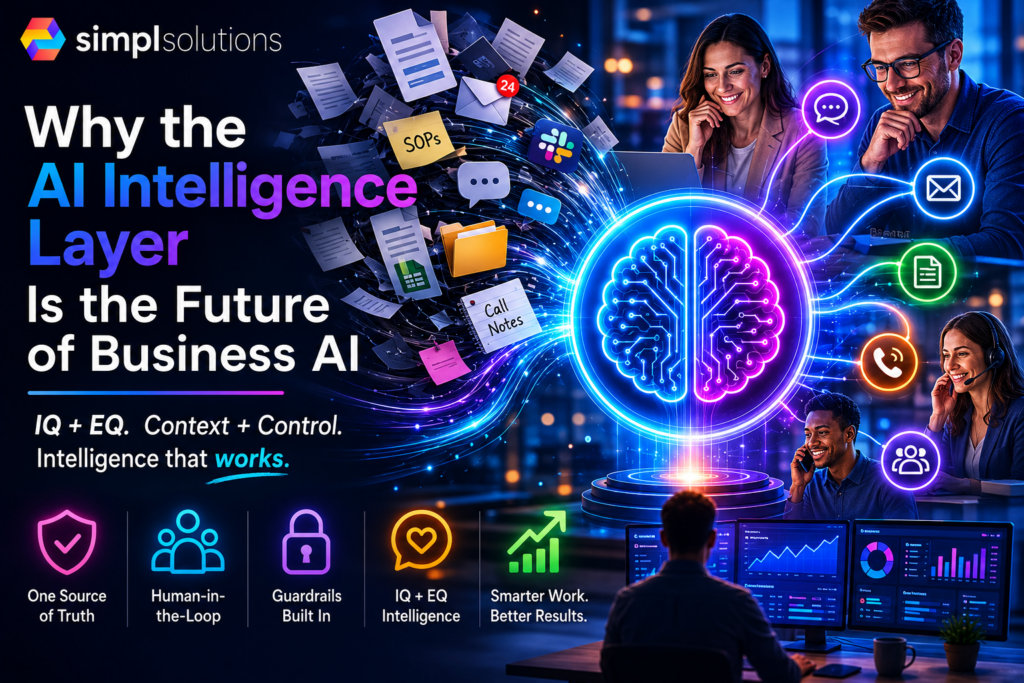
Yet I do not believe the future of business AI will be decided at the model layer alone. The next era will be defined by the intelligence layer: the system that sits above the model and turns raw AI capability into something a business can actually use. It is the layer that knows the company, understands its voice, follows its rules, connects its workflows, and recognizes when a human needs to engage.
At SimplSolutions, that is what we have been building from the beginning. We call it the Business Brain. It is a centralized intelligence layer trained on an organization’s knowledge, tone, workflows, decision rules, and guardrails, then deployed across assistant, content, social, email, and voice workflows. The goal is not to create more AI output. The goal is to make intelligence usable across the business.
That distinction matters because too much of the AI market is still focused on generation. Can the system write a paragraph? Can it draft an email? Can it summarize a document? Can it answer a customer question? Those are helpful capabilities, but they are not the same thing as business execution. Businesses do not run on isolated outputs. They run on context, timing, trust, approvals, escalation, tone, memory, and follow-through.
There is another part of this that the market is still underestimating. A real intelligence layer cannot be built on IQ alone. It also needs EQ, emotional intelligence.
Businesses are not solely built out of information. They are built out of people. People have pressure, hesitation, urgency, frustration, tone, memory, and emotion. If an AI system ignores those critical factors , then it may be technically correct and still feel wrong. That intelligence is the difference between an AI system that sounds like a robot and one that actually feels like the company it represents.
An AI intelligence layer is the operating layer that turns model capability into business capability. A large language model can answer, draft, summarize, and reason. Yet by itself, it does not know the specific business. It does not automatically know which documents are authoritative, which claims are approved, which tone fits the brand, which workflows require review, or which decisions should be escalated to a person.
The intelligence layer provides that structure. It determines what the AI can know, what it can say, what it can do, when it should pause, when it should escalate, and how it should represent the organization across channels. It is the difference between a general-purpose AI tool and a governed business system.
That matters because most organizations do not need another tool that produces isolated output. They need a system that can carry context across the business. A support question should inform future communication. A voice interaction should connect to follow-up. A blog should reinforce the same positioning that sales uses. An email should sound like the same company that answers the phone. Internal knowledge should not reset every time work moves from one channel to another.
This is why SimplSolutions is built around one Business Brain rather than a patchwork of separate automations. The platform is designed so SimplAssist, SimplTraining, SimplContent, SimplSocial, SimplMail, SimplVoice, and SimplAgency can operate from shared intelligence instead of fragmented logic.
That is the intelligence layer in practical terms. It is not a feature added onto AI. It is the architecture that enables AI to become part of how work actually gets done well.
The reason this concept is so important is that it applies across the entire business.
In marketing, the intelligence layer keeps content aligned with positioning and prevents the brand voice from drifting across platforms. It supports consistent publishing without turning the company into generic AI content.
In sales, it protects follow-up discipline. It helps communication happen at the right time, in the right tone, with the right context, without removing the human relationship from the process.
In customer support, it handles routine questions while escalating the moments that require judgment, care, or empathy.
In operations, it reduces repeated explanations, scattered knowledge, manual routing, and dependency on “the one person who knows where everything lives.”
In voice workflows, it can support calls, qualification, routing, and follow-up while recognizing when a human needs to enter the conversation.
This is why the intelligence layer is not a department-level feature. It is an organizational layer. It becomes the way intelligence moves through the company.
Many AI products still operate like advanced generators. They can write a paragraph, create a social post, summarize a file, draft an email, or answer a question. In the right context, that can be useful. But if the work stops there, then the business is still left carrying the burden of execution.
The real work happens after the output. Someone has to decide whether the answer is accurate, whether the tone is right, whether the message is approved, whether the customer needs a human, whether the next step belongs in email, CRM, voice, social, or support. The AI may have generated something, but the organization still has to turn it into action.
That is where many AI deployments stall. The demo works because the demo is controlled. The real business environment is not a perfectly controlled space. In the real world, the system has to deal with messy source material, conflicting information, overloaded teams, emotional customers, legal sensitivity, brand standards, and processes that live partly in documents and partly in people’s heads.
A model can generate through that mess, but generation is not the same as governed execution. Output is the visible artifact. Execution is the actual value. The intelligence layer is what connects the two.
One of the biggest misconceptions in AI right now is that choosing the model is the strategy. It is not. The model is a powerful component, but it is still a component. Two companies can use the same underlying model and get completely different outcomes because the outcome depends on what information surrounds it.
A serious business AI system has to answer questions that the model alone does not resolve. Does the system know the company’s approved knowledge? Does it understand the brand voice? Does it know what claims are allowed? Does it know who approves outbound communication? Does it know when a customer is distressed? Does it know when to stop? Does it know which workflow it is supporting and what success actually means?
Those questions are answered by the intelligence layer.
This is why SimplSolutions is designed to be model-flexible. The intelligence layer can sit on top of large language models where that makes sense, and it can also support more controlled or closed-loop environments when a client requires tighter boundaries. The deployment model may change, but the principle does not: the intelligence layer is what makes AI much more effective inside the business.
The model provides broad capability. The intelligence layer provides context, judgment, memory, and control.
SimplSolutions did not start from the assumption that businesses needed another AI tool. We started from the reality that businesses already have intelligence. It’s just scattered.
That intelligence lives in documents, inboxes, SOPs, voice calls, sales conversations, marketing plans, leadership decisions, support tickets, and the minds of the people everyone depends on for information/answers. Over time, it becomes fragmented. One department knows one version of the truth. Another department uses a different language. A new hire asks the same question five times to five different people. A customer receives a different answer depending on who responds.
That is not an AI problem first. It’s an operating problem.
The Business Brain exists to centralize that scattered intelligence and make it usable across the organization. It gives the business a shared source of truth and a shared communication structure. Then the modules become deployment surfaces for that combined intelligence.
SimplAssist helps teams access knowledge and support decisions. SimplTraining turns internal expertise into practical learning paths, role-play, assessments, and enablement materials so teams can use the Business Brain responsibly. SimplContent turns expertise into long-form and SEO-aware content. SimplSocial supports consistent social execution. SimplMail helps with governed email workflows. SimplVoice supports inbound and outbound voice interactions with escalation logic. SimplAgency adds managed execution for teams that need the work managed, not just enabled.
The difference is not that each module “uses AI.” The difference is that each module can operate from the same intelligence layer. That critical layer is what makes the system coherent.
Most AI systems are built around IQ. They focus on retrieval, reasoning, summarization, classification, drafting, and task execution. Those capabilities are important. A business AI system must be able to find the right information, understand a request, follow workflow rules, and produce a useful response.
But IQ alone is not enough.
If an AI system only understands information, then it will miss the human reality of the interaction. A customer does not call after hours just to exchange data. They may be worried. A support request is not just text in a queue. It may contain frustration. A parent asking a school-related question may be anxious. A patient calling a healthcare office may be nervous. A prospect responding to outreach may be skeptical. A team member asking for help may be overwhelmed.
If the system treats every interaction as a neutral information exchange, then that system will feel robotic even when it is factually accurate.
That is why EQ matters. Emotional intelligence in AI is not about pretending the system is human. EQ is about designing the system to recognize emotional context and respond appropriately. EQ is about knowing when tone should soften, when urgency should rise, when a message should be brief, when reassurance matters, and when a human should take over.
People do not want to feel processed. They want to feel understood.
Implementing EQ does not mean AI should overact empathy or manufacture emotion. That usually makes things worse. It means the system should communicate with enough awareness to feel aligned with the company’s best human standards. In business, that is not softness. That is operational intelligence.
The real breakthrough happens when IQ and EQ work together. IQ gives the system structure. It knows the policy, the workflow, the approved answer, the escalation rule, the customer record, the brand guidance, and the next step.
EQ gives the system awareness. It detects that the situation is sensitive. It recognizes frustration in the wording. It hears urgency in a voice interaction. It understands that the right response is not always the fastest response. Sometimes the right response is calmer, more careful, more human, or escalated sooner.
When those two forms of intelligence combine, the system starts to feel less like a robot speaking on behalf of a company and more like the company has extended its own operating brain into the workflow. That is the level of inference businesses actually need.
The question is not only, “What should we say?” The better question is, “What is happening here, what does this person need, what does the company know, what are we allowed to do, and should the system continue, pause, or escalate?”
That is the difference between automation and intelligence.
It is also one of the reasons we believe the intelligence layer will become the defining category in business AI.
Voice makes this critical factor especially obvious. When someone types a message, there is context in the words. When someone speaks, there is context in the voice. Pace, hesitation, stress, anger, confusion, urgency, and emotion all carry meaning.
A voice system that ignores those signals is not really listening. It’s just transcribing.
Transcription is not good enough for real business communication. SimplVoice is designed around the idea that voice workflows need escalation logic, not just call handling. Inbound and outbound voice interactions can support routine questions, qualification, routing, and follow-up, but emotional, urgent, complex, or high-risk situations need clear handoff to a human. The SimplSolutions materials frame SimplVoice around knowing when calls require human escalation, especially when emotion, complexity, urgency, or risk are present.
Those human factors matter because voice is where trust can be won or lost quickly. If someone sounds distressed and the system keeps pushing through a script, then the company feels careless. If someone is confused and the system responds with generic efficiency, then the company feels cold. If someone is angry and the system misses the emotional signal, then the company may create a bigger problem than the one it was trying to solve.
Voice AI cannot be judged only by whether it completes a call flow. It has to be judged by whether it protects the relationship.
That is EQ. And in a serious business system, EQ has to be part of the intelligence layer.
There is a common mistake in AI: treating guardrails as limitations. We see them differently.
Guardrails are what make AI deployable.
A business cannot trust an AI system just because it is capable. It can only trust the system if it knows where the boundaries are. What can it say? What can it send? What can it publish? What can it decide? What requires approval? What requires escalation? What should never be automated?
These questions have to be answered before scale. That is why SimplSolutions is built around human-in-the-loop control, approval checkpoints, and escalation logic. The company’s operating materials consistently position guardrails and human authority as core design principles, not optional safety language.
A system without guardrails may look impressive in the short term. But as volume grows, risk grows with it. Automating chaos just creates faster chaos.
A true intelligence layer does the opposite. It makes the business calmer because it gives intelligence a structure to operate inside. It gives people confidence that AI is not making unsupported decisions, inventing claims, ignoring tone, or crossing lines the organization would never cross manually.
That is how adoption happens. Not because people are dazzled, but because they trust the system enough to use it.
Scattered automation creates the illusion of progress. One tool handles social. Another handles email. Another handles customer support. Another handles the voice. Another stores documents. Another manages internal knowledge. Each tool may work in isolation, but the organization still has to manually stitch everything together.
That creates a familiar pattern: more software, more dashboards, more context switching, and more places for the business to lose its voice.
Shared intelligence solves a different problem. When one Business Brain powers the workflows, the organization does not have to keep reteaching itself across every channel. The same approved knowledge can inform content, support, email, social, and voice. The same tone standards can shape public communication. The same escalation rules can protect sensitive interactions. The same institutional memory can support internal teams and external audiences.
That is why the intelligence layer is more important than any single module. The module is where the work shows up. The intelligence layer is why the work makes sense.
AI access is becoming common. That means access will not be the advantage.
The advantage will belong to organizations that know how to structure intelligence. Companies that centralize knowledge, preserve voice, enforce guardrails, and deploy AI through real workflows will be in a significantly better position than companies that simply add another tool to the stack.
The future of AI will not be defined by who generates the most content or who has the flashiest demo. It will be defined by who can make AI useful, trusted, emotionally aware, and operationally durable inside real organizations.
That is what the intelligence layer does. It takes the raw capability of AI and gives it business shape. It combines IQ with EQ. It connects knowledge with action. It protects the company while extending its capacity. It makes AI feel less like a robot and more like a governed extension of the organization’s best thinking.
This intelligence layer is the category we believe in andIt’s the architecture we are building. And that is why the AI intelligence layer is the future of business AI.
An AI intelligence layer is the system above a model that governs how AI operates inside a business. It manages knowledge, workflow logic, brand voice, approvals, escalation, and communication behavior so AI can support real work instead of producing isolated outputs.
A large language model provides generative capability. An intelligence layer determines how that capability is grounded, governed, routed, approved, and used inside a specific organization.
Emotional intelligence matters because business communication is human communication. Customers, staff, leads, and stakeholders bring emotion, urgency, hesitation, and frustration into interactions. AI systems that ignore those signals may be technically accurate but still feel robotic or misaligned.
SimplSolutions uses a Business Brain to describe a centralized AI intelligence layer trained on an organization’s approved knowledge, tone, workflows, decision rules, and guardrails, then deployed across assistant, content, social, email, voice, and managed execution workflows.
Guardrails define what the system can say, do, approve, publish, route, or escalate. They help preserve human authority and reduce the risk of unsupported, off-brand, or sensitive actions being handled incorrectly.
IQ gives AI the ability to reason, retrieve, classify, and execute. EQ gives AI the ability to respond with appropriate tone, timing, restraint, and escalation awareness. Together, they make AI more useful, trusted, and human-aligned inside business workflows.