
Most AI conversations still start with the model.
Which model is smarter?
Which one is faster?
Which one has the bigger context window?
Which one can write better, reason better, search better, summarize better?
Those questions matter. But they are not the whole game.
The model gives a business raw capability. It can generate, classify, summarize, reason, retrieve, and draft. That is powerful.
But a business does not run on raw capability.
A business runs on context, memory, permissions, workflows, approvals, judgment, timing, tone, escalation, and trust.
That is where the intelligence layer comes in.
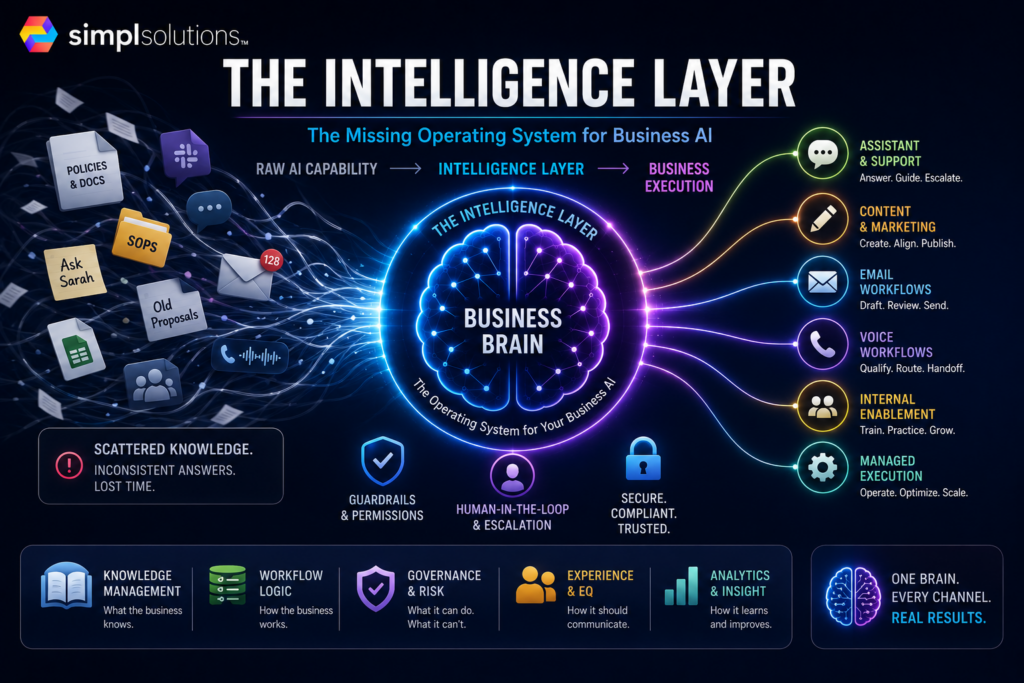
The intelligence layer is the governed operating layer above the model. It turns general AI capability into business-specific execution. It connects what the organization knows, how the organization works, what the AI is allowed to do, and when a human needs to step in.
At SimplSolutions, we call our version of that layer the Business Brain.
A chatbot answers questions.
A Business Brain coordinates knowledge, workflow logic, brand voice, approval paths, guardrails, escalation rules, and human judgment across the business.
Big difference.
The intelligence layer is the part of an AI system that makes the model usable inside a real organization.
A large language model can answer a question. But by itself, it does not automatically know:
Which documents are authoritative.
Which claims are approved.
Which tone fits the brand.
Which customer situation requires care.
Which workflow should happen next.
Who needs to approve the output.
Which channel the response belongs in.
When the system should stop and escalate.
The intelligence layer provides that structure.
It is not just a prompt. It is not just a knowledge base. It is not just a chatbot interface. It is not just an automation workflow.
It is the operating layer that connects all of those pieces.
The model provides capability. The intelligence layer provides context, judgment, boundaries, and coordination.
That is what makes AI usable inside the business instead of just impressive in a demo.
The intelligence layer overlaps several traditional software layers. That is why it can be confusing at first.
People try to place it in one box.
Is it knowledge management?
Is it middleware?
Is it workflow automation?
Is it governance?
Is it user experience?
Is it analytics?
Yes.
Annoying, but yes.
The intelligence layer does not replace every traditional technology layer. It coordinates them around how work actually happens.
Here is the practical map.
Knowledge management
Source-of-truth documents, policies, SOPs, FAQs, approved language, institutional memory
Data and retrieval
Finding the right internal knowledge, grounding answers, separating approved sources from stale information
Workflow logic
Rules, routing, approvals, handoffs, task sequencing, exception handling
Application layer
Assistant, content, email, voice, social, support, and internal tools
Integration and orchestration
Connecting AI outputs to CRM, inboxes, calendars, phone systems, CMS, social tools, and help desks
Identity and permissions
Who can access what, who can approve what, and which roles have authority
Governance and risk
Guardrails, compliance boundaries, escalation rules, audit needs, and human-in-the-loop controls
Experience layer
Tone, brand voice, emotional awareness, user context, and channel-specific behavior
Analytics and optimization
Feedback loops, usage patterns, failure detection, content refresh, and workflow improvement
Traditional software often separates these layers.
The intelligence layer makes them work together.
That is the point.
Choosing a model is not the same thing as building an AI strategy.
Two companies can use the same model and get completely different results. One gets generic output that still needs heavy editing. The other gets useful, governed support across real workflows.
The difference is not only the model.
The difference is what surrounds it.
A serious business AI system has to answer operating questions:
What does the business know?
Where does that knowledge live?
Which source wins when two documents conflict?
What can the system say publicly?
What should stay internal?
What requires approval?
What should never be automated?
What happens when the user is frustrated, urgent, confused, or distressed?
What happens when the request touches legal, financial, privacy, healthcare, student-data, or compliance-sensitive territory?
The model alone does not solve those questions.
The intelligence layer does.
Speed without structure is just panic with better formatting.
Traditional knowledge management is usually passive.
Documents sit in folders. Policies live in PDFs. SOPs get buried in drives. Brand voice lives in someone’s head. The best process is often remembered by one person who is also somehow expected to answer Slack, approve a campaign, fix the website, and remember where the Q3 intake template went.
Very calm. Very scalable. No notes.
The intelligence layer changes knowledge from passive storage into active operating context.
Instead of asking, “Where is the document?” the business can ask, “What should we do based on the approved source of truth?”
That shift matters.
A Business Brain should not just retrieve information. It should help the team apply the right information inside the right workflow, with the right constraints.
That means the system needs to know more than facts. It needs to understand authority.
Not all information is equal. A current policy beats an old draft. A signed procedure beats a Slack opinion. A compliance-approved statement beats a clever line from a brainstorm.
The intelligence layer gives the system a way to respect those differences.
A lot of AI output fails because it stops at the draft.
The system writes an email.
Then a human has to check the facts.
Then another human checks the tone.
Then someone asks whether it is approved.
Then someone else asks whether it should be sent at all.
Then the team realizes the actual problem was not the email.
It was the workflow.
The intelligence layer connects AI to workflow logic.
That means the system can understand:
What stage the work is in.
What decision needs to happen next.
Who owns that decision.
Which approval path applies.
Which channel should be used.
What should happen if the system is uncertain.
This is where AI starts moving from output to operational support.
The goal is not “let AI do everything.”
The goal is: let AI support the repeatable parts while humans keep authority over judgment, risk, and final decisions.
That is the difference between controlled leverage and automated chaos.
In weak AI systems, governance is treated like a disclaimer.
In serious AI systems, governance is architecture.
The intelligence layer defines what the AI can know, say, draft, recommend, route, publish, send, or escalate.
That includes guardrails like:
Human approval for outbound communication.
Escalation for sensitive, emotional, urgent, or high-risk situations.
Restrictions on unsupported legal, financial, medical, privacy, security, or compliance claims.
Clear rules for public-facing content.
Clear boundaries around regulated or sensitive data.
Known limits when source material is incomplete.
This is not red tape. This is what makes the system usable.
A business cannot trust AI because it is powerful. It can trust AI when the boundaries are clear.
Guardrails are features.
Most technical systems are built around IQ.
Can the system retrieve?
Can it reason?
Can it summarize?
Can it classify?
Can it generate?
Those capabilities matter. But businesses are not made only of information. They are made of people.
People bring pressure, hesitation, urgency, frustration, confusion, fear, skepticism, and emotion into workflows.
If an AI system ignores that, it may be technically correct and still feel wrong.
That is why emotional intelligence belongs inside the intelligence layer.
EQ in business AI does not mean pretending the system is human. It means the system recognizes when tone, pacing, care, or escalation matters.
A frustrated customer does not need the same response as a curious prospect.
A confused employee does not need a wall of information.
A worried parent does not need robotic efficiency.
A sensitive voice call should not keep pushing through a script.
IQ gets the answer.
EQ knows how the answer should land.
Governance knows whether the answer should be delivered at all.
That combination is where AI starts to feel aligned with the business.
The intelligence layer becomes more valuable when it works across channels.
In marketing, it keeps content aligned with positioning, proof, and brand voice.
In sales, it supports follow-up discipline, qualification, objection handling, and careful handoffs.
In support, it helps answer routine questions while escalating issues that need human judgment.
In operations, it reduces dependency on tribal knowledge and repeated explanations.
In voice workflows, it supports routing, qualification, and follow-up while recognizing when human escalation is required.
In email, it helps with drafting, triage, pacing, and approval-aware workflows.
In training, it turns internal expertise into learning paths, practice scenarios, role-play, and assessments that help teams use the system responsibly.
The module is where the work shows up.
The intelligence layer is why the work stays coherent.
Scattered automation looks productive at first.
One tool writes social posts.
Another drafts emails.
Another answers support questions.
Another handles calls.
Another stores documents.
Another summarizes meetings.
Each tool may be useful on its own.
But if they do not share memory, rules, voice, permissions, and escalation logic, the business still has to stitch the whole thing together manually.
That creates more dashboards, more context switching, more duplicated work, and more ways for the organization to lose its voice.
The real problem is not that the tools are bad.
The problem is that they are not operating from the same brain.
Shared intelligence beats scattered automation because it lets the organization reuse the same source of truth across channels.
The same approved knowledge can inform content, email, support, voice, and internal decisions.
The same guardrails can protect outbound communication.
The same brand voice can show up consistently.
The same escalation rules can prevent the system from pushing past its authority.
That is how AI becomes calmer, not louder.
The cleanest way to understand it is this:
The model is the engine.
The intelligence layer is the operating system around the engine.
It tells the engine what matters, what is allowed, where to go, when to slow down, and when to hand the wheel back to a human.
Without that layer, businesses get isolated AI outputs.
With that layer, they get coordinated AI support across real workflows.
That is the future of business AI.
Not more tools.
Not louder automation.
Not faster chaos.
A governed intelligence layer that connects knowledge, workflow, permissions, tone, approvals, escalation, analytics, and human judgment.
Build the brain once.
Deploy it carefully.
Scale calmly.