
Most businesses do not have an AI problem first.
They have a knowledge problem.
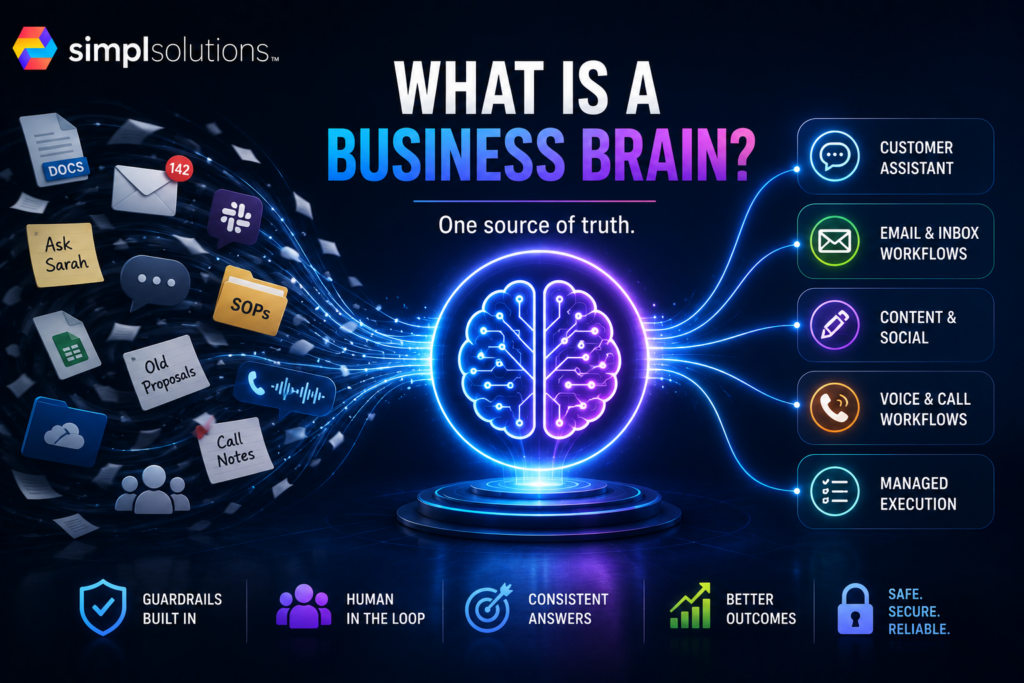
Information lives in documents, inboxes, Slack threads, old proposals, SOPs, sales calls, customer conversations, staff memory, and “ask Sarah, she knows” moments. Over time, that knowledge gets scattered. The team gets busier. The answers get less consistent. Follow-up slips. Content starts sounding different from sales. Customer support handles the same questions again and again.
A Business Brain is designed to solve that problem.
It is a shared knowledge and execution layer for a business. Instead of using disconnected AI tools for isolated tasks, a Business Brain centralizes approved knowledge, voice, workflows, decision rules, guardrails, and escalation logic so AI can support real work across the organization.
A chatbot answers.
A Business Brain coordinates.
A chatbot usually handles a narrow task: answer a question, respond to a website visitor, or provide basic support.
That can be useful. But it is not the same as building an operating layer for the business.
A Business Brain is built around the company’s actual information: its services, policies, tone, FAQs, SOPs, workflows, approval rules, and customer communication standards. It is not just generating text. It is helping the organization use the same source of truth across multiple channels.
That matters because businesses do not run on isolated answers. They run on context.
A customer question may affect support. A sales conversation may affect follow-up. A blog may need to match the same positioning used in a proposal. A voice interaction may need to route to a human when emotion, urgency, or risk shows up.
A Business Brain gives those workflows shared memory.
A Business Brain helps an organization bring order to scattered knowledge and repetitive work.
Depending on the scope, it can support:
The important part is not that each workflow “uses AI.” The important part is that each workflow can operate from the same approved intelligence layer.
That creates consistency.
The same tone can guide content, email, and support. The same policies can shape assistant responses. The same escalation rules can tell the system when to stop and hand the situation to a person.
A serious Business Brain needs guardrails.
Guardrails are the rules that define what AI can say, do, draft, route, approve, or escalate. They protect the business from uncontrolled automation, off-brand messaging, unsupported claims, and sensitive situations being handled the wrong way.
Good guardrails answer questions like:
This is where many AI deployments go sideways. Teams get excited about what AI can produce before they define what it is allowed to do.
Speed without structure is just panic in nicer packaging.
A Business Brain should make the business calmer, not louder.
Many teams already use AI in small ways. Someone uses it to draft emails. Someone else uses it for content ideas. Another person uses it to summarize notes. That can help in the short term.
But if every person uses AI separately, the business may end up with more inconsistency, not less.
Different prompts. Different assumptions. Different tone. Different answers.
That is tool sprawl with a nicer interface.
A Business Brain takes a different approach. It starts with the business itself:
Those questions are the foundation. The AI comes after.
A Business Brain does not remove human judgment. It preserves it.
Human-in-the-loop means people stay involved where judgment, approval, risk, emotion, or accountability matter. AI can support the workflow, draft the first version, route the question, summarize the issue, or prepare the next step. But humans keep authority.
That is especially important for public-facing communication, outbound email, voice workflows, privacy-sensitive environments, education, healthcare-adjacent contexts, legal or financial topics, and anything that could affect trust.
AI handles repetition.
Humans keep responsibility.
The best place to start is not “everywhere.”
The best place to start is one workflow.
Look for the area where the team repeats the same work, loses the same information, or answers the same questions over and over. That might be customer inquiries, internal SOP questions, sales follow-up, content production, onboarding, inbox routing, or voice call handling.
A strong first workflow usually has three traits:
Once that workflow is mapped, the Business Brain can be trained around approved knowledge, tone, decision rules, and escalation logic. After that foundation is stable, additional channels can be added more safely.
Build once. Scale calmly.
Generic AI tools are useful for general tasks. They can brainstorm, summarize, draft, and explain. But they do not automatically understand your business.
They do not know which policy is current. They do not know your approved pricing posture. They do not know your escalation rules. They do not know which claims are safe to make. They do not know your team’s preferred voice unless you define it clearly.
A Business Brain is different because it is organized around the business’s own knowledge and operating rules.
The goal is not just better output.
The goal is better execution.
A Business Brain becomes valuable when it reduces the drag caused by scattered knowledge and repeated decisions.
It can help a team:
A Business Brain is a centralized AI intelligence layer trained on an organization’s approved knowledge, tone, workflows, decision rules, and guardrails, then used to support coordinated work across assistant, content, social, email, voice, and managed execution workflows.
Plain English version:
It is the place where the business teaches AI how the business actually works.
Not just what to say.
What to trust.
What to avoid.
What to draft.
What to route.
What to escalate.
What needs a human.
That is the difference.
AI adoption is not the same thing as operational improvement.
A business can add more tools and still be disorganized. It can generate more content and still sound inconsistent. It can automate more communication and still create more risk.
A Business Brain starts with the operating problem: scattered knowledge, repeated work, unclear ownership, and inconsistent execution.
Then it builds the AI system around the business.
One source of truth.
Clear workflows.
Human approval.
Practical guardrails.
Calm execution.
That is what makes the Business Brain useful. Not because it replaces people, but because it helps the people and the systems around them work with more clarity.
Most businesses do not have an AI problem first.
They have a knowledge problem.
Information lives in documents, inboxes, Slack threads, old proposals, SOPs, sales calls, customer conversations, staff memory, and “ask Sarah, she knows” moments. Over time, that knowledge gets scattered. The team gets busier. The answers get less consistent. Follow-up slips. Content starts sounding different from sales. Customer support handles the same questions again and again.
A Business Brain is designed to solve that problem.
It is a shared knowledge and execution layer for a business. Instead of using disconnected AI tools for isolated tasks, a Business Brain centralizes approved knowledge, voice, workflows, decision rules, guardrails, and escalation logic so AI can support real work across the organization.
A chatbot answers.
A Business Brain coordinates.
A chatbot usually handles a narrow task: answer a question, respond to a website visitor, or provide basic support.
That can be useful. But it is not the same as building an operating layer for the business.
A Business Brain is built around the company’s actual information: its services, policies, tone, FAQs, SOPs, workflows, approval rules, and customer communication standards. It is not just generating text. It is helping the organization use the same source of truth across multiple channels.
That matters because businesses do not run on isolated answers. They run on context.
A customer question may affect support. A sales conversation may affect follow-up. A blog may need to match the same positioning used in a proposal. A voice interaction may need to route to a human when emotion, urgency, or risk shows up.
A Business Brain gives those workflows shared memory.
A Business Brain helps an organization bring order to scattered knowledge and repetitive work.
Depending on the scope, it can support:
The important part is not that each workflow “uses AI.” The important part is that each workflow can operate from the same approved intelligence layer.
That creates consistency.
The same tone can guide content, email, and support. The same policies can shape assistant responses. The same escalation rules can tell the system when to stop and hand the situation to a person.
Many teams already use AI in small ways. Someone uses it to draft emails. Someone else uses it for content ideas. Another person uses it to summarize notes. That can help in the short term.
But if every person uses AI separately, the business may end up with more inconsistency, not less.
Different prompts. Different assumptions. Different tone. Different answers.
That is tool sprawl with a nicer interface.
A Business Brain takes a different approach. It starts with the business itself:
What knowledge is approved?
What workflows matter most?
Who owns review?
What can AI draft?
What should AI never decide?
When should a human step in?
Those questions are the foundation. The AI comes after.
A serious Business Brain needs guardrails.
Guardrails are the rules that define what AI can say, do, draft, route, approve, or escalate. They protect the business from uncontrolled automation, off-brand messaging, unsupported claims, and sensitive situations being handled the wrong way.
Good guardrails answer questions like:
What source material should the system trust?
What claims are allowed?
Which topics require human review?
When should the system say it does not know?
When should a customer, parent, prospect, or staff member be routed to a person?
This is where many AI deployments go sideways. Teams get excited about what AI can produce before they define what it is allowed to do.
Speed without structure is just panic in nicer packaging.
A Business Brain should make the business calmer, not louder.
A Business Brain does not remove human judgment. It preserves it.
Human-in-the-loop means people stay involved where judgment, approval, risk, emotion, or accountability matter. AI can support the workflow, draft the first version, route the question, summarize the issue, or prepare the next step. But humans keep authority.
That is especially important for public-facing communication, outbound email, voice workflows, privacy-sensitive environments, education, healthcare-adjacent contexts, legal or financial topics, and anything that could affect trust.
AI handles repetition.
Humans keep responsibility.
The best place to start is not “everywhere.”
The best place to start is one workflow.
Look for the area where the team repeats the same work, loses the same information, or answers the same questions over and over. That might be customer inquiries, internal SOP questions, sales follow-up, content production, onboarding, inbox routing, or voice call handling.
A strong first workflow usually has three traits:
It happens often.
It follows a recognizable pattern.
A human can review or take over when needed.
Once that workflow is mapped, the Business Brain can be trained around approved knowledge, tone, decision rules, and escalation logic. After that foundation is stable, additional channels can be added more safely.
Build once. Scale calmly.
Generic AI tools are useful for general tasks. They can brainstorm, summarize, draft, and explain. But they do not automatically understand your business.
They do not know which policy is current. They do not know your approved pricing posture. They do not know your escalation rules. They do not know which claims are safe to make. They do not know your team’s preferred voice unless you define it clearly.
A Business Brain is different because it is organized around the business’s own knowledge and operating rules.
The goal is not just better output.
The goal is better execution.
A Business Brain becomes valuable when it reduces the drag caused by scattered knowledge and repeated decisions.
It can help a team:
None of that should be treated as magic. The system is only as useful as the workflow design, source material, governance, and human review behind it.
But when those pieces are in place, AI becomes less like another tool and more like shared operational infrastructure.
A Business Brain is a centralized AI intelligence layer trained on an organization’s approved knowledge, tone, workflows, decision rules, and guardrails, then used to support coordinated work across assistant, content, social, email, voice, and managed execution workflows.
Plain English version:
It is the place where the business teaches AI how the business actually works.
Not just what to say.
What to trust.
What to avoid.
What to draft.
What to route.
What to escalate.
What needs a human.
That is the difference.
AI adoption is not the same thing as operational improvement.
A business can add more tools and still be disorganized. It can generate more content and still sound inconsistent. It can automate more communication and still create more risk.
A Business Brain starts with the operating problem: scattered knowledge, repeated work, unclear ownership, and inconsistent execution.
Then it builds the AI system around the business.
One source of truth.
Clear workflows.
Human approval.
Practical guardrails.
Calm execution.
That is what makes the Business Brain useful. Not because it replaces people, but because it helps the people and the systems around them work with more clarity.