
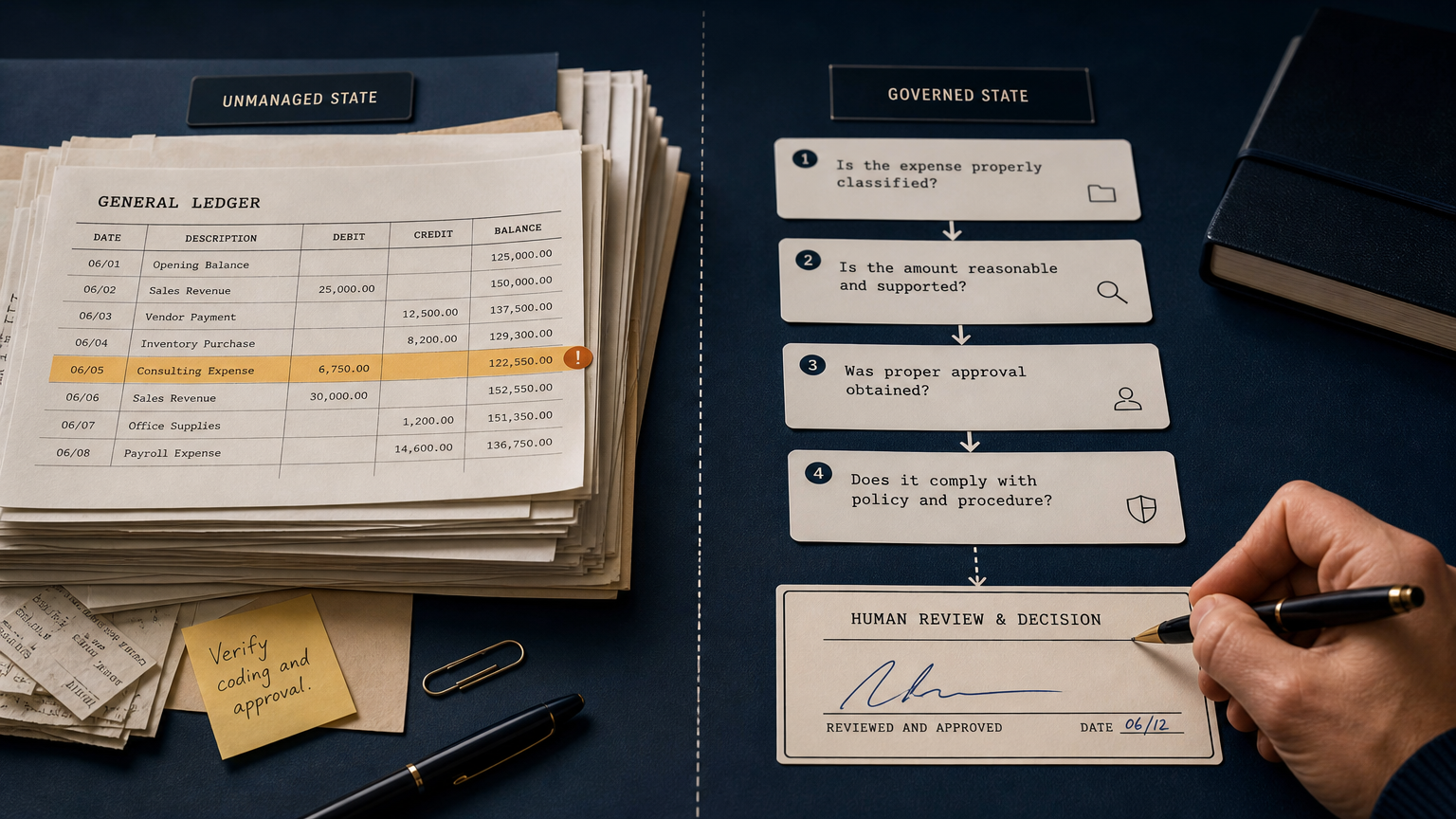
Questions and conclusions are different work
A system may identify an inconsistency, point to a missing record, or propose a follow-up question. Those outputs can be useful because they direct attention to material that deserves closer review.
They are not, by themselves, conclusions.
A question asks whether something needs explanation. A conclusion states what the available evidence means and what should happen next. The latter may require context that is absent from an initial document set: amendments, exceptions, policy history, transaction details, professional interpretation, or knowledge held by the engagement team.
This distinction helps avoid a common category error. An output can be well phrased, specific, and apparently persuasive while still resting on incomplete context. It can also be valuable even if the answer is ultimately that no issue exists.
For audit, compliance, and control-review teams, the practical objective is not to make every generated question sound decisive. It is to make each worthwhile question reviewable. That means a reviewer can understand what prompted it, what uncertainty it identifies, and what evidence or judgment would be needed to resolve it.
Keep evidence, observation, and interpretation separate
A review record is easier to assess when it distinguishes among four layers:
- Source material: The record, document, policy, calculation, or transaction being considered.
- Observation: What can be directly identified in that material, such as a date difference, an omitted field, or an apparent mismatch.
- Question or inference: The uncertainty raised by the observation and the possible explanation being tested.
- Disposition: The reviewer’s documented response, including any conclusion, escalation, or additional work.
For example, an observation might be that two records list different dates. A useful follow-up question could ask whether the difference reflects timing, correction, amendment, or data-entry error. That question does not establish that an error occurred.
Separating these layers reduces the chance that a tentative inference becomes embedded as a fact. It also gives reviewers a clearer way to reject low-value output: the source may be irrelevant, the observation may be inaccurate, the context may be incomplete, or the question may not matter to the review objective.
Build a reviewable question trail
Teams considering AI-assisted question generation can design for traceability from the outset. The appropriate details will vary by engagement, but a reviewable trail may include:
- the specific source context that prompted the question;
- the record location or reference needed to retrieve that context;
- the precise mismatch, omission, ambiguity, or pattern identified;
- a clear distinction between direct observation and proposed interpretation;
- the follow-up evidence, explanation, or specialist input requested; and
- the reviewer’s resolution and rationale.
The aim is not to treat generated narrative as proof of how a system reached an answer. It is to preserve the evidence a reviewer needs to evaluate the question on its merits.
Context should travel with the question where possible. A policy excerpt without its effective date, a contract without its amendment history, or a transaction without related documentation can produce a misleading line of inquiry. A compact question may be easier to read, but it should not remove the material needed to assess whether the question is well founded.
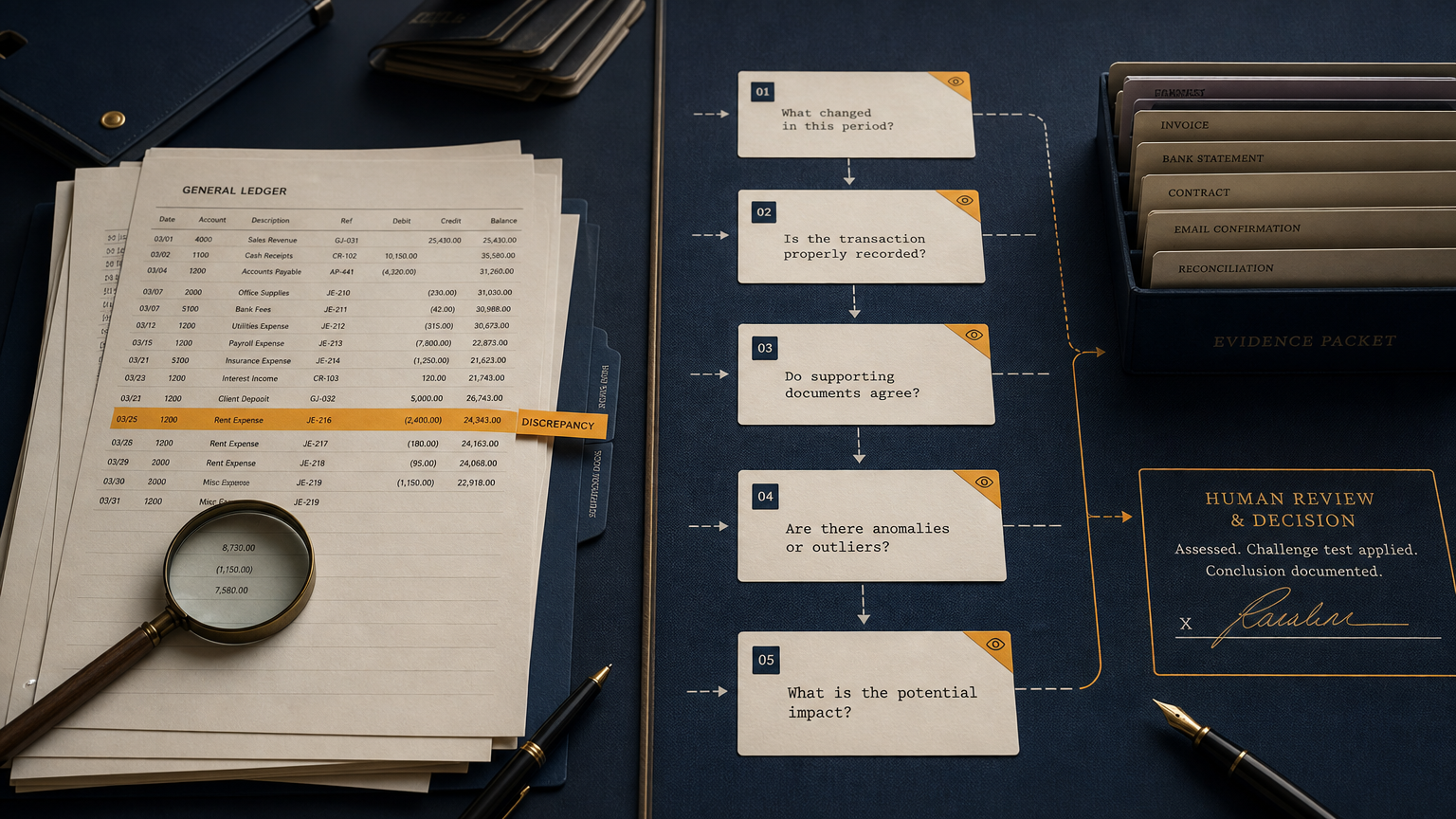
Define the human decision boundary
Human oversight is more than the ability to inspect output after the fact. A workable operating model identifies the point at which a person must assess the evidence and make the decision.
Depending on the organization and engagement, that boundary may include decisions about:
- interpreting accounting, regulatory, contractual, or internal-policy language;
- determining whether evidence is sufficient and relevant;
- assessing significance, severity, control implications, or uncertainty;
- accepting an exception or deciding that more work is needed;
- changing review scope or priority; and
- approving a formal finding, communication, or conclusion.
These are adaptable operating considerations, not universal legal or regulatory rules. Teams should align their process with the responsibilities and review requirements that apply to their work.
Clear labels can make the boundary visible. Terms such as “question for review,” “draft interpretation,” and “reviewer decision” help prevent a preliminary output from being mistaken for an approved conclusion. The record should also make clear who reviewed the issue, which evidence they considered, and what action they authorized.
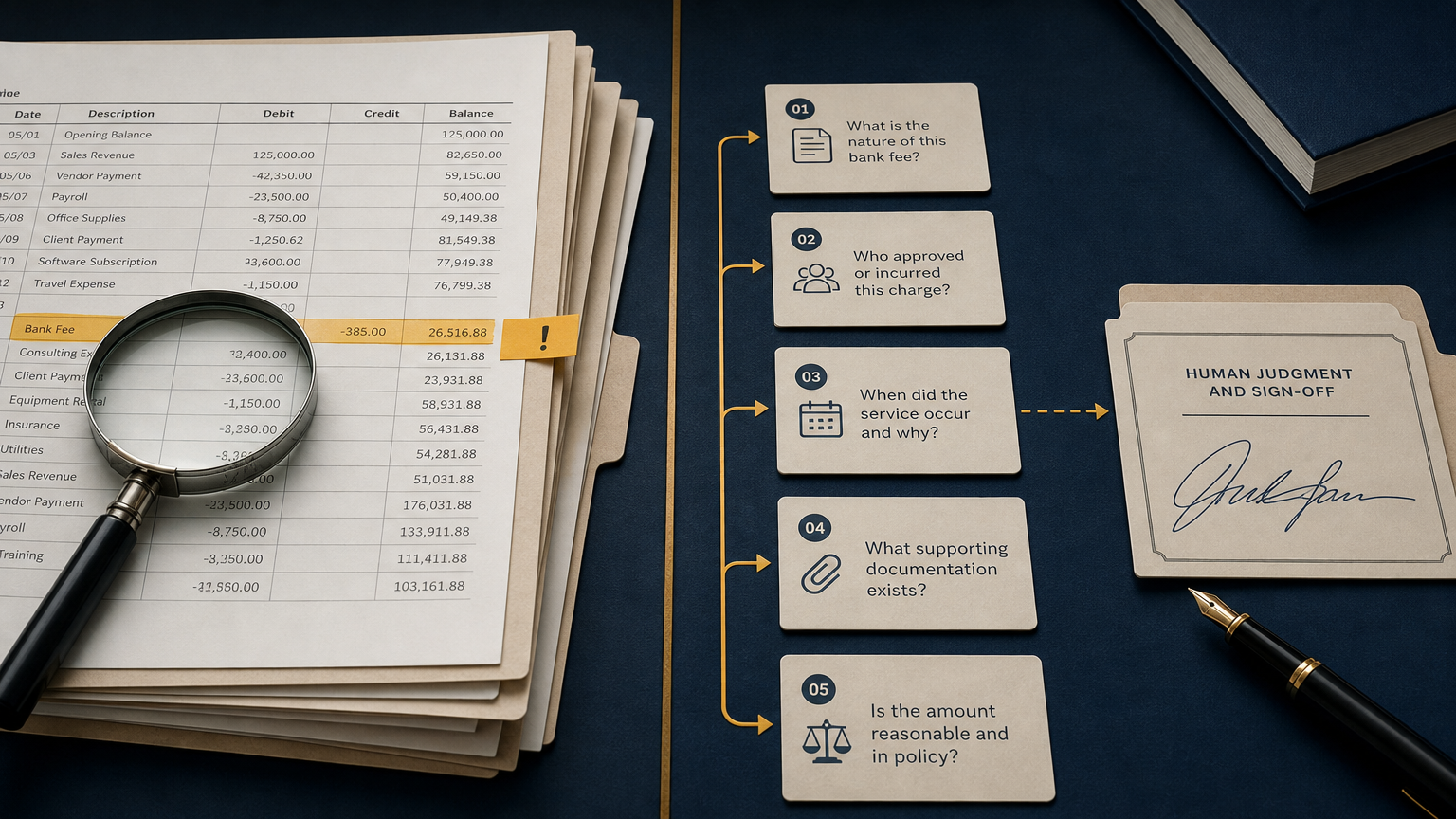
Measure usefulness, not just output volume
More questions do not necessarily create a better review process. High volumes can consume reviewer time, elevate trivial discrepancies, or distract from matters that need attention.
A practical evaluation can consider four dimensions:
Evidence alignment. Does the question accurately reflect the cited material?
Review relevance. Does it concern a matter within the defined purpose and scope of the work?
Escalation quality. Does it identify when further evidence, specialist input, or managerial judgment may be needed?
Resolution integrity. Can the team show what happened after the question was raised?
Rejected questions are useful data when their reasons are recorded. A question may fail because of poor source selection, missing context, a mistaken interpretation, weak prioritization, or an issue that is genuine but immaterial to the current review. Those distinctions are more informative than a simple acceptance-rate target.
Testing can also include cases where initial appearances are misleading. These cases help reveal whether a workflow encourages reviewers to examine source material rather than accept a plausible narrative at face value.
Start with a bounded use case
A cautious starting point is a defined evidence set and a limited task: generating follow-up questions for a qualified reviewer. This is materially different from giving a system authority to close matters, assign final ratings, or issue conclusions.
Before emphasizing speed, teams can define what a useful question looks like. It may need to be grounded in identified source material, relevant to the review objective, specific about uncertainty, and clear about the next information needed. Teams can also define outputs that are unacceptable, such as unsupported allegations, ambiguous references, invented citations, or statements presented as settled facts without evidence.
Responsibility remains central. For each material issue, the organization should be able to identify the human reviewer, the evidence considered, the uncertainty that remained, and the person who authorized the final action.
The takeaway
AI-generated questions can support review work by drawing attention to possible inconsistencies and missing context. Their value does not depend on treating them as decisions.
The durable boundary is straightforward: records provide evidence, generated output raises questions, and qualified people make accountable judgments. A workflow that preserves that separation can make follow-up work more organized while keeping conclusions tied to evidence and human responsibility.