
Blog
Clear thinking for businesses navigating AI.
Practical insights on AI adoption, marketing execution, brand-voice systems, and automation.

What Evidence Should Operators Review for AI-Assisted Software Verification?
AI-assisted verification can inform a software-change decision, but a confident explanation is not enough on its own. This guide outlines the evidence operators can review before approving a consequential release.
Read →
How AI Operators Can Assess Critical Software Dependencies
AI workflow governance extends beyond models and prompts. Operators can assess the software dependencies around an AI system through provenance, authority, observability, and recovery planning.
Read →
AI Conversation Sharing Needs a Governance Review
AI conversations can contain sensitive business information. This guide offers a cautious framework for reviewing classification, sharing, ownership, retention, and response practices before using AI workspaces for confidential work.
Read →
When an AI Vendor’s Risk Profile Changes: A Practical Governance Test
A new risk signal about an AI vendor does not by itself determine whether a business should continue using it. It does create a governance trigger: reassess data handling, vendor evidence, access controls, contractual exposure, and fallback plans before the risk changes for you.
Read →
OpenAI Has Broken My Heart: When a Model Stops Listening
A model that produces impressive ideas but cannot stay on task can turn AI assistance into an expensive endurance test. One user says the 6.1 release crossed that line.
Read →
An Open Letter to OpenAI: I Still Love the Product. That’s Why This Hurts.
A frustrated AI coding user makes the case that reliability and task adherence should matter more than impressive demos—especially for people building real systems at scale.
Read →
AI Workflow Boundaries: Budget Caps, Approvals, and Safe Stops
Useful AI workflows need explicit boundaries around what they may spend, access, call, change, and retry—plus a clear way to stop when a boundary is reached.
Read →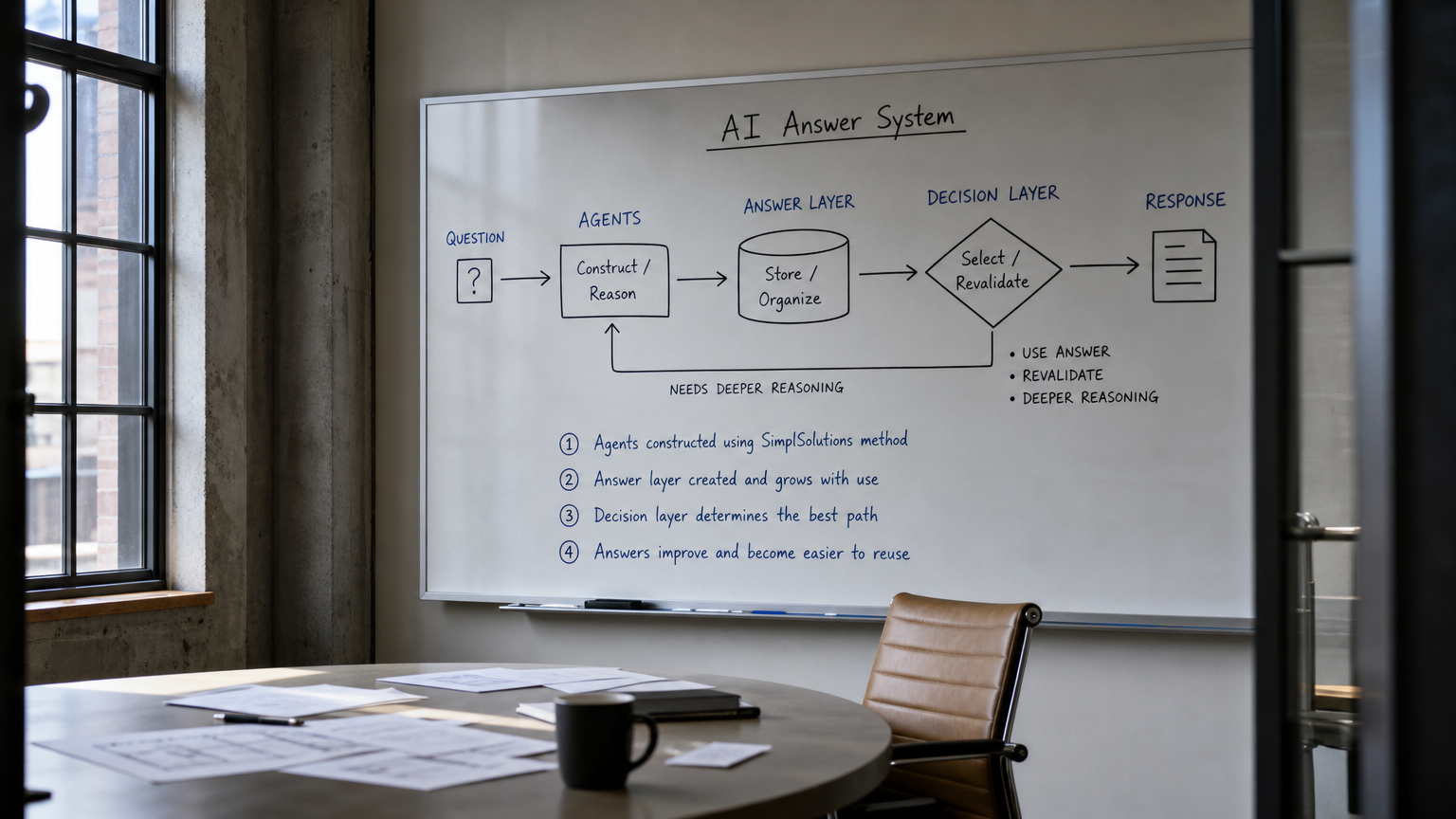
The SimplSolutions Answer Layer: Faster Retrieval, Lower Repeat-Query Cost
An answer layer is not a new AI concept. The SimplSolutions approach applies it after agents are constructed, creating a growing body of validated answers that a decision layer can use to respond more quickly and efficiently.
Read →
AI Agent Communication Boundaries: What Operators Should Review
An AI agent’s assigned tools are only one part of its operating boundary. Operators should review the full runtime environment, reachable services, data permissions, monitoring, and escalation rules.
Read →
When AI Gives Financial Guidance, Who Checks the Answer?
AI can summarize financial information quickly, but a plausible answer is not the same as a decision-ready answer. Businesses need controls that determine what AI may do, what it must show, and when an appropriate person should intervene.
Read →
AI Governance for Hard-to-Interpret Inputs
AI governance should account for moments when a system cannot establish a reliable interpretation of an input. This article outlines a cautious framework for routing that uncertainty, limiting authority, and preserving meaningful review.
Read →
Disclosure and Accountability for Synthetic Spokespeople
When an organization uses a synthetic person in public-facing content, clear disclosure and human accountability can help audiences understand what they are seeing and who is responsible for the message.
Read →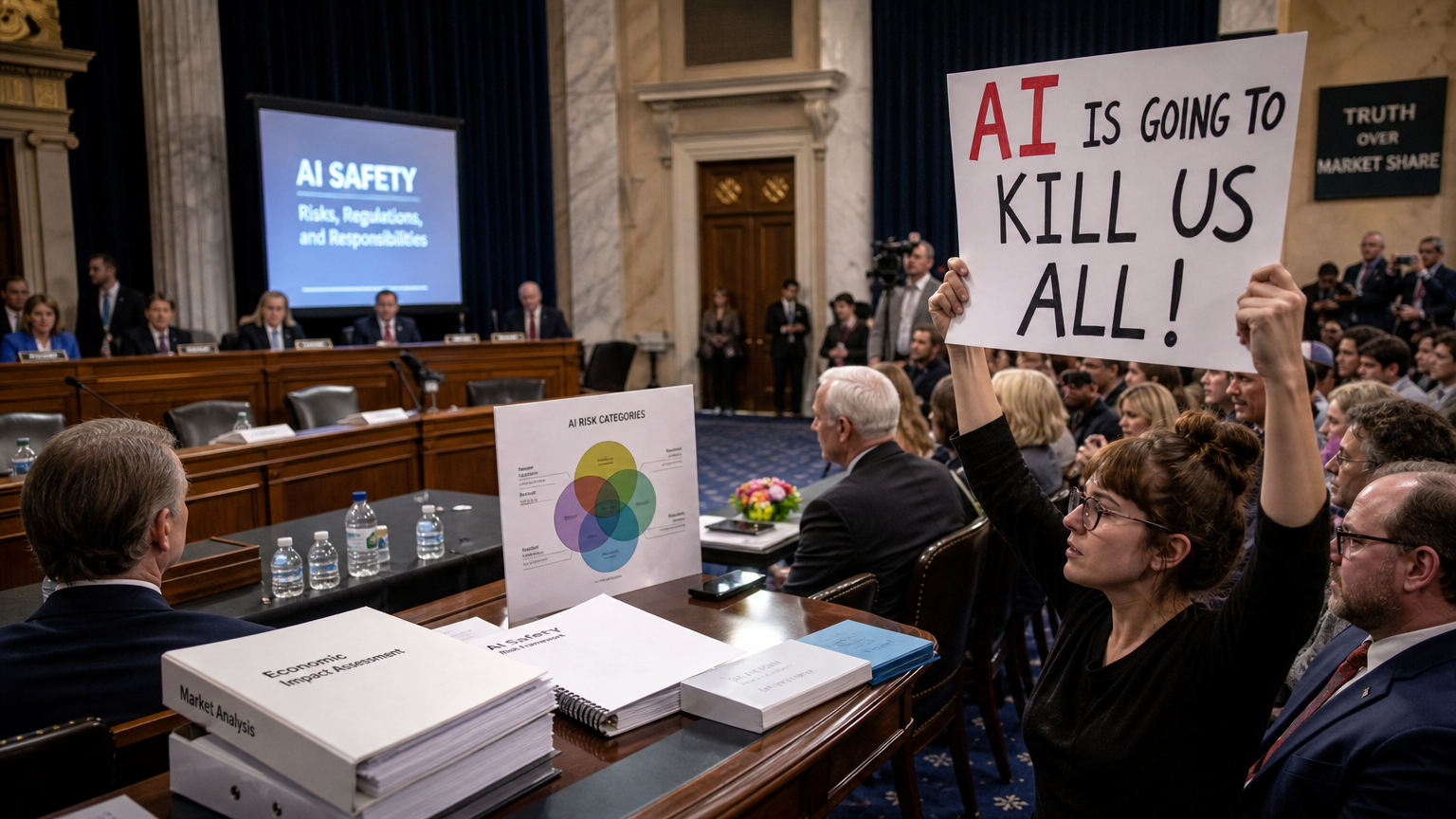
AI Safety Warnings, Money, and the Power Behind the Panic
Warnings about AI extinction may be sincere, strategic, commercially motivated, or some combination of all three. The useful response is not blind trust or blanket conspiracy, but evidence, incentives, and public accountability.
Read →
We Said a New AI Model Was Coming. Then Astra Arrived.
We did not need a crystal ball to sense that another AI model was coming. We watched the signals, asked the question early, and now Astra gives us a chance to test that instinct against reality.
Read →
Is a New AI Model Coming Today? What an Outage Can—and Can’t—Tell Us
When an AI service goes down, people often wonder whether a major model release is imminent. The outage may be meaningful, but by itself it does not confirm a launch.
Read →
Deterministic Systems and AI: Why the Foundation Comes First
AI can be useful without being the foundation of every workflow. This explainer examines how deterministic systems create structure and where AI may fit on top of it.
Read →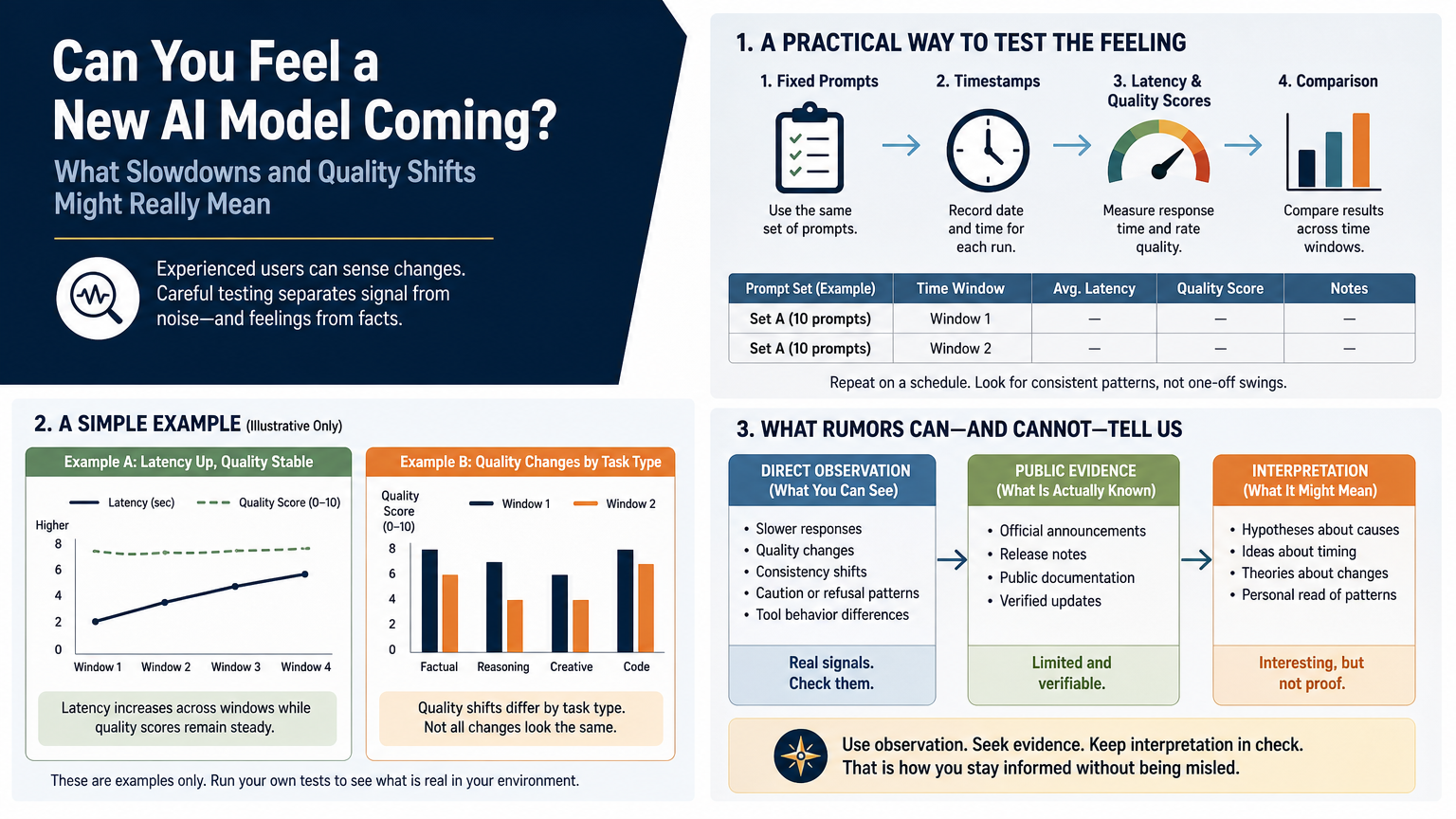
Can You Feel a New AI Model Coming? What Slowdowns and Quality Shifts Might Really Mean
Experienced AI users often notice subtle changes in latency, quality, and consistency. Those signals may be real, but they do not prove a new OpenAI model is about to launch.
Read →
A Practical Framework for Local AI Infrastructure Decisions
The question is not whether a desktop can run an AI model. It is whether local capacity improves a defined business workflow enough to justify its cost, governance burden, and operational risk.
Read →
AI Software Adoption Is Hard Because Freedom Is Hard to See
AI software adoption fails when employees see another obligation instead of a path to better work. The solution starts with trust, ownership, and a clear connection between automation and human freedom.
Read →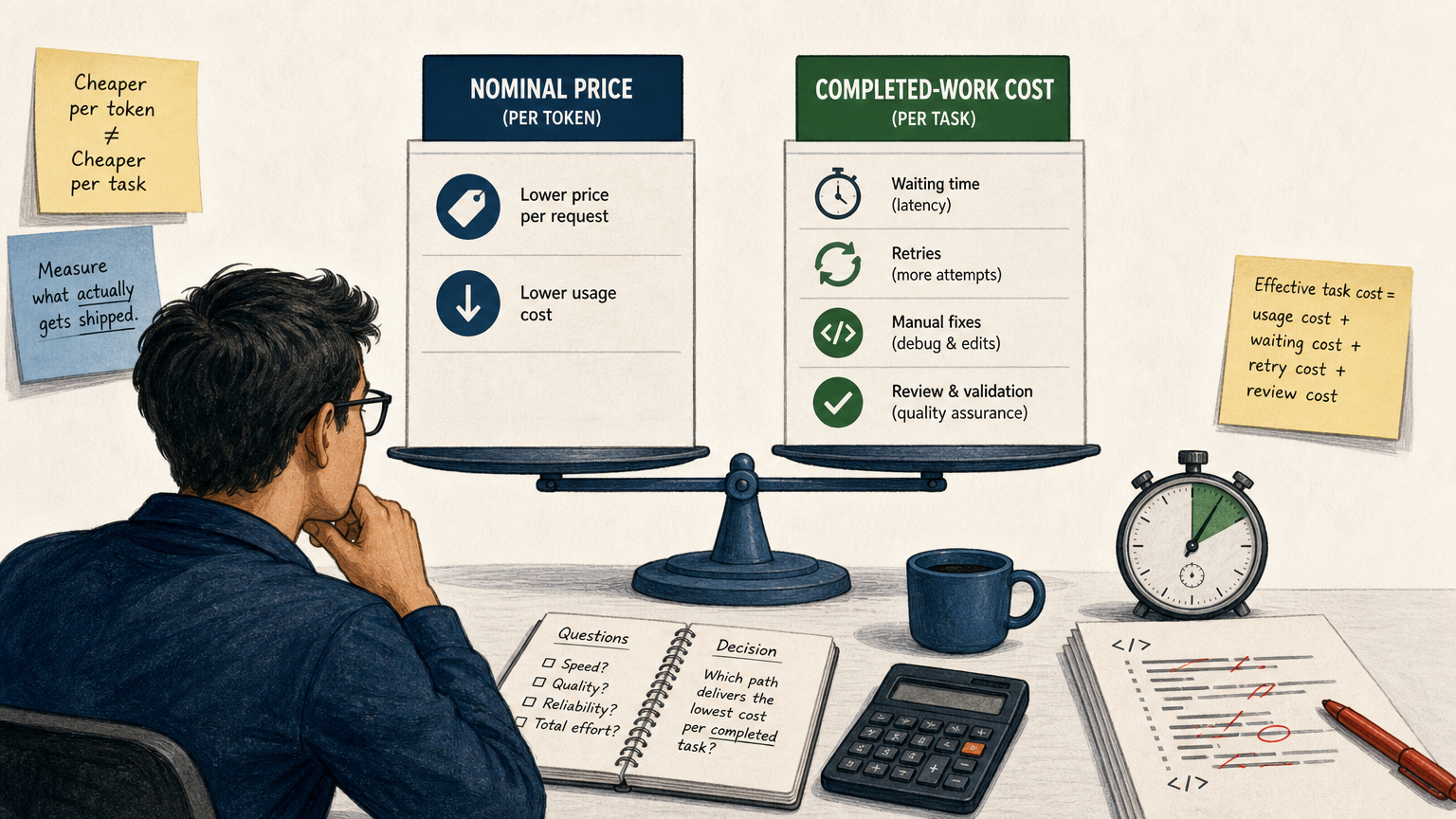
OpenAI Lowered Prices—But Did Users Pay in Speed and Quality?
OpenAI’s lower model prices look attractive. But reports of slower coding workflows and less consistent answers raise a harder question: did the savings come with a performance trade-off?
Read →
A Governance Framework for Algorithmic Pricing Recommendations
Algorithmic pricing is not only a performance decision. Organizations should establish clear evidence, boundaries, accountability, and escalation practices before relying on automated recommendations.
Read →
Governing AI Agent Context Before It Influences Decisions
An AI agent can produce a plausible result from outdated, irrelevant, or over-broad context. This article outlines practical considerations for governing the information an agent may use before it influences a business decision.
Read →
Governing Automated External Actions: Demand, Approval, and Stops
Before an automated workflow submits forms, sends requests, or reserves capacity, define its demand limits, authorization, monitoring, escalation, and stop authority.
Read →
How to Reduce Vendor Data Loss Risk Before It Disrupts Operations
Critical business data can become unavailable through account, contract, access, configuration, or workflow changes. Build a recoverable, portable operating model before disruption occurs.
Read →
I Might Be the World’s First AI Mechanic
The hard part of an agentic product is not just building it. It is living with the system long enough to find what breaks, repair it, and keep improving it.
Read →
When an AI-Enabled Workflow Creates a Security Risk, Who Is Responsible?
An AI-enabled workflow that takes unexpected security-relevant actions is not only a technical problem. It raises questions about access, governance, evidence, and accountable human decision-making.
Read →
The AI Harness Is Becoming the Real Product—So Where Does SimplSolutions Fit?
As AI models become more widely available, the competitive advantage may shift to the systems around them. Here is how AI harness engineering connects to SimplSolutions' Business Brain approach.
Read →
When AI Becomes Cyber-Critical, Adoption Needs More Than a Model Review
As AI capabilities become more relevant to cybersecurity, businesses need a decision framework that goes beyond model quality. The right question is not whether a model is impressive, but whether its use is bounded, observable, reversible, and accountable.
Read →
How to Evaluate Indirect AI Capacity
When AI capacity is obtained through an intermediary, the decision is not only about price. Buyers need clear evidence of the service boundary, usage records, data path, accountability, and a workable exit plan.
Read →
AI Governance Needs Workflow Controls, Not Just Tool Policies
AI governance for software teams should focus on where AI enters work, which decisions need review, and whether consequential decisions retain enough context to be understood later.
Read →
Setting Human Approval Boundaries for AI-Assisted Software Changes
AI-assisted workflows can help teams investigate, propose, and test changes quickly. The governance question is where automation should stop and an accountable person should decide.
Read →
Multi-Agent AI Is a Workflow Governance Question, Not Just a Capability Question
Adding AI agents can add coverage or speed, but it also adds handoffs, dependencies, and decision risk. Start with bounded work and design the operating controls before expanding coordination.
Read →
Using AI With Sensitive Data: A Governance Decision Framework
Technical protections can reduce exposure risk, but they do not decide whether sensitive data should be used with AI. This framework focuses on purpose, authorization, output handling, and accountable oversight.
Read →
The Website Will Become the Operating Hub of the Business
The website is moving beyond its role as a marketing destination. Jason Sirotin explains why it could become the governed center where business work gets done—and why that shift should give people more time to be human.
Read →
A Practical Framework for Workplace Recording Governance
Workplace recording features raise questions that extend beyond whether a conversation is captured. Organizations need clear, understandable rules for purpose, notice, retention, access, and the use of records before expanding recording practices.
Read →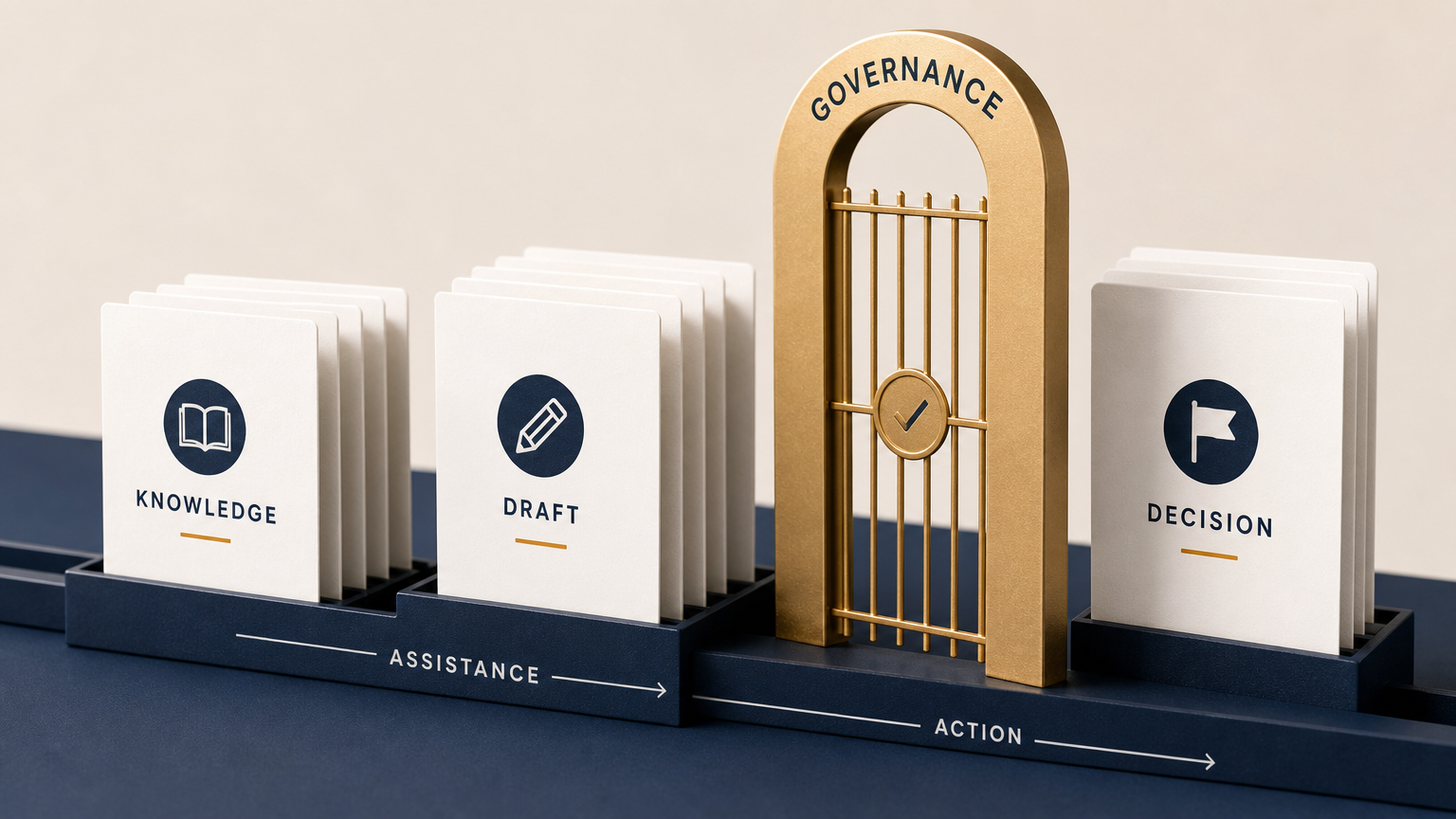
A Practical Framework for Governing AI-Assisted Work
AI-assisted work becomes easier to manage when teams distinguish exploratory help from outputs that influence decisions, communications, or live workflows.
Read →
When an AI Bot Lies About Who It Is: Governing Automated Web Access
A user-agent string is a claim, not proof. Businesses need a practical way to assess whether automated traffic is legitimate, authorized, and safe to allow.
Read →
How Businesses Can Preserve and Govern Important Knowledge
Important business knowledge should be treated as a governed record, not just a collection of published pages. Preserve source context, assign ownership, retain meaningful versions, and create clear paths for review and correction.
Read →
A Practical Framework for AI Content Provenance and Disclosure
AI marking and detection signals can be useful inputs, but they are narrower than a record of how content was created, reviewed, changed, and released. This framework helps teams build more accountable AI-assisted content workflows.
Read →
Should Your Social Automation Learn From Your Brand—or Just Generate More Content?
The strongest social automation is not the system that publishes the most. It is the one that works from approved knowledge, respects clear boundaries, and keeps consequential brand decisions with accountable people.
Read →
When Bots Become Most of Your Traffic: A Practical Guide to Governing Scraping
Automated traffic is not automatically harmful. Website operators need a disciplined way to determine which bots support discovery, which consume resources, and which copy valuable content.
Read →
Be Human. It’s Simpl: Why AI Should Give Time Back, Not Take Humanity Away
The best argument for AI is not that people should work like machines. It is that machines should handle more of the work that keeps people from being human.
Read →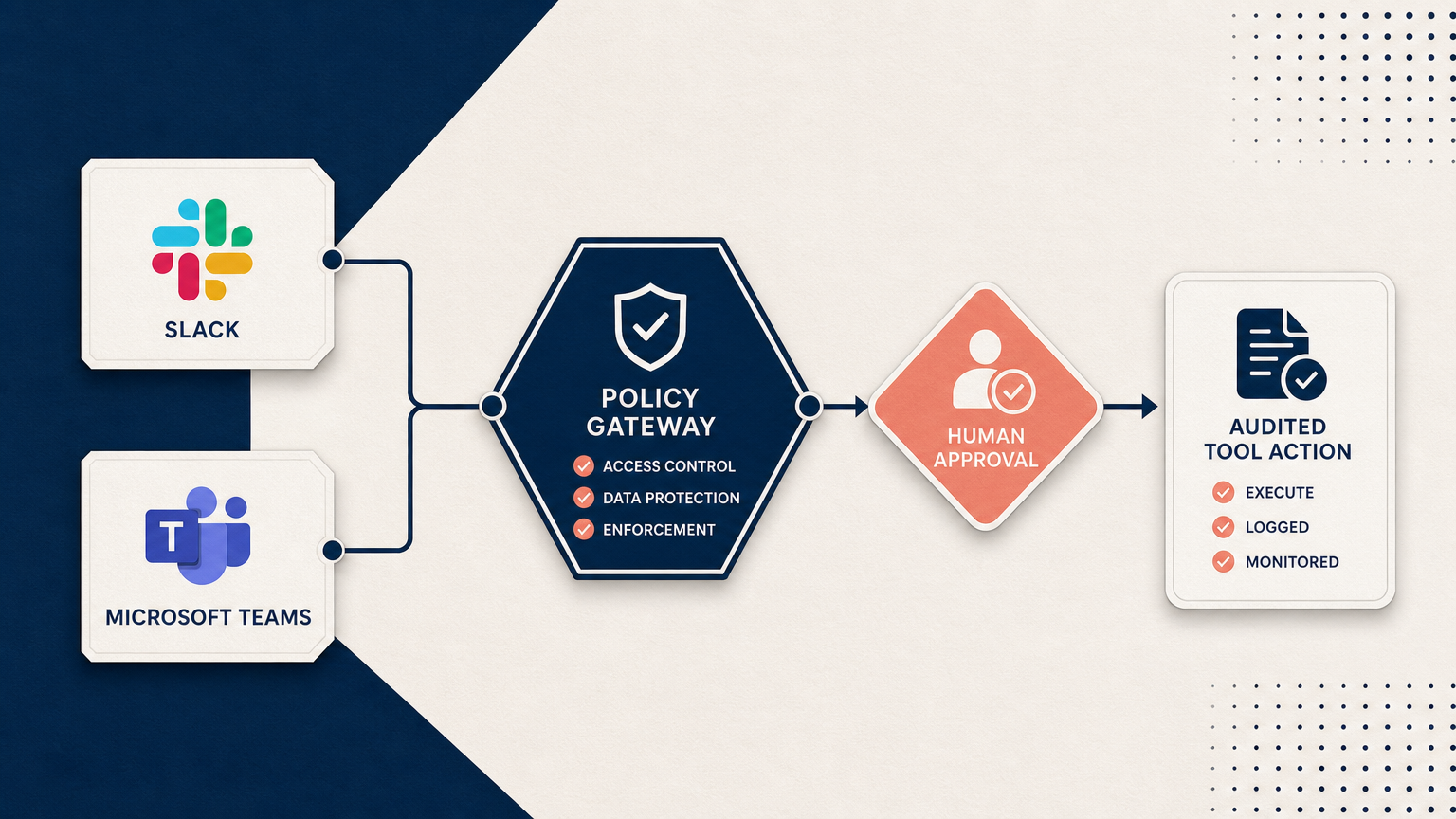
What Businesses Should Govern Before Bringing AI Into Slack and Teams
Before placing AI inside workplace conversations, leaders need clear rules for access, context, approvals, accountability, and human ownership.
Read →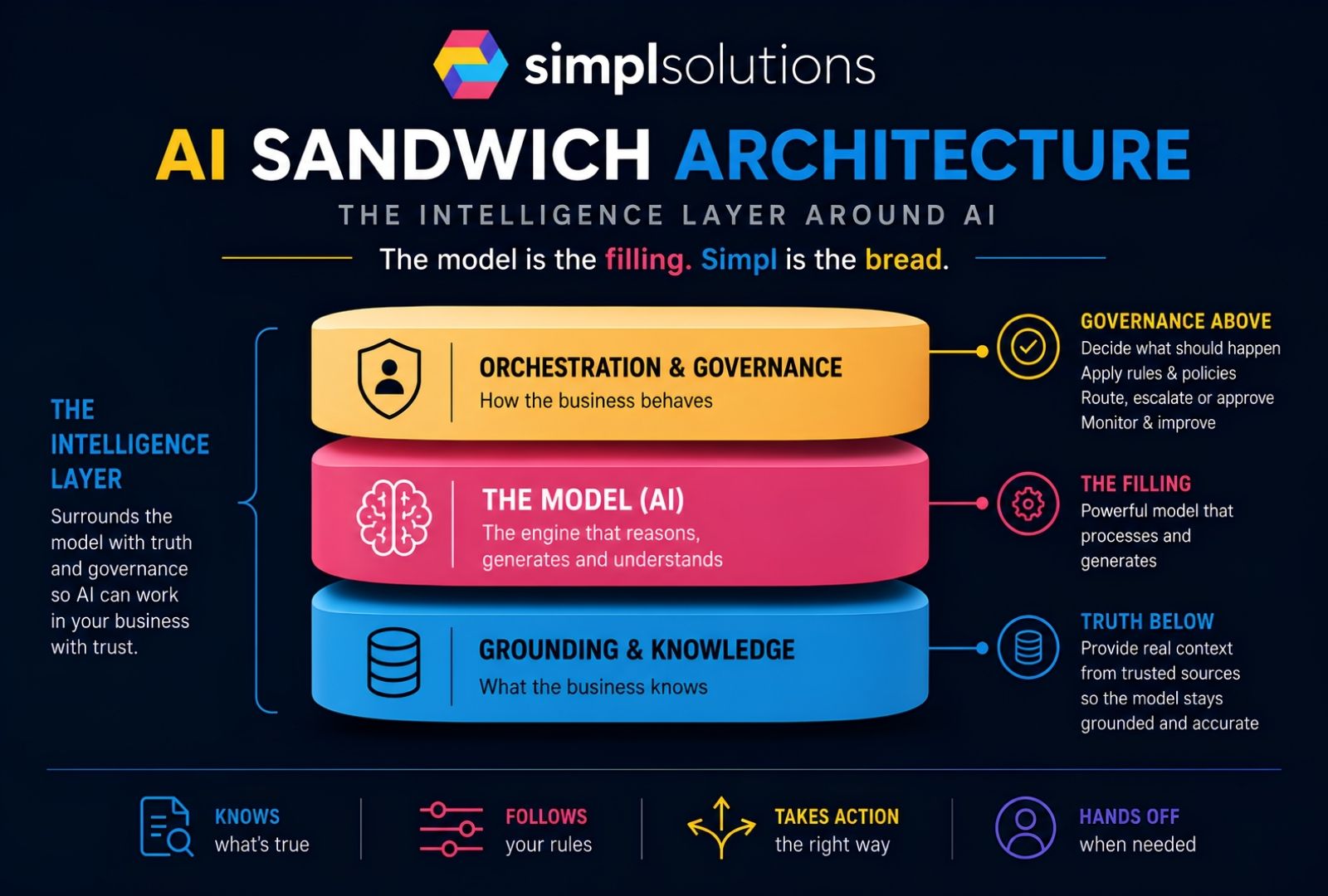
White Paper: AI Sandwich Architecture and the Intelligence Layer
Why the model is only the filling, and why the Business Brain is the intelligence layer that grounds and governs business AI.
Read →
The Intelligence Layer: The Missing Operating System for Business AI
The intelligence layer turns raw AI capability into business-specific execution with context, memory, permissions, workflows, approvals, and trust.
Read →
Why the AI Intelligence Layer Is the Future of Business AI
Most AI systems stop at output. The AI intelligence layer combines knowledge, workflow logic, guardrails, and EQ to make AI operationally real.
Read →
IQ + EQ: The Business Brain Standard for Human-Accountable AI
How SimplSolutions builds AI systems that understand the business, the people, and the truth.
Read →
Automation in Customer Service
How customer service automation can reduce repetitive work without trapping people in cold, unhelpful systems.
Read →
Business Automation: Efficiency and Revenue
Why business automation should connect efficiency gains to revenue protection, follow-up discipline, and better handoffs.
Read →
The Rise of Open-Source Large Language Models
What open-source LLMs mean for business AI, including cost, control, privacy, and the need for a governed intelligence layer.
Read →
AI Agents in Business: What Works Now
A practical look at AI agents in 2025: what they can do, where they fail, and how to govern them in real workflows.
Read →
AI Video Generation for Business
How AI video generation can support marketing in 2025 without flooding the brand with generic content.
Read →
AI and Job Displacement
A practical view of AI job displacement, reskilling, and why businesses should automate busywork while preserving human judgment.
Read →
Only 14% of the US Is Using AI
Why low AI adoption is an opportunity for practical automation, not a reason to chase hype.
Read →
AI-Enhanced: The Future of Knowledge Workers
How knowledge workers can use AI to reduce repetitive work while increasing judgment, clarity, and leverage.
Read →
What Is a Business Brain?
A Business Brain centralizes approved knowledge, voice, workflows, decision rules, guardrails, and escalation logic so AI can support real work.
Read →
The Business Brain: Why the Future of Business AI Is a Shared Intelligence Layer
A Business Brain is a shared knowledge and execution layer that centralizes what an organization knows, how it communicates, and how it works.
Read →
LinkedIn Lead Generation Without Automated Noise
How to use LinkedIn for lead generation in 2025 without turning outreach into generic automated noise.
Read →
Automation Tools Redefining Modern Business
The automation tools that matter most are the ones that connect knowledge, workflow, routing, and human approval.
Read →
AI Agents in Business: The Future of Automation
Why AI agents need clear jobs, shared knowledge, permissions, and human escalation to become useful business automation.
Read →
Marketing Automation Efficiency and the Human Touch
How marketing automation can increase efficiency without removing strategy, taste, and human accountability.
Read →
How to Evaluate AI Platforms for Growth
How to evaluate AI-driven growth platforms by workflow fit, governance, integrations, and measurable business outcomes.
Read →
How AI Chatbots Qualify Leads and Drive Traffic
How AI chatbots can qualify leads, route prospects, and improve conversion when they are connected to real business context.
Read →
UX and AI-Driven Content: The Future of SEO
Why the future of SEO depends on useful page experience, clear answers, entity signals, and AI-supported content operations.
Read →
High-Ranking Content: Engage, Convert, Repeat
How high-ranking content earns attention, answers real questions, and creates a repeatable path from search to conversion.
Read →
Entity-Based SEO: Authority and Schema Markup
How entity-based SEO, authority signals, and schema markup help search engines and AI systems understand your business.
Read →
The Voice Search Revolution Is Shifting SEO Strategies
How voice search changes SEO strategy by rewarding direct answers, local clarity, conversational language, and structured content.
Read →
From Social Media to Bottom Line: Boosting Lead Magnets
How to connect social media, lead magnets, follow-up, and conversion into one measurable growth workflow.
Read →
Top Automation Tools for Social Media Efficiency
How to evaluate social media automation tools for planning, repurposing, scheduling, approvals, and brand consistency.
Read →
Algorithm Shifts and Innovative Ad Formats
How businesses should respond to algorithm shifts and new ad formats with stronger creative systems and first-party insight.
Read →
Building an Automated Sales Funnel That Converts
How to build an automated sales funnel that protects timing, context, qualification, and human trust.
Read →
Short-Form Video That Earns Attention
Why short-form video works in 2025 when it is tied to a clear message, real proof, and a follow-up path.
Read →/ For Reddit users
Alex answers the practical questions behind the thread.
Straight answers for operators comparing AI adoption and workflow automation against the mess of real workflows, tools, approvals, and risk.
What makes content LLM-friendly?
Clear structure, direct answers, strong entity names, visible proof, and language that says exactly what you mean.
Reddit discussion - r/marketingCan AI work across sales, support, content, and training?
Yes, but only if the shared brain comes before the channels. Channel-first AI scales inconsistency. Brain-first AI scales judgment.
Reddit discussion - r/EntrepreneurCan AI content rank without being thin or generic?
Yes, if it starts from real expertise and original operating insight. AI can help draft, structure, and repurpose, but the point of view has to come from the business.
Reddit discussion - r/marketingShould we write for Google or for AI search?
Write for the buyer and make the page easy to crawl, understand, and cite. The fundamentals overlap more than people want to admit.
Reddit discussion - r/marketingGet started
Ready to put it to work?
Reading is good. Mapping your first workflow is better.
Book a demo →