
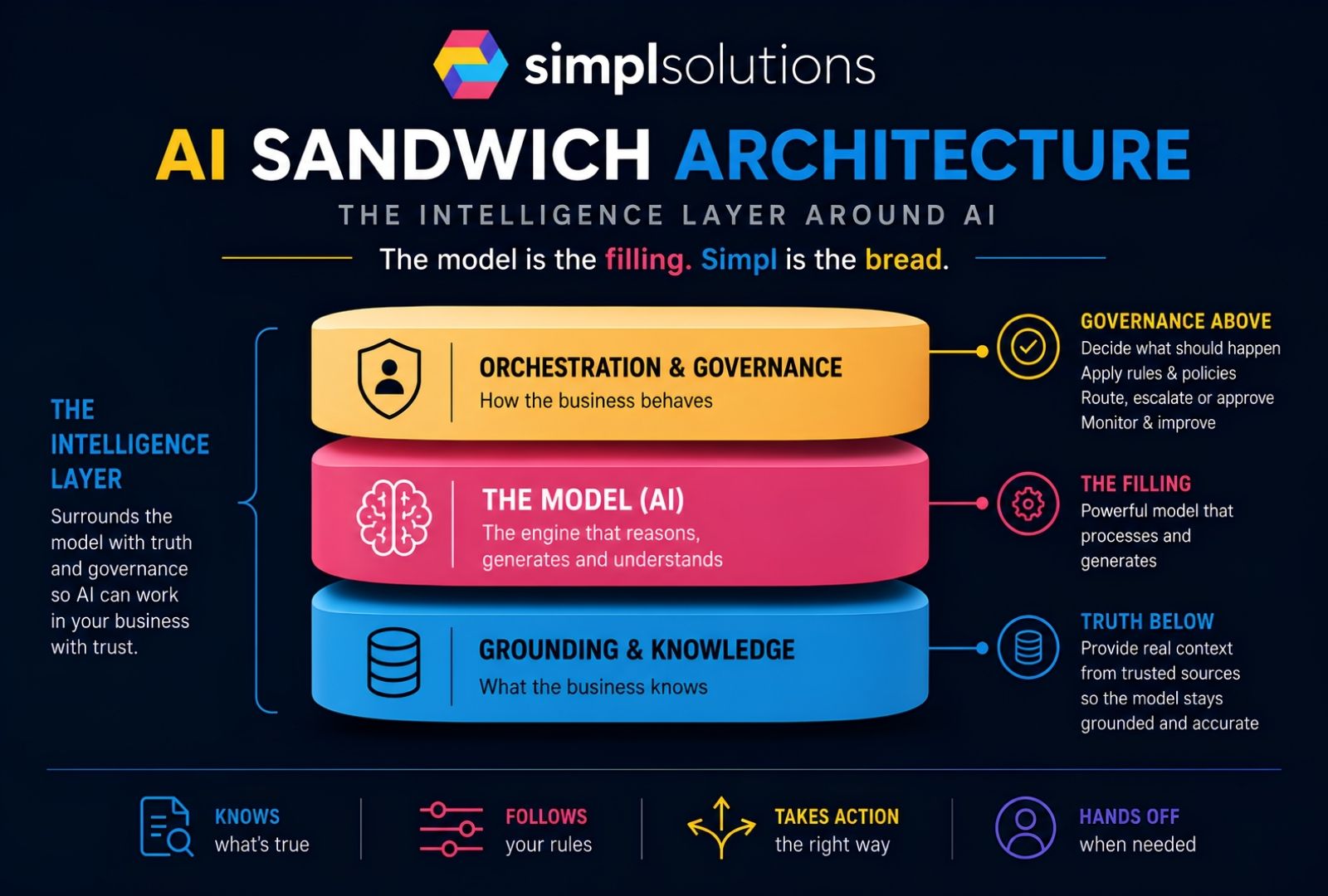
Why the model is only the filling — and why the Business Brain is the bread
Executive Summary
Most companies think the model is the AI system.
It is not.
The model is the filling.
It can reason, summarize, classify, draft, synthesize, and infer. That matters. But by itself, the model does not know what the business actually knows. It does not know which documents are authoritative, which claims are approved, which policies changed, which tone fits the customer, or when a human needs to step in.
That is why SimplSolutions uses AI Sandwich Architecture.
In Sandwich Architecture, the intelligence layer is the system around the model.
Below the model, it grounds. Above the model, it governs.
The bottom layer gives the model truth. The top layer gives the model control. The model sits in the middle as the engine.
That is the AI sandwich.
The model is the filling. SimplSolutions is the bread.
The Business Brain sits below and above the model so AI can operate inside the real business, not outside it.
Because capability without context is noise. Context without governance is risk. Governance without execution is paperwork.
The intelligence layer brings them together.
1. The mistake most businesses make about AI
Most AI conversations start with the model.
Which model are we using? How fast is it? How smart is it? How big is the context window? Can it write? Can it reason? Can it answer?
Those are useful questions, but they are incomplete.
A model is not a business system. A model is a capability engine. It can generate output, but output is not the same as execution.
A business needs more than output.
It needs approved knowledge. It needs workflow rules. It needs brand voice. It needs escalation logic. It needs human approval. It needs decision boundaries. It needs memory. It needs restraint.
Without those layers, the model is working in open space. It may sound confident, but confidence does not mean alignment.
That is where AI Sandwich Architecture matters.
It puts the model where it belongs: in the middle, surrounded by the business context below it and the business governance above it.
2. What AI Sandwich Architecture means
AI Sandwich Architecture is the SimplSolutions model for turning raw AI capability into governed business execution.
It has three parts:
- The bottom bread: grounding
- The filling: the model
- The top bread: orchestration and governance
The model does the AI work. The Business Brain makes that work safe, useful, and aligned.
The bottom bread: grounding
Below the model are the truths the AI needs to work from.
Documents. Policies. SOPs. FAQs. Brand voice. Customer context. Workflow rules. Decision boundaries. Approved claims. Unknowns. Contradictions.
This is the grounding layer.
It says:
“This is what the business knows.”
Without this layer, the model guesses. It may produce a polished answer, but the answer may not be true for that business.
Grounding makes the model useful because it gives the model something real to work from.
The filling: the model
Then comes the model.
The language engine. The reasoning system. The generator.
This is the part that can synthesize, summarize, classify, draft, infer, and respond.
The model matters. It is powerful. But it is not enough.
The model does not automatically know whether a claim is approved. It does not automatically know whether a customer issue should escalate. It does not automatically know whether a voice caller is too upset for automation to continue. It does not automatically know what the organization’s ethics require.
The model is the filling.
It needs the bread.
The top bread: orchestration and governance
Above the model is the orchestration layer.
This layer asks:
Now what should happen?
Should the system answer? Ask a question? Draft an email? Route to support? Escalate to a human? Refuse an unsupported claim? Change tone? Slow down? Pause for approval? Log the interaction? Trigger a workflow? Hand off to another channel?
This is the governance and execution layer.
It says:
“This is how the business behaves.”
That is what makes AI operational.
3. Why the Business Brain surrounds the model
The SimplSolutions Business Brain is not just a prompt. It is not just a chatbot. It is not just a wrapper around a model.
It is the intelligence system that sits below and above the model.
Below the model, the Business Brain organizes what the company knows.
It gives the AI access to approved context, source material, rules, tone, workflows, and boundaries.
Above the model, the Business Brain governs what the system does next.
It decides whether the output should be answered, drafted, routed, reviewed, escalated, paused, or refused.
That is the difference between model access and business intelligence.
A generic model can produce language. A Business Brain helps the organization behave.
The model can say something. The Business Brain helps decide whether it should.
4. Why grounding matters
Grounding is what keeps AI tied to the business reality.
A business has its own truth layer. That truth may include public information, internal knowledge, customer history, policies, pricing rules, brand standards, and workflow logic.
If that truth is not available to the system, the model has to rely on general knowledge or pattern prediction. That is where generic AI breaks down.
The model may produce an answer that sounds right but does not match the business.
It may use an outdated policy. It may invent a process. It may overstate a claim. It may use the wrong tone. It may answer a question that should have been escalated.
Grounding reduces that risk by giving the model approved material to work from.
But grounding alone is not enough.
A model can have access to the right documents and still behave badly if it does not know what to do with uncertainty, conflict, emotion, or risk.
That is why the top bread matters too.

5. Why governance matters
Governance is what keeps AI from turning capability into chaos.
A model can generate. Governance decides whether generation is appropriate.
A model can answer. Governance decides whether the answer is supported.
A model can draft. Governance decides whether the draft needs review.
A model can continue a conversation. Governance decides whether a human should take over.
This is especially important in real business settings.
Outbound email needs approval and pacing. Voice workflows need escalation logic. K–12 communication needs privacy-aware, human-reviewed framing. Healthcare or legal-adjacent workflows need careful boundaries. Customer complaints need judgment. Public claims need proof. Pricing needs current approval. Sensitive questions need restraint.
Governance is not a slowdown. It is what makes AI deployable.
Guardrails are features.

6. The intelligence layer is not the model
This is the central point.
The intelligence layer is not the model.
The intelligence layer is the system around the model.
It is the grounding below it and the governance above it.
That distinction matters because many businesses are trying to solve operational problems by buying access to more model capability.
But more capability does not automatically create better execution.
A stronger model without grounding can hallucinate more persuasively. A stronger model without governance can automate risk faster. A stronger model without workflow logic can create more disconnected output.
The future of business AI is not just better models.
It is better systems around the models.
That is AI Sandwich Architecture.
7. How AI Sandwich Architecture works in practice
Imagine a customer asks a question.
The system does not simply send the question to the model and hope for the best.
First, the bottom layer grounds the request.
What does the business know about this topic? Which source is approved? Is there a policy? Is there a contradiction? Is the information current? Is this answer allowed?
Then the model does the synthesis.
It interprets the request. It summarizes the source material. It drafts a response. It identifies the likely intent.
Then the top layer governs the next move.
Should the answer go out? Should it be shortened? Should the tone change? Should a human approve it? Should the system escalate? Should the system say it does not have enough support?
That is the full AI sandwich.
The model is important, but the model is not alone.
It is held by the Business Brain.
8. Why this creates better AI behavior
Good AI behavior does not come from generation alone.
It comes from structure.
The system needs to know:
What is true? What is allowed? What is uncertain? What is sensitive? What needs approval? What needs escalation? What should never be automated? What should happen next?
AI Sandwich Architecture makes those questions part of the system.
That creates AI that is more useful because it is grounded.
It creates AI that is safer because it is governed.
It creates AI that is more operational because it can route work.
It creates AI that is more human-accountable because it knows when to step back.
And it creates AI that feels more aligned because it is operating inside the real business instead of outside it.
9. The role of IQ and EQ inside the AI sandwich
The model provides much of the IQ.
It can reason, classify, draft, summarize, infer, and synthesize.
But the Business Brain gives that IQ context.
It gives the model the right documents, rules, tone, and boundaries. It turns general reasoning into business-specific reasoning.
The Business Brain also supports EQ.
It helps the system recognize when tone matters. It helps the system slow down when a user is frustrated, confused, urgent, or anxious. It helps the system understand that the right answer is not always the fastest answer.
Sometimes the right answer is a careful answer.
Sometimes it is a clarifying question.
Sometimes it is a handoff.
Sometimes it is a refusal.
That is what makes the system feel less like a generic AI tool and more like an extension of the organization’s best judgment.
10. Why SimplSolutions is the bread
The simplest way to explain AI Sandwich Architecture is this:
The model is the filling. SimplSolutions is the bread.
The bottom bread gives the model truth.
It grounds the system in the business: documents, SOPs, policies, FAQs, customer context, brand voice, workflow rules, decision boundaries, approved claims, unknowns, and contradictions.
The top bread gives the model governance.
It controls what happens next: answer, ask, draft, route, escalate, refuse, change tone, slow down, pause for approval, or continue.
That is the SimplSolutions intelligence layer.
It surrounds the model so AI can operate inside the real business.
Not as a loose tool. Not as a guessing engine. Not as a chatbot with nicer branding.
As a governed Business Brain.
11. The final thesis
Capability without context is noise. Context without governance is risk. Governance without execution is paperwork.
The intelligence layer brings them together.
That is the future of business AI.
Not just models.
Systems that know how to behave.