
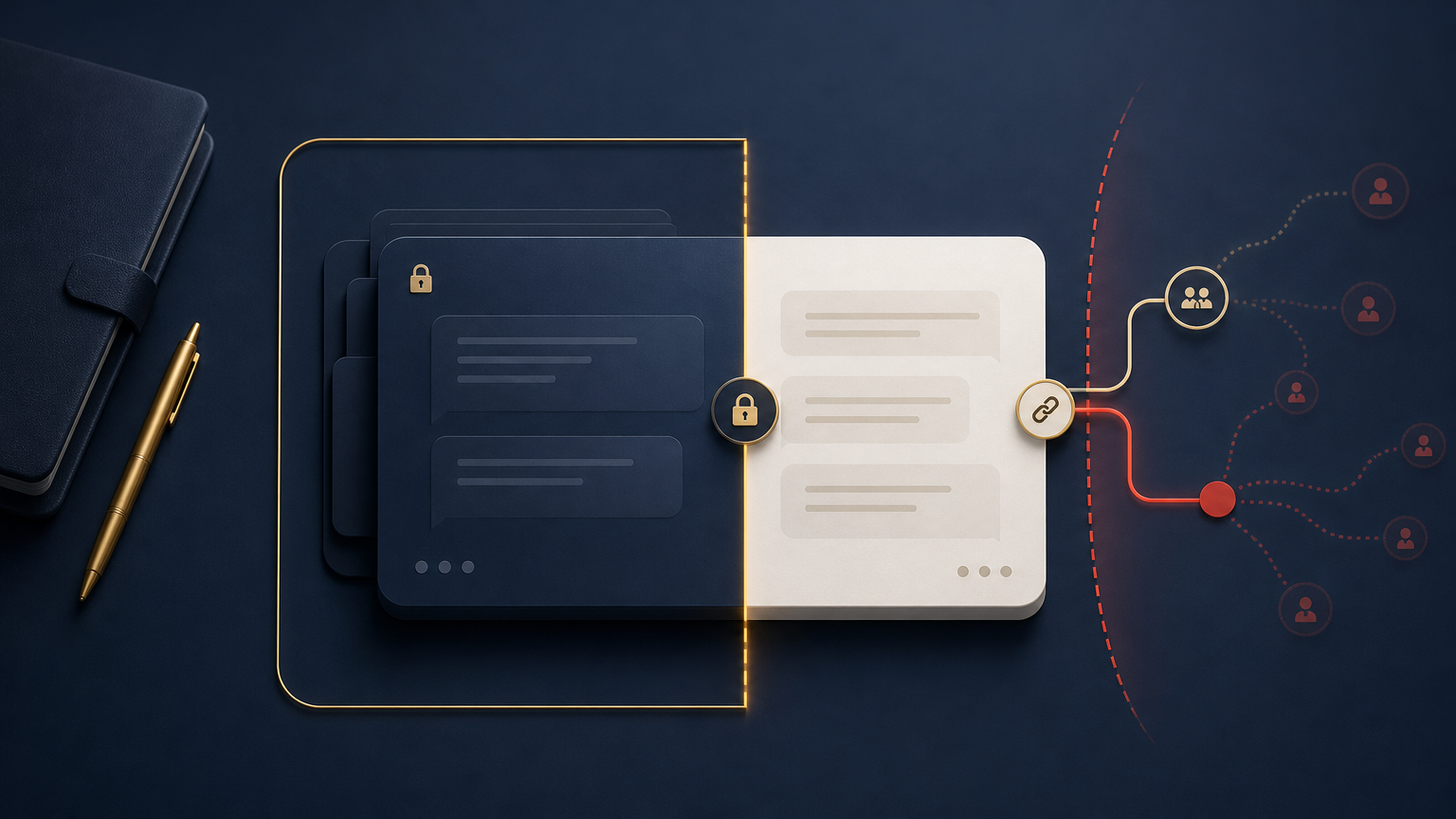
AI conversations can become business information
Employees may use AI workspaces to summarize material, prepare for meetings, draft content, organize ideas, or analyze information. A single conversation can combine an original request, supporting context, uploads, generated output, and follow-up discussion. Depending on how it is used, that material may contain confidential plans, personal information, financial details, customer information, security-sensitive context, or internal decisions.
That makes conversation sharing a governance question, not merely an interface choice. When a user shares a conversation or generated artifact, the relevant questions are broader than whether a link was created. Teams need to understand the intended audience, the visibility setting, the ownership of the shared item, the retention approach, and the available response if access is wider than intended.
This article does not assume that all AI workspaces behave alike. Product behavior, organizational configurations, and contractual terms differ. The framework below is designed to help organizations ask clearer questions before confidential business information is used in an AI workspace.
Start with the information, not the tool
A useful first step is to assess the most sensitive information likely to appear in a conversation. The classification of a final output should not be considered in isolation: a seemingly ordinary summary may still reflect sensitive source material or reveal context that should remain limited.
Before entering information into an AI workspace, decision-makers can ask:
- What is the most sensitive material in this conversation? That material may set the appropriate handling level for the conversation and any resulting artifact.
- Whose information is involved? Customer, employee, partner, and third-party information can create different responsibilities from personal notes or public source material.
- Who has a legitimate need for the result? A request for help from one colleague is different from a request for broad internal or external access.
- How long does the information need to remain available? A short-lived drafting activity and a business record may warrant different lifecycle decisions.
- What would be the consequence of wider-than-intended access? Financial, legal, reputational, operational, safety, and personal impacts can help determine the level of review needed.
The aim is not to prevent useful AI work. It is to avoid making an access decision accidentally while trying to complete a productivity task.
Consider private creation as a baseline
For business use, organizations may choose to treat private creation as a baseline for new conversations, uploaded context, and generated artifacts, with broader access requiring an intentional decision. Whether and how that baseline can be configured depends on the product and the organization's environment.
The important distinction is between an item that remains within a defined audience and an item that can be made available more broadly. A shared link, a named-recipient permission, a team workspace, and an organization-wide audience are not equivalent access choices. Users benefit when the audience is clear at the moment they make a sharing decision.
This consideration can apply across several types of material:
- Personal experimentation: Low-risk, non-business exploration may call for a different environment and retention approach from organizational work.
- Business conversations: Work-related discussions may need to remain within an approved organizational identity and access boundary.
- Sensitive records: Financial, personnel, customer, legal, security, and strategic information may warrant narrower audiences and additional review.
- Generated artifacts: Summaries, plans, analyses, and documents can carry sensitivity derived from their source material even when the output appears routine on its own.
Private creation does not mean information can never be shared. It means a request to expand access should be visible, intentional, and considered in light of the information involved.
Separate personal experimentation from business records
Personal AI use and organization-sponsored AI work should not automatically be treated as interchangeable. An organization may decide that low-risk, non-confidential experimentation belongs in one context, while business information belongs in a managed environment with defined accountability.
Teams can also decide what makes an AI conversation a business record. Possible indicators include whether the conversation contains an approved decision, customer or employee information, analysis used in a material process, or an artifact that others rely on. Where an organization treats a conversation or output as a record, it may need an owner and a lifecycle rather than indefinite, ownerless accumulation.
This is a governance distinction, not a statement about the reliability of AI output. An output can be incomplete or inaccurate while the source material remains sensitive.
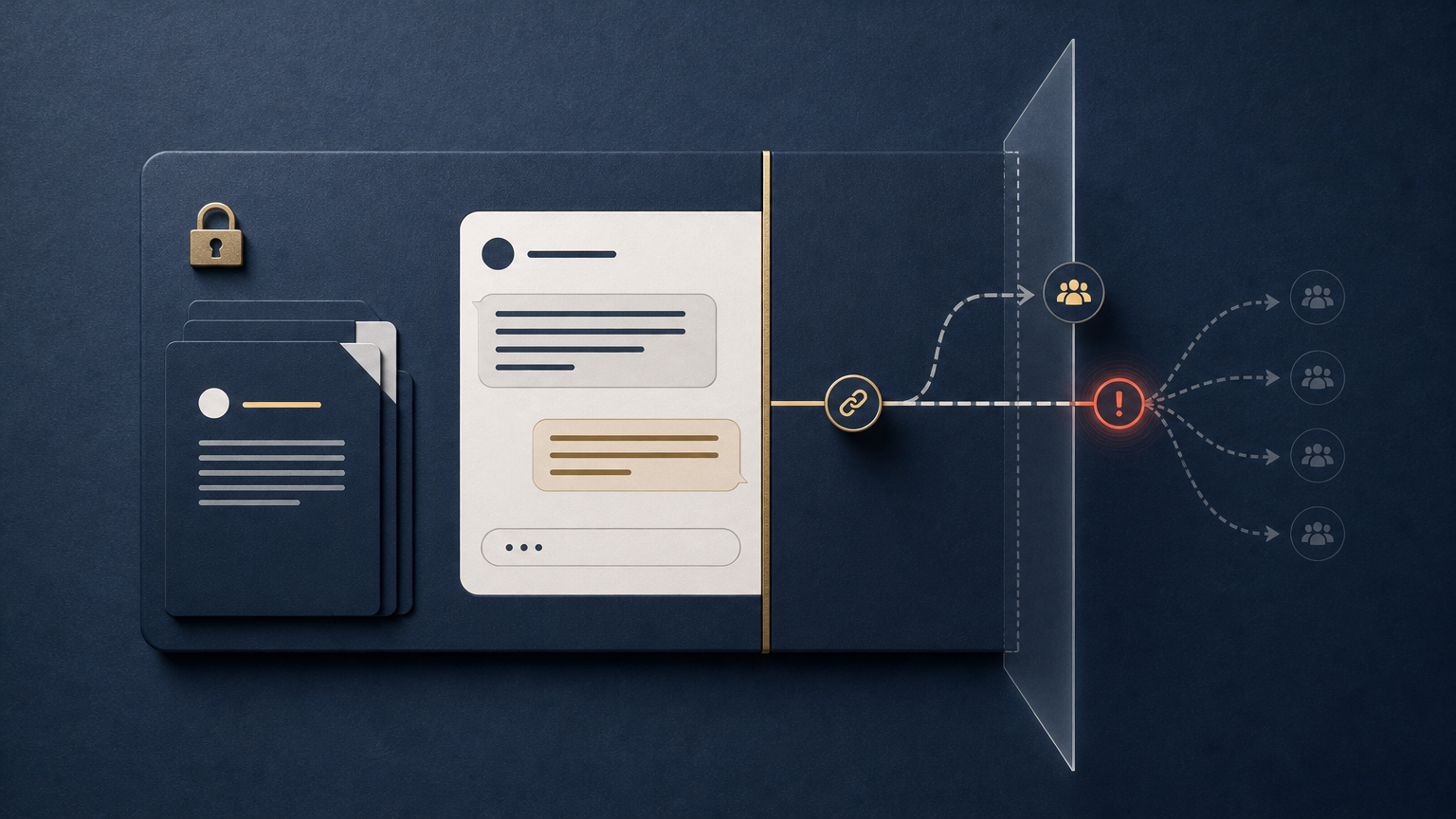
Review sharing as a set of decisions
A sharing action can involve several separate questions. Organizations evaluating an AI workspace can ask how the product represents and manages each of the following:
- Audience: Can the intended audience be understood as named individuals, a managed group, the organization, or external recipients?
- Discovery: What information, if any, may be visible beyond the intended audience, and how is visibility tested?
- Duration: Can access have a defined end date where that is appropriate?
- Resharing and copying: What choices, warnings, or limitations exist around forwarding, downloading, or reproducing shared material?
- Ownership: Who is accountable if the creator changes role, leaves, or no longer has access?
- Review records: What information is available about sharing and access events, if any?
- Removal of access: What steps are available to remove access, and how can the organization assess the result?
These are evaluation questions, not assumptions about any particular product. The answers should come from documented terms, tested configurations, and the organization's approved use case.

Plan for review and response
For higher-risk material, an organization may choose to introduce review before sharing and at intervals afterward. The review can be proportionate: it might identify the information category, intended audience, owner, and planned duration of access.
It is also useful to define a response path for mistakenly shared information. The appropriate response will depend on the circumstances, product behavior, applicable obligations, and the information involved. At a high level, a response process may address containment where possible, preservation of relevant records, assessment of the affected material, escalation to the relevant owners, and documentation of decisions.
Removing access to an item may not remove copies, screenshots, downloaded material, or downstream summaries. That practical limitation is one reason why audience limitation and careful sharing decisions can be more reliable than relying solely on post-sharing cleanup.
Questions for an AI workspace review
Before approving an AI workspace for confidential business use, procurement, privacy, security, legal, and business stakeholders can consider questions such as:
- What are the default visibility settings for conversations, uploads, and generated artifacts?
- What does each sharing option create, and how is the intended audience communicated to a user?
- What testing or documentation addresses visibility beyond the intended audience?
- Can access be scoped to organizational identities or managed groups when needed?
- What ownership options apply when a creator changes roles or leaves?
- What retention and deletion terms apply to chats, uploads, outputs, and shared artifacts?
- What information is available to support review of sharing and access activity?
- What options exist to remove access, and how can the organization assess their operation?
- Can the organization distinguish low-risk personal experimentation from business work?
- Which internal policies, contracts, and legal or regulatory requirements apply to the intended use?
Answers should be based on the specific product, configuration, contract, and use case under consideration. A feature label alone is not a substitute for understanding how a sharing choice works in practice.
A practical operating principle
A cautious approach to AI workspace governance is to minimize unnecessary exposure, make access choices understandable, assign ownership where needed, retain information intentionally, and prepare for correction when something goes wrong.
The exact operating model will vary. A workspace suitable for low-risk drafting may not be suitable for personnel material, customer information, unreleased financial plans, or security-sensitive work. Organizations can make better decisions by matching the information and business purpose to a documented review of the environment in which it will be used.
Takeaway
Treat AI conversations as potentially sensitive when they include business information, uploaded context, or outputs that others will rely on. Review how information is classified, who is intended to access it, how sharing is communicated, who owns it, how long it remains available, and what response options exist if access is broader than intended.
The practical question is not whether people will use AI workspaces. It is whether the organization has made the intended, well-understood path easier than an accidental sharing decision.
Useful next step: create an inventory of AI workspaces approved for business use and record the intended use case, information categories, default visibility, sharing options, ownership approach, retention terms, available review records, and response process for each one.