
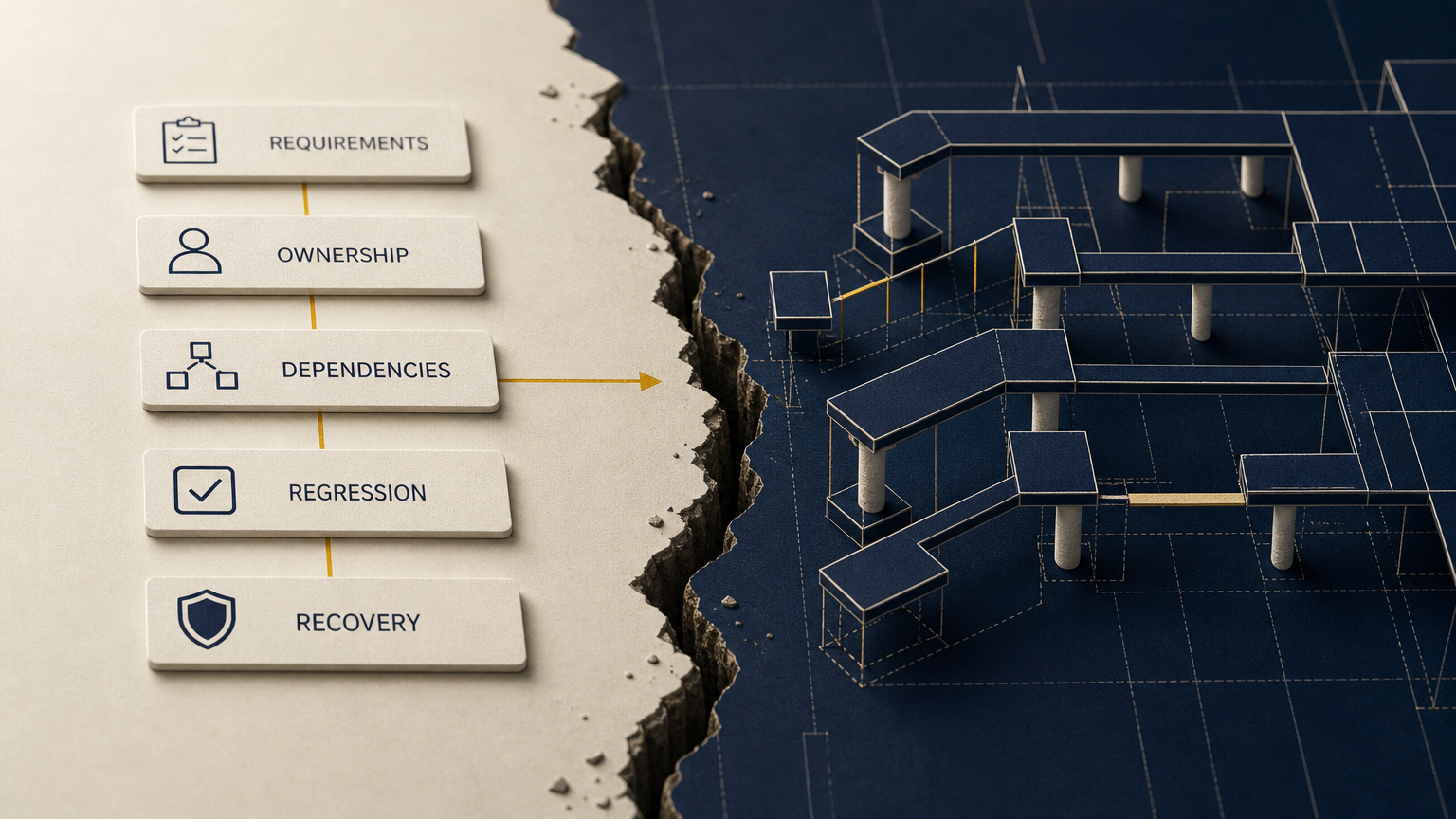
The real question is not whether AI writes code faster
Engineering and operations leaders face a more consequential question: can the business still understand, operate, and safely change the software after AI-assisted development has accelerated delivery?
A passing test suite is useful evidence. It is not proof that a change reflects the right business rule, covers the right user behavior, or remains understandable to the team responsible for it.
That distinction matters because development capacity is not the same as code production. Capacity includes the ability to make a correct change, detect when it is wrong, recover from failure, and maintain the system as its dependencies and requirements evolve.
What the warning actually says
In a first-person account, Evan X. Merz describes AI-assisted development as producing fragile code. The account is an individual observation, not a controlled study, but it identifies four risks that leaders can test against their own operating model:
- shallow tests that cover easy implementation details rather than important user and business scenarios;
- unnecessary complexity and abstractions that make code harder to understand;
- declining human understanding of the data structures, dependencies, and decisions in the system; and
- review pressure that causes people to skim increasingly large or frequent changes.
The important leadership lesson is not that AI-generated code is always poor. It is that the existing signals of quality can become misleading when output increases faster than human comprehension and review capacity.
A team may merge more pull requests while becoming slower at answering basic questions: What business decision does this code implement? Which customers are affected? What else depends on it? Who can safely change it at 2 a.m.?
Passing tests are necessary but incomplete
Tests usually answer a bounded question: did the software behave as expected for the cases that were specified?
They do not automatically answer whether the right cases were specified. An automated test can pass while a pricing exception, approval rule, entitlement boundary, data-retention requirement, or failure path is missing entirely.
This is why leaders should separate at least four kinds of evidence:
- Requirement traceability: Can the change be linked to a clear customer, operational, regulatory, or commercial requirement?
- Business-rule evidence: Has someone with domain responsibility confirmed that the software encodes the intended decision, including exceptions?
- Regression evidence: Has the team tested adjacent behavior and known failure modes, not only the new path?
- Operational evidence: Can the team observe, roll back, diagnose, and recover from the change?
The source account specifically warns that line-level coverage can conceal gaps in meaningful behavior. That observation should not be treated as a universal measurement finding, but it is a useful governance prompt: coverage percentages should be accompanied by scenario quality and business-risk review.
A practical operating standard for AI-assisted development
Leaders do not need to ban AI-assisted coding to raise the quality bar. They need to make safe change the unit of accountability.
1. Require a traceable reason for every material change
A reviewer should be able to move from a deployed change to the requirement it serves, the owner who accepted the behavior, and the risks considered before release.
This does not require bureaucracy for every minor edit. It does require a higher standard for code that affects money, access, customer data, contractual commitments, operational continuity, or externally visible behavior.
If a team cannot explain why a material change exists, faster implementation is not a capacity gain. It is untracked exposure.
2. Name ownership for behavior, not just files
File ownership is not the same as responsibility for a business capability. A system may have one team maintaining the code while another team owns the policy, customer promise, or operational outcome that the code implements.
For important paths, identify both technical ownership and business ownership. A review should make clear who can answer whether the behavior is correct and who can respond when it fails.
3. Review dependencies and impact before review becomes a formality
AI-assisted changes can look locally reasonable while interacting badly with existing assumptions. Leaders should expect impact analysis for material changes: upstream inputs, downstream consumers, data contracts, permissions, integrations, scheduled work, and user-visible states.
The exact depth should match the risk. A visual adjustment does not need the same evidence as a change to account balances or access control. But the decision should be explicit rather than implied by a green pipeline.
4. Make human understanding observable
“Someone reviewed it” is a weak control if review time is shrinking and the reviewer cannot explain the change.
Useful review questions include:
- Can the accountable engineer explain the main data flow without relying on the coding assistant?
- Can the team identify the most important invariant or business rule being protected?
- Is the design simpler than the previous behavior, or merely more abstract?
- Could an on-call engineer diagnose a failure using the available logs, metrics, and context?
- Is there a clear owner for the next change in this area?
These questions are not anti-automation. They are checks that automation has not displaced understanding.
5. Connect delivery metrics to operational outcomes
A rise in code volume or merge frequency does not establish increased capacity. Review delivery metrics alongside indicators such as escaped defects, change-related incidents, rollback frequency, time to restore service, repeat incidents, and time spent explaining unfamiliar code.
The source account describes a pattern in which incidents become more frequent and harder to resolve as human understanding declines. That is a reported observation, not a benchmark. The responsible response is to inspect whether similar patterns exist in your own data rather than assume the pattern is inevitable.

What operations leaders should look for
Operations teams often see the consequences before engineering dashboards do. Warning signs include:
- incidents that cannot be quickly assigned to a known owner;
- alerts that identify symptoms but not the affected business process;
- changes that are difficult to roll back because dependencies are unclear;
- user-visible errors that do not appear in automated test or monitoring paths; and
- repeated escalation to the original developer or an AI tool because the wider team cannot explain the behavior.
None of these symptoms proves that AI caused the problem. They do show that the organization may lack sufficient traceability and recovery evidence for the pace of change.
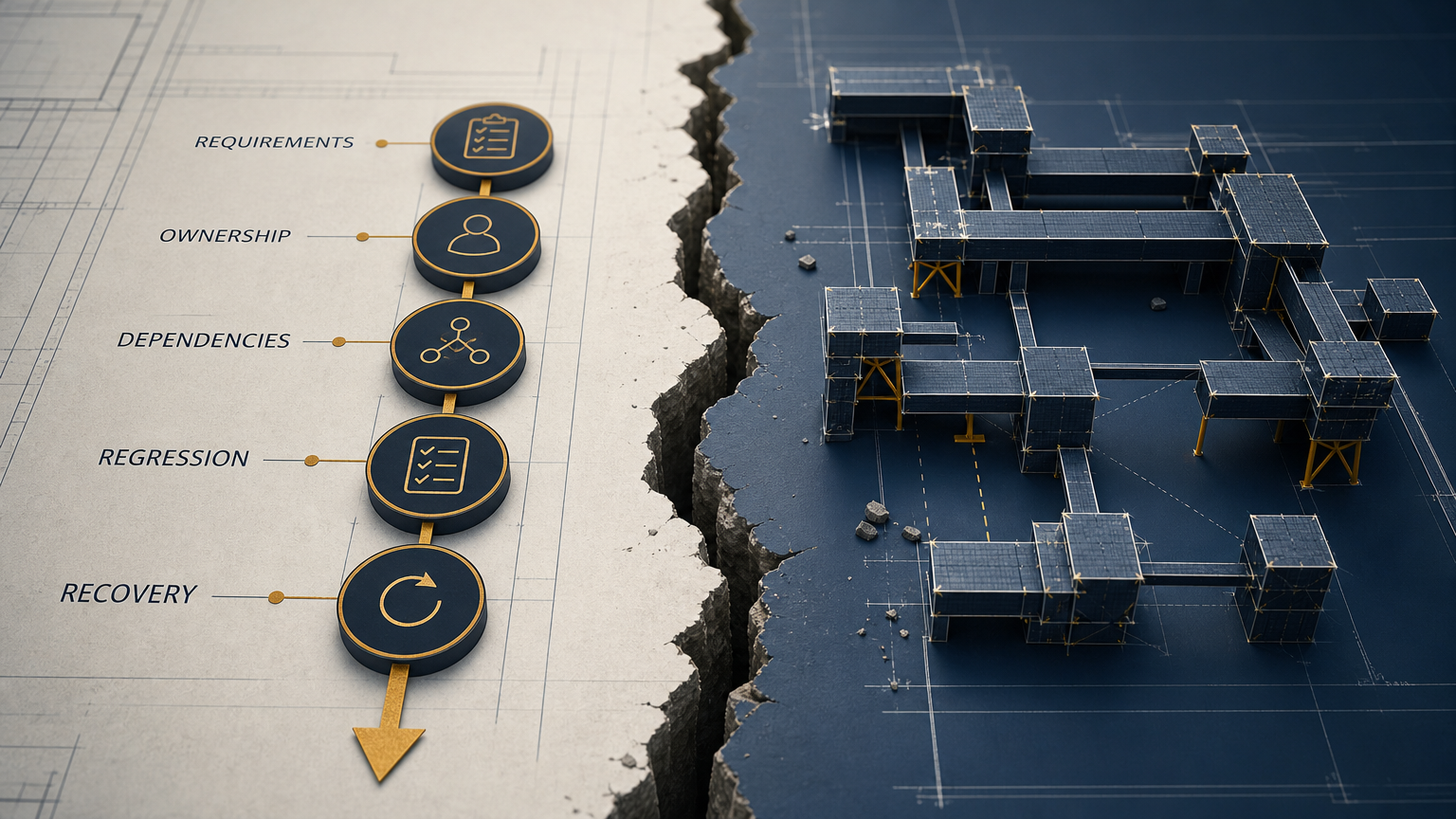
What remains uncertain
The supplied account is valuable as practitioner testimony, but it has clear limits. It is one person’s experience, it does not isolate AI from team composition or management pressure, and it does not establish that AI-assisted development causes higher incident rates in every environment.
The outcome will depend on factors such as task selection, review quality, system complexity, domain risk, developer expertise, testing discipline, and release controls. AI may be useful for bounded work where the requirements are clear and the consequences are limited. The risk rises when generated output is accepted without preserving the human ability to explain and govern the resulting system.
That uncertainty is not a reason to wait for a perfect industry benchmark. It is a reason to measure the outcomes that matter in the business’s own environment.
A better definition of delivery capacity
For leaders, the standard can be concise:
A team has increased delivery capacity only when it can deliver more valuable change without losing the ability to understand, verify, operate, and recover from that change.
Under this standard, AI assistance is one input into a governed delivery system. It is not the outcome. A team that ships twice as much code but takes longer to diagnose incidents, cannot identify owners, and discovers business-rule errors through customers has not doubled capacity. It has increased the rate at which it creates obligations.
SimplSolutions’ perspective is that governed AI should preserve human accountability at the points where software becomes a business decision: requirements, ownership, release evidence, exception handling, and operational recovery. The practical next step is to review a recent set of AI-assisted changes against those controls and identify where the evidence is missing—not to ask whether the code was produced by a person or a model.
The takeaway
AI-assisted development should be judged by safe change, not code volume. Require traceable requirements, named technical and business owners, dependency mapping, meaningful regression evidence, review of business rules, and a recovery path proportionate to the risk.
If those controls weaken as delivery accelerates, the organization is not gaining capacity. It is moving maintenance and incident costs into the future.