
The immediate problem is not only the outage
When a banking service or integration fails, the visible symptom may be a delayed transfer, an unavailable status, or a queue that stops advancing. The larger operational risk is uncertainty: teams may not know which records were accepted, which failed, which are still pending, and which downstream systems acted on incomplete information.
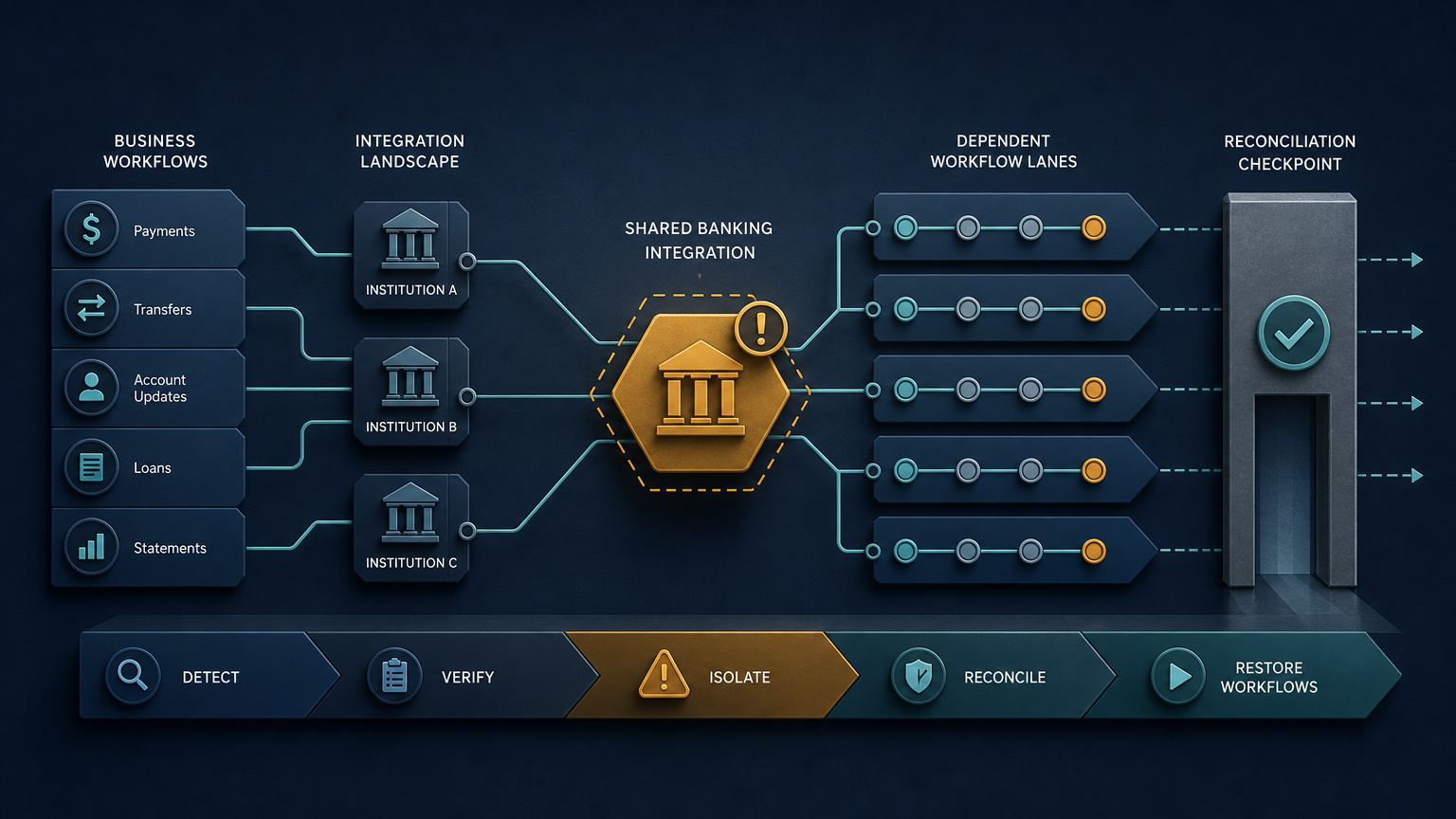
That uncertainty can spread across organizations when several workflows depend on the same financial institution, connectivity layer, processor, or shared data exchange. A reported technical issue at JPMorgan Chase was associated with online banking delays for U.S. banks, according to the Associated Press report. The supplied source does not provide enough detail to establish the precise technical cause, duration, scope, or transaction-level impact.
For an operations leader, the first question is therefore not “Is the service back?” It is “What evidence shows that the workflow is safe to resume?”
1. Identify the shared dependency
Start by mapping the failure to the service that multiple workflows rely on. Avoid naming a root cause before the evidence supports it.
The dependency may be:
- A financial institution’s online or transaction service
- A banking connectivity provider
- A payment, file-transfer, or account-data exchange
- An internal integration layer that presents an upstream failure as a local error
- A downstream reconciliation or notification service
Create a short dependency statement for the incident record:
“Workflow A, B, and C all depend on service X. Service X is currently unavailable, delayed, or returning an unverified state.”
This wording is deliberately narrower than “the bank caused the outage.” It records what the operating team knows without converting an early hypothesis into an official explanation.
Then identify the blast radius. Which legal entities, accounts, business units, customers, currencies, payment types, or reporting processes use the affected dependency? A shared failure is often discovered through several symptoms that look unrelated until the dependency map is reviewed.
2. Separate confirmed facts from assumptions
During an incident, facts and interpretations tend to mix quickly. Keep them separate.
Confirmed facts are observations supported by logs, provider notices, transaction acknowledgments, or direct operational evidence. Examples include:
- A defined endpoint, account service, or workflow is unavailable
- A request received a documented response
- A file was transmitted at a recorded time
- A transaction has an authoritative acknowledgment
- A reconciliation job completed or failed
Assumptions are plausible but unverified explanations. Examples include:
- A request was accepted because the client timed out after sending it
- A failed status means the transaction did not settle
- The issue affects every account or organization
- Retrying is safe because no confirmation was returned
- The service is healthy because the login page is available
Use an incident timeline with three fields: observation, source, and confidence. Add an owner and next verification step for each material unknown. This gives executives a reliable view of uncertainty and prevents a confident but unsupported status update from becoming the basis for a recovery decision.
3. Activate a controlled manual fallback
A manual fallback is not permission to improvise. It is a temporary control mode with defined scope, approval, and evidence requirements.
Before moving work outside the normal automation path, decide:
- Which transactions or workflow classes qualify
- Who can approve the exception
- What duplicate-submission checks are required
- How source documents and approvals will be retained
- How the manual activity will be marked for later reconciliation
- When the fallback expires or requires renewed approval
Keep the fallback narrow. Prioritize work according to business impact, contractual commitments, regulatory obligations, liquidity needs, and customer harm. Do not treat every queued item as equally urgent.
A useful control is to maintain a separate list of work processed manually during the incident. Each item should have a stable business identifier, the intended action, the person or role approving it, the time of action, and its later reconciliation status. The specific record format will vary by organization; the principle is consistent: temporary work must remain visible after normal service returns.

4. Preserve the incident record while people are still working
Operational memory is least reliable when teams are under pressure. Record decisions as they happen, not only after recovery.
The incident record should capture:
- The first observed symptom and time
- Affected dependencies and workflow categories
- Status changes and the evidence behind them
- Retries, manual actions, cancellations, and holds
- Approvals and changes in operating mode
- Customer, supplier, treasury, and internal communications
- Unresolved questions and their owners
Preserve relevant request identifiers, response states, file names, timestamps, and error details in accordance with the organization’s security and retention policies. Avoid copying sensitive financial data into informal channels when a controlled record is available.
This record serves two purposes. It supports recovery now, and it gives the organization a way to determine later whether a delay, duplicate, omission, or misapplied status occurred.

5. Verify downstream reconciliation before resuming automation
Service availability is not the same as workflow integrity. A provider may appear reachable while earlier requests remain delayed, duplicated, incomplete, or in an uncertain state.
Before restoring automation, verify at least four layers:
- Transport: Can the integration connect and exchange messages reliably?
- Acknowledgment: Are new requests receiving authoritative responses rather than only technical receipts?
- Business state: Do the financial records reflect the intended outcome, including items sent during the disruption?
- Reconciliation: Do internal records, bank records, ledger entries, and downstream notifications agree?
Pay particular attention to the uncertain middle. These are requests that may have been submitted but lack a definitive business outcome. They should not be blindly retried. Assign them a controlled disposition: confirm, cancel, hold, or escalate according to the organization’s operating policy.
Reconcile both directions. Check not only what the organization expected to send, but also what the financial service reports as received, rejected, pending, or completed. Then compare those results with internal ledgers, customer communications, and exception queues.
6. Restore in stages, not all at once
A safe restoration has a small test population, explicit success criteria, monitoring, and a rollback or hold decision. The first successful transaction is evidence of a successful test—not proof that the whole dependency has recovered.
A staged return should answer:
- Which workflow resumes first, and why?
- What volume or scope is permitted in the first stage?
- Which signals must remain stable before expansion?
- Who has authority to pause the rollout?
- How will manually processed work be prevented from being resubmitted?
- What is the escalation path if responses become ambiguous again?
Do not use a green status indicator as the sole release criterion. Combine technical health with business reconciliation and exception monitoring. A workflow should remain in a controlled state when the system is responsive but the business outcome is still uncertain.
What this incident pattern should change
The durable lesson is not that one institution or integration will always fail. It is that shared dependencies can turn a local technical issue into a multi-organization operating problem.
Leaders should ask whether their teams can answer five questions quickly:
- Which workflows depend on the same external service?
- How do we distinguish a technical receipt from a completed business outcome?
- What work can be paused, and what work needs a controlled fallback?
- Can we identify every manual action taken during the incident?
- What evidence is required before automation resumes?
These questions are useful beyond banking. They apply to payroll, logistics, identity, cloud services, data exchanges, and any process where an external dependency can leave records in an uncertain state.
A practical next step for operations leaders
Run a short dependency-failure review using one recent or plausible banking workflow. Do not start with technology diagrams. Start with the business records: what is sent, what acknowledgment is received, what outcome is authoritative, who can approve a fallback, and how reconciliation proves that automation can safely resume.
SimplSolutions can help teams examine those decision points with a focus on workflow resilience, exception handling, and human oversight—without assuming that every failure should be solved by adding more automation.