

A familiar tool can still require a new review
A creative application may already be widely used, approved by procurement, and embedded in daily production. That history does not automatically answer whether newly available AI-assisted capabilities fit the organization’s content standards.
The relevant question is not whether a product is generally approved. It is whether a particular capability changes how business assets are created, altered, recorded, reviewed, or understood by an audience.
A careful review helps marketing leaders avoid two unhelpful extremes: treating every new capability as inherently unsafe, or assuming that a familiar application needs no further governance. The more useful approach is feature-level, risk-based, and tied to the actual workflow.
For a CMO, the aim is straightforward: ensure the team can explain what was used, what changed, what standards apply, and who approved the final result.
Start with a capability-level inventory
Begin with the specific functions employees may use rather than a broad category such as “AI.” A feature inventory creates a shared baseline for creative, brand, legal, security, procurement, and content-operations teams.
Ask these questions:
- Which functions are AI-assisted, automated, or generative?
- What inputs can each function accept?
- What type of output can it produce or change?
- Is its use optional, enabled by default, or easily invoked during a routine task?
- Can administrators limit access to particular functions or user groups?
- Which version of the tool is in use on managed devices?
This inventory should include less obvious functions, not only prompt-based generation. A workflow may involve automated selection, cleanup, enhancement, resizing, translation, recomposition, or other transformations that require different standards depending on the asset and intended use.
The purpose is not to label every automated action as high risk. It is to ensure that the organization knows which capabilities affect a production workflow and can set expectations accordingly.
Review inputs, outputs, and information handling
Before employees use business materials with a newly enabled capability, establish what information enters and leaves the managed workflow.
A pre-enablement review can ask:
- Are prompts, source files, or output files transmitted beyond the organization’s environment?
- Which asset types may contain confidential, licensed, personal, customer, or unreleased information?
- What contractual, security, client, or internal rules apply to those materials?
- Are there different terms or controls for different account types, devices, or workspaces?
- What records does the organization need to retain for important creative decisions?
- Who can approve use of sensitive assets in an experimental workflow?
These are operational questions, not assumptions about any particular vendor or feature. The answers may differ across tools, contracts, account configurations, and asset classes.
A proportionate policy can permit controlled experimentation with low-risk materials while applying stronger review to sensitive production assets. The distinction should be clear enough that employees do not have to make consequential decisions from vague guidance.
Treat provenance as part of the deliverable
Provenance concerns the information that helps explain an asset’s origin and relevant production history. It can include source records, edit histories, disclosure information, metadata, or other documentation maintained by the organization or associated with a file.
For public-facing work, provenance may matter even when the final asset appears visually acceptable. A client, publisher, platform, regulator, or audience may interpret an asset differently depending on how it was created or materially altered.
Before approving use, determine:
- What records, labels, or metadata may be associated with the asset?
- Which actions create or modify those records?
- Does the available information accurately describe the work performed?
- What source asset and version history should the team preserve?
- Who decides whether a disclosure is needed for a particular channel or audience?
The objective is not to remove or obscure provenance information. It is to make sure the organization’s records and disclosures are accurate, understandable, and aligned with its commitments.
Where a workflow cannot clearly explain an asset’s history, the team should use a different process or seek an accountable decision before publication.
Define acceptable uses by asset type
A tool can support transformations that exceed what an organization is prepared to publish. Editorial and brand rules should therefore describe permitted uses in terms employees can apply.
Useful categories may include:
- Technical adjustments intended to preserve the source material
- Accessibility adaptations and approved format changes
- Removal, replacement, or addition of visual elements
- Material changes to composition or context
- Fully generated concepts or illustrations
- Internal ideation that will not be published
- Customer evidence, product representations, journalistic material, or regulated communications
These categories are adaptable considerations, not universal rules. A campaign concept, an internal presentation, a product image, and a customer-facing claim can carry very different consequences.
For each relevant asset type, define what is allowed, prohibited, or subject to review. Clarify whether the concern is factual accuracy, audience expectations, licensing, client commitments, brand consistency, or another identified requirement.
Clear standards are more useful than a general instruction to “use AI responsibly.” They give creative teams a practical boundary before work enters an approval queue.

Set access and accountability rules
Controls should reflect the sensitivity of the asset and the consequence of publication. Not every employee needs access to every function, and not every output requires the same level of approval.
Decide:
- Who may use AI-assisted features on production work?
- Which teams may experiment, and with what types of materials?
- Who can approve a materially transformed asset?
- How are agencies, contractors, and freelancers informed of the standard?
- What evidence should accompany higher-risk work?
- Who owns exceptions, training, and policy updates?
Access restrictions alone are not a complete governance program. They work best alongside clear standards, review responsibilities, and a process for escalating uncertain cases.
An accountable owner should also monitor material changes in the creative workflow. That includes changes to features, permissions, asset types, or organizational commitments that may alter the original risk assessment.
Make human approval specific
“Human in the loop” is not a control unless the organization identifies what the reviewer is expected to assess.
For content requiring review, an approval record should enable a reviewer to answer:
- What was the source asset or source material?
- Which relevant automated or AI-assisted functions were used?
- What changed, and does the change affect meaning or audience interpretation?
- Does the asset meet the applicable brand, editorial, client, legal, and channel requirements?
- Is the available provenance or disclosure information appropriate?
- Who approved the work, and at what stage?
The reviewer should be able to request clarification, require an alternative approach, or escalate an ambiguous case. This is particularly important where content could affect factual claims, customer trust, contractual obligations, or regulated communications.
Human review should add judgment, not simply create an approval timestamp.
Use a practical go/no-go standard
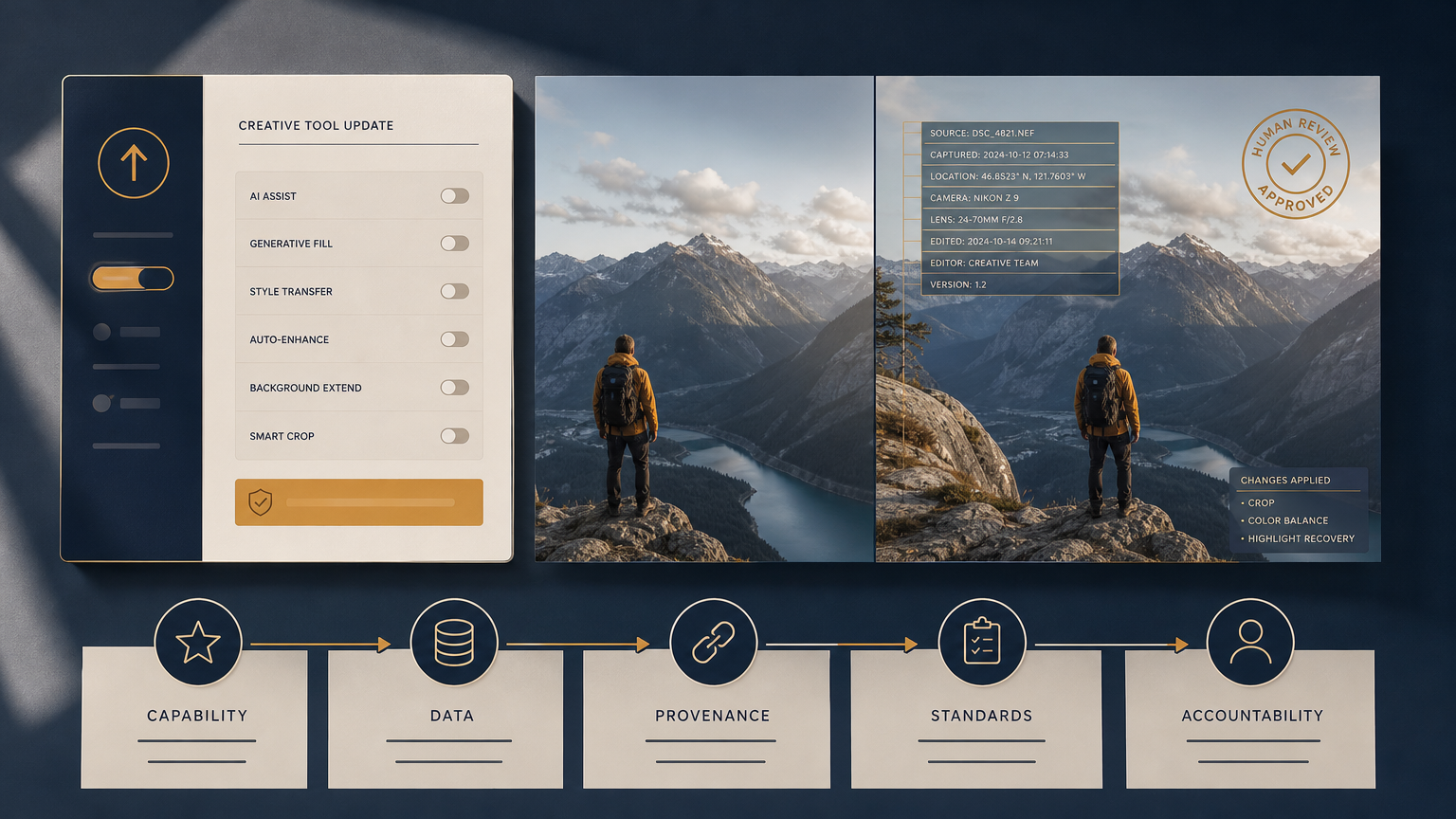
A capability is ready for production use when the organization can explain the following in plain language:
- Capability: What does it do within this workflow?
- Data: What inputs and outputs may be involved, and what handling requirements apply?
- Provenance: What history, records, labels, or disclosures are relevant?
- Standards: Which transformations and asset types are permitted?
- Accountability: Who has access, who approves the work, and how are exceptions handled?
If a material answer is missing, limit the capability to an approved lower-risk context while the organization decides how to address the gap. That is a measured response to uncertainty, not a blanket ban on innovation.
The next step for marketing leaders
Select one representative workflow: for example, a campaign image, a product visual, a social asset, or an agency handoff. Walk through the checklist with the people responsible for creative production, brand, security, legal, and content operations.
The resulting decision should be specific. It may permit certain uses, require review for others, restrict sensitive inputs, or identify areas where the organization needs clearer standards.
The central discipline is simple: assess the capability that touches the work, not just the name of the application. A well-governed creative operation can adopt useful tools while remaining able to explain how important content was made and why it was approved.