
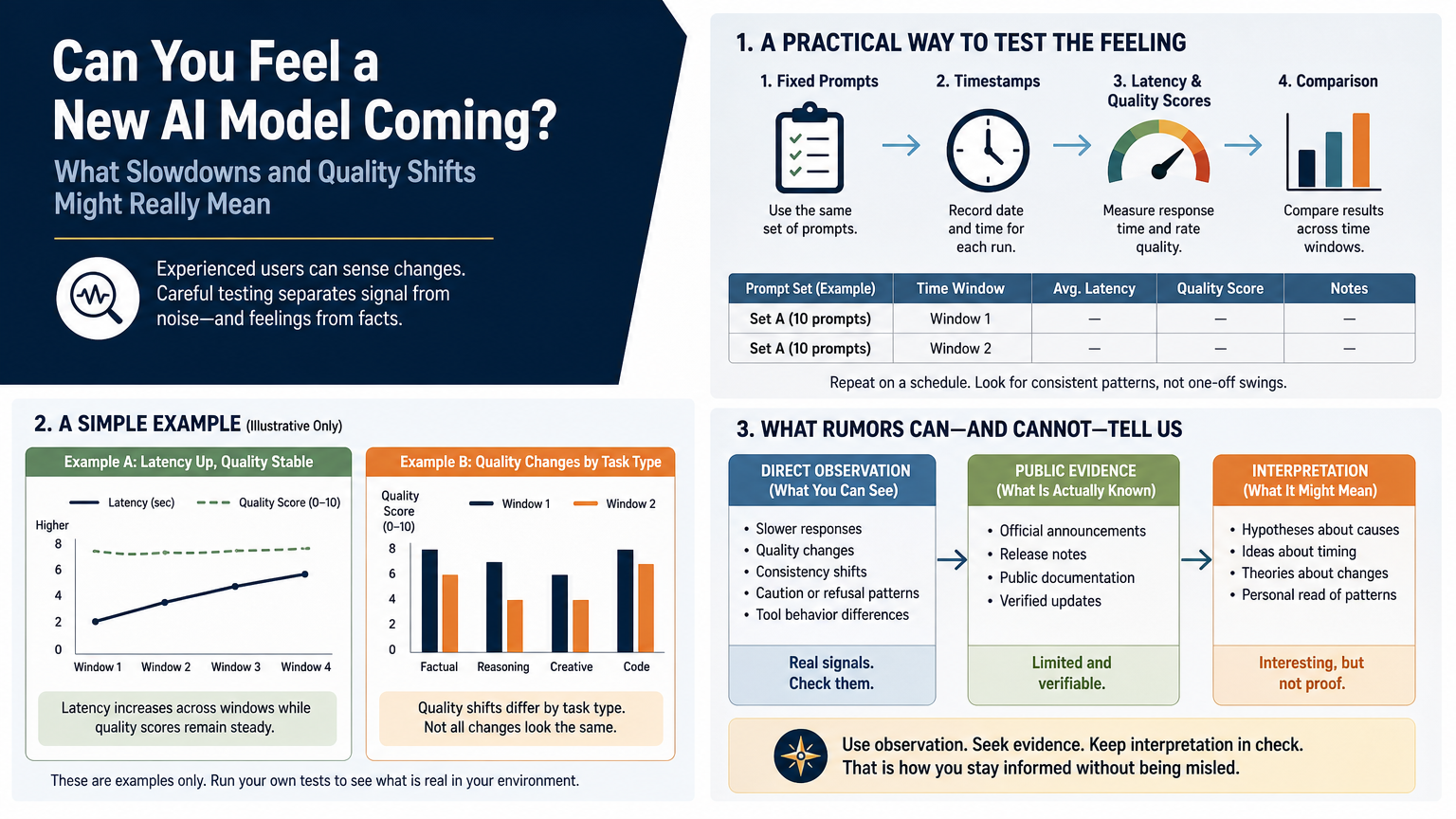
A heavy AI user can develop a surprisingly sensitive sense for how a model behaves. After thousands of hours with the same platform, small changes become noticeable: a response takes longer, an answer feels less precise, or the system seems more cautious and repetitive than usual.
That experience raises an intriguing question: can someone actually sense that a major model release is approaching?
The answer is more nuanced than either “you are imagining it” or “you have detected the launch schedule.” Experienced users may detect genuine changes in a system’s behavior. But the cause could be several layers below the model itself, and a perceived pattern is not evidence of an upcoming release without controlled observations or public confirmation.
What an experienced user may be detecting
The observation in this story is not simply that one answer was bad. It is a perceived change across repeated interactions: slower responses, weaker outputs, and a general sense that the platform is operating differently. That distinction matters.
Large AI products are not just a single model answering every request in a fixed environment. A user interacts with a service that may include model routing, capacity allocation, moderation and safety systems, retrieval or browsing tools, context management, interface changes, and experiments. A change in any of those layers can affect the experience.
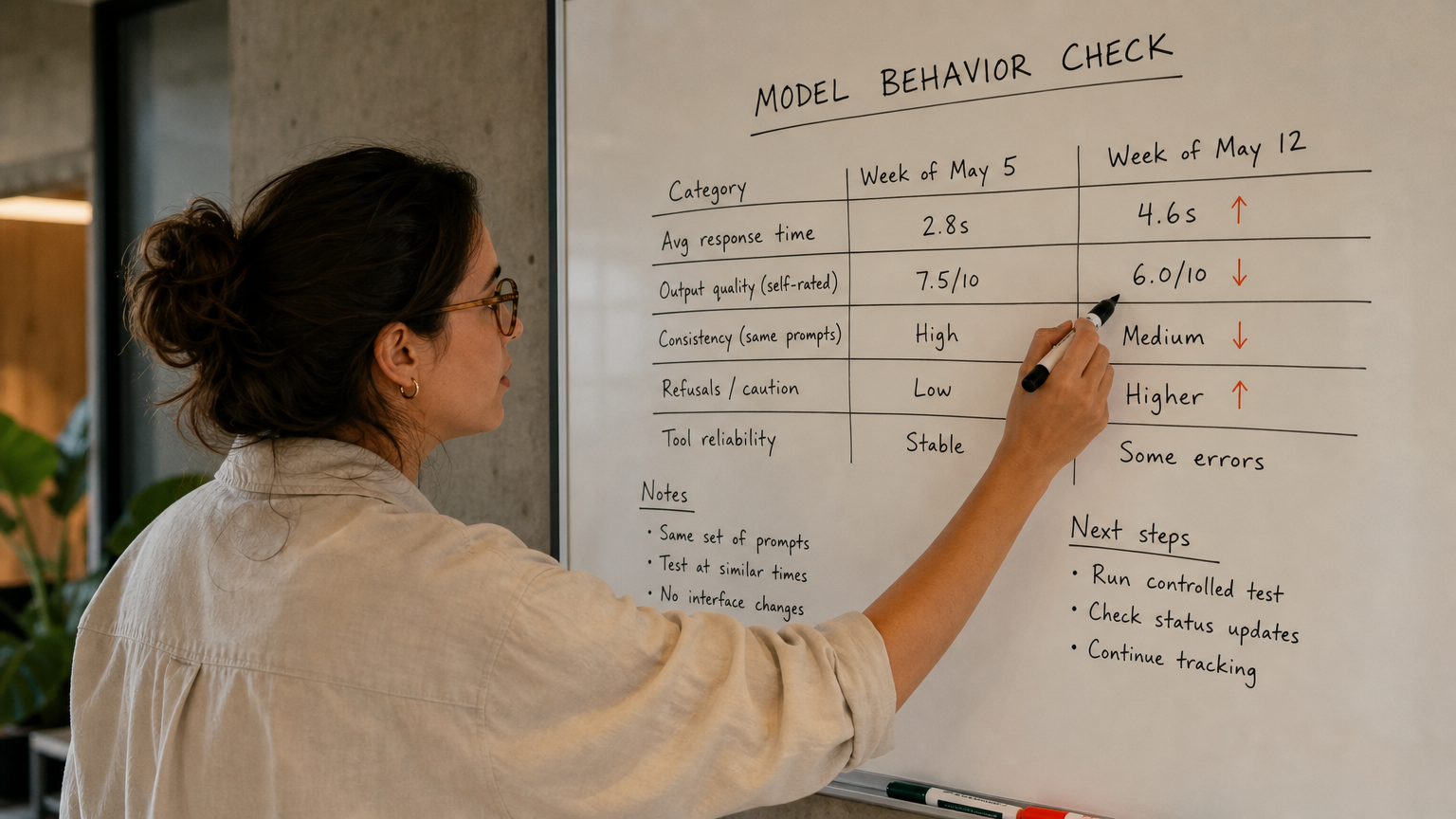
Several signals are especially noticeable to frequent users:
- Latency: how long the system takes to begin responding and to finish.
- Output quality: whether answers are accurate, coherent, and appropriately detailed.
- Consistency: whether similar prompts produce similar levels of performance.
- Refusal or caution patterns: whether the system handles borderline requests differently.
- Tool behavior: whether browsing, coding, file analysis, or other tools behave differently.
- Style: changes in verbosity, structure, hedging, or willingness to follow instructions.
An expert user’s intuition may be a form of informal pattern recognition. Familiarity creates a baseline. When the system departs from that baseline repeatedly, the departure can feel obvious even before the user can explain it.
That does not make the intuition supernatural. It makes it a hypothesis-generating signal.
Why a platform might feel slower or less capable
A perceived decline in performance can have multiple causes. Without internal telemetry, it is impossible to identify one with confidence, but the main possibilities are understandable.
Traffic and capacity changes
AI services experience changing demand. When more users are active, the platform may manage capacity in ways that affect latency, throughput, or the resources available to individual requests. The user may experience this as a slower or less responsive system even if the underlying model has not changed.
Routing between systems
A product may route requests across different model versions, serving configurations, or capacity pools. Routing can change for operational, product, or testing reasons. If two configurations behave differently, a frequent user might notice changes in tone, speed, or reasoning quality.
Experiments and staged changes
Software platforms often test changes with subsets of users or gradually introduce new behavior. Those changes might involve the model, system instructions, safety layers, interface, tools, or routing. A user who encounters several changes over time may interpret the combined effect as a single shift in the “intelligence” of the platform.
Context and prompt effects
The same model can perform differently depending on conversation length, attached files, instructions, tool calls, and the exact wording of a request. Long-running conversations can also accumulate context that changes later responses. A perceived system-wide decline may partly reflect changes in the user’s own workload or interaction style.
Safety and reliability adjustments
Changes intended to reduce harmful, incorrect, or overconfident outputs can alter how a system responds. A model may appear less capable when it becomes more cautious, more qualified, or less willing to complete a particular type of request. That may be a trade-off rather than a straightforward loss of intelligence.
Does a pre-release slowdown make sense?
It is plausible that platform changes around a major release could affect a user’s experience before the new model is publicly available. Preparing a release may involve capacity work, routing changes, evaluation, staged deployment, infrastructure adjustments, or experiments. But plausibility is not proof, and the exact operational sequence for any specific OpenAI release is not established by the supplied account.
There is also a risk of hindsight bias. If a user notices a rough period and later hears a rumor or sees a launch, the two events can feel connected. If the release does not happen, the earlier impression may receive less attention. This is why a personal “release radar” needs a record of predictions, not just memories of successful ones.
A more defensible claim would be:
“I noticed a repeated change in response behavior before a rumored release.”
A much stronger claim would be:
“The change proves that the company was preparing a new model.”
The first is an observation. The second requires evidence that is not available here.

A practical way to test the feeling
The most useful next step is to convert intuition into a lightweight measurement process. It does not need to be a scientific benchmark, but it should reduce the influence of memory and mood.
- Create a fixed prompt set. Use prompts that represent real work: summarization, coding, reasoning, editing, factual explanation, and instruction following.
- Record timestamps. Note the date, time, platform, selected model if visible, and whether tools or files were involved.
- Measure latency. Record both time to first token and total completion time when possible.
- Score outputs against a rubric. Track factual accuracy, completeness, instruction following, clarity, and unwanted filler.
- Repeat prompts. One poor answer is weak evidence. Repeated changes across comparable prompts are more informative.
- Separate model behavior from service behavior. A slow response may indicate infrastructure or traffic rather than lower reasoning quality.
- Log predictions before announcements. Write down what you think is happening and what would count as confirmation or disconfirmation.
This approach does not turn a user into an insider. It does make the observation more useful to developers, researchers, and other power users.
A simple example
Suppose a user runs ten fixed prompts each evening for three weeks. They record response time and score each answer from one to five for accuracy and instruction following. If latency rises while quality remains stable, capacity or routing becomes a plausible explanation. If quality changes only on tool-using tasks, the tool path deserves attention. If all categories shift at once, a broader service or model change becomes more plausible—but still not proven.
The key is comparison. “It feels worse” is valuable as an alert. “Here are 210 comparable observations showing when and how it changed” is valuable as evidence.
What rumors can—and cannot—tell us
Rumors may help explain why a user interprets a change as release-related, but they should not be treated as confirmation. In the supplied request, no verifiable rumor, announcement, date, benchmark, or public statement was provided. The article therefore cannot responsibly identify a specific upcoming OpenAI model or claim that a release is imminent.
For readers following model news, the safer distinction is between three categories:
- Direct observation: what changed in your own interactions.
- Public evidence: an official announcement, documented product change, or reproducible test.
- Interpretation: the theory that the change reflects preparation for a new release.
Keeping those categories separate preserves the interesting part of the theory without overstating it.
The deeper question: what does “feeling the model” mean?
The most interesting idea here may not be whether a user can predict a launch. It may be that long-term AI users build an operational relationship with a system. They learn its usual pacing, its common failure modes, its preferred answer structures, and the boundary between a strong response and a merely fluent one.
That familiarity has practical value. It can help someone notice regressions, identify unreliable outputs, and decide when to verify rather than trust. It can also create overconfidence: a familiar system may feel predictable even when hidden variables are changing.
The right stance is neither blind trust nor dismissal. Treat the feeling as an early-warning mechanism, then investigate it with repeatable prompts, timestamps, and public evidence.
For readers who have noticed similar shifts, share your observations on social media: what changed, when you noticed it, and how you separated latency, routing, tool behavior, and answer quality. If your team is trying to understand how AI systems behave in real workflows, explore the SimplSolutions product and schedule a demo to discuss the next step.