
The risk is not the draft. It is the institutional memory
Most content teams do not need to ban AI assistance. They need to prevent an unverified draft from quietly becoming an approved answer.
That distinction matters because a knowledge base is more than a collection of documents. It may become material that employees, customers, search systems, and future AI-assisted workflows rely on. Once an unsupported claim is accepted, copied, summarized, and reused, its original uncertainty can become harder to see.
The practical question is not simply, “Was AI used?” It is: What evidence and review does this material have before the organization treats it as true?
Start with evidence, not writing style
A polished sentence is not evidence. Neither is a citation that has not been checked, a confident tone, or an automated classification result.
AI-assisted content can be useful when it is grounded in identified material and reviewed for the purpose it will serve. It can also introduce unsupported wording, omit conditions, flatten important exceptions, or make a source appear to support more than it does.
That is why governance should focus on the admission decision: what must be known, checked, and approved before content becomes a source others can rely on?
Automated tools can help teams identify material for closer examination. They should not be the final basis for deciding who authored content, whether a claim is accurate, or whether a document is ready for operational use.
Record provenance before editing begins
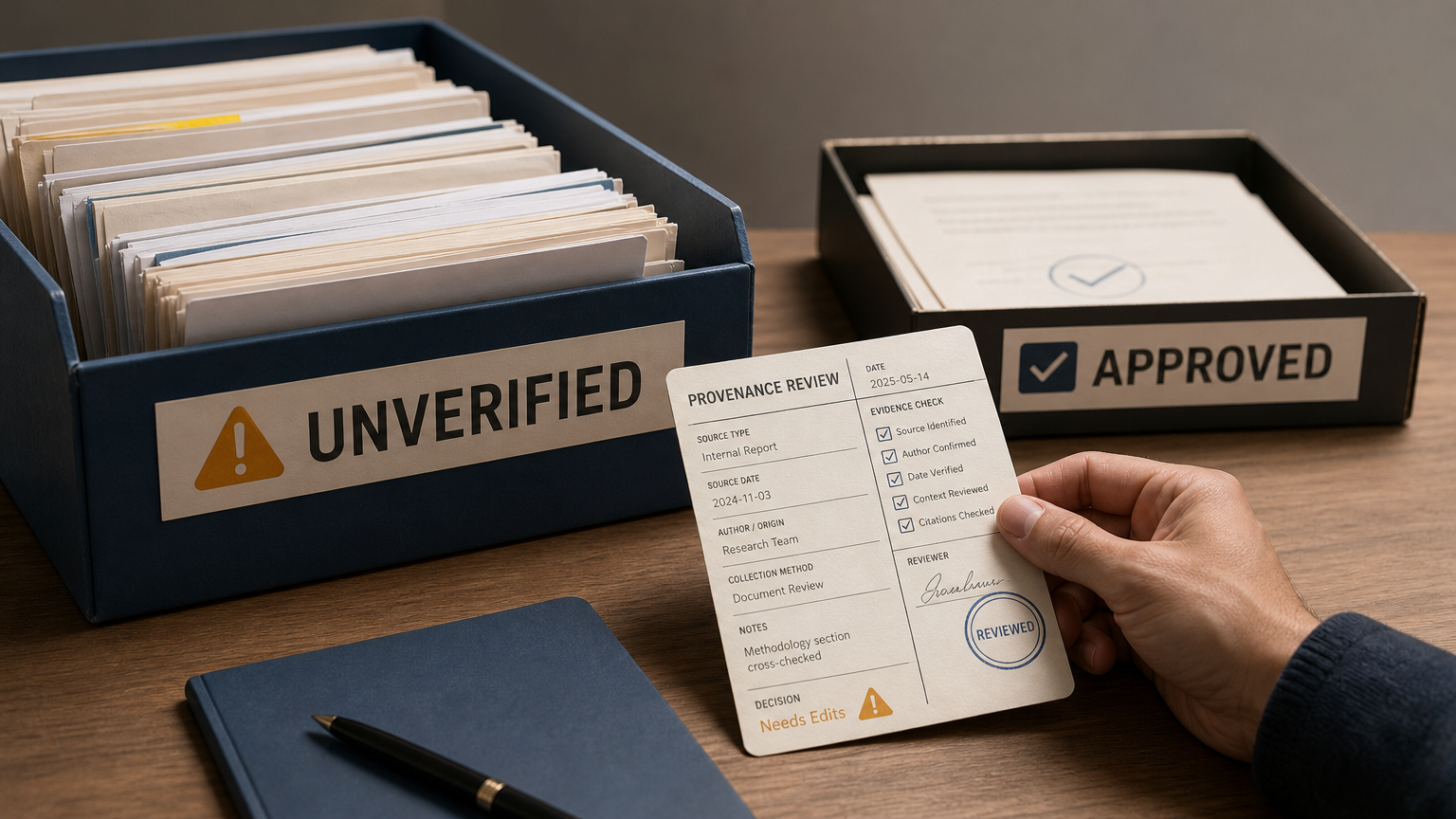
Each proposed knowledge-base entry can carry a concise provenance record. It need not expose private prompts or preserve every keystroke. Its purpose is to make reviewable facts visible:
- Who submitted the material?
- Was AI used for drafting, summarizing, translation, classification, or editing?
- Which source documents were consulted?
- What date and version apply to those sources?
- Who is accountable for approving the final text?
- What parts were independently checked?
The goal is not to stigmatize AI-assisted work. A well-researched draft and an unsupported generated draft may look similar on the page. Provenance gives reviewers a basis for distinguishing them.
Where provenance is unknown, teams can treat the material as unverified rather than automatically admitting it into approved knowledge.
Separate assistance from authorship
“AI-assisted” is too broad to guide review. A model used for spelling correction presents a different review question from one used to synthesize policy guidance or summarize a customer incident.
Organizations can use operational categories such as:
- Low-risk transformation: formatting, transcription, spelling, or tone edits that do not intentionally alter meaning.
- Supported drafting: prose prepared from identified source material, with material claims checked against those sources.
- Interpretive synthesis: comparison, summarization, recommendation, or explanation that requires judgment.
- New factual material: claims, procedures, policies, or decisions requiring appropriate authoritative support before approval.
These categories are adaptable considerations, not universal rules. Their value is in connecting the kind of assistance used to the depth of review needed.
A document should not receive a low-risk label merely because someone made minor edits after generation.
Verify claims, not just citations
A citation becomes useful evidence only when a reviewer checks the relationship between the source and the claim.
For each material assertion, ask:
- Does the source actually support this wording?
- Is the wording stronger than the available evidence?
- Has a date, condition, exception, or scope limitation been removed?
- Is the source appropriate for this question?
- Would another reviewer reasonably reach the same interpretation?
This review is particularly important for policy, legal, financial, security, health, and operational content. A plausible sentence with a valid-looking link may invite more trust than an obviously incomplete draft.
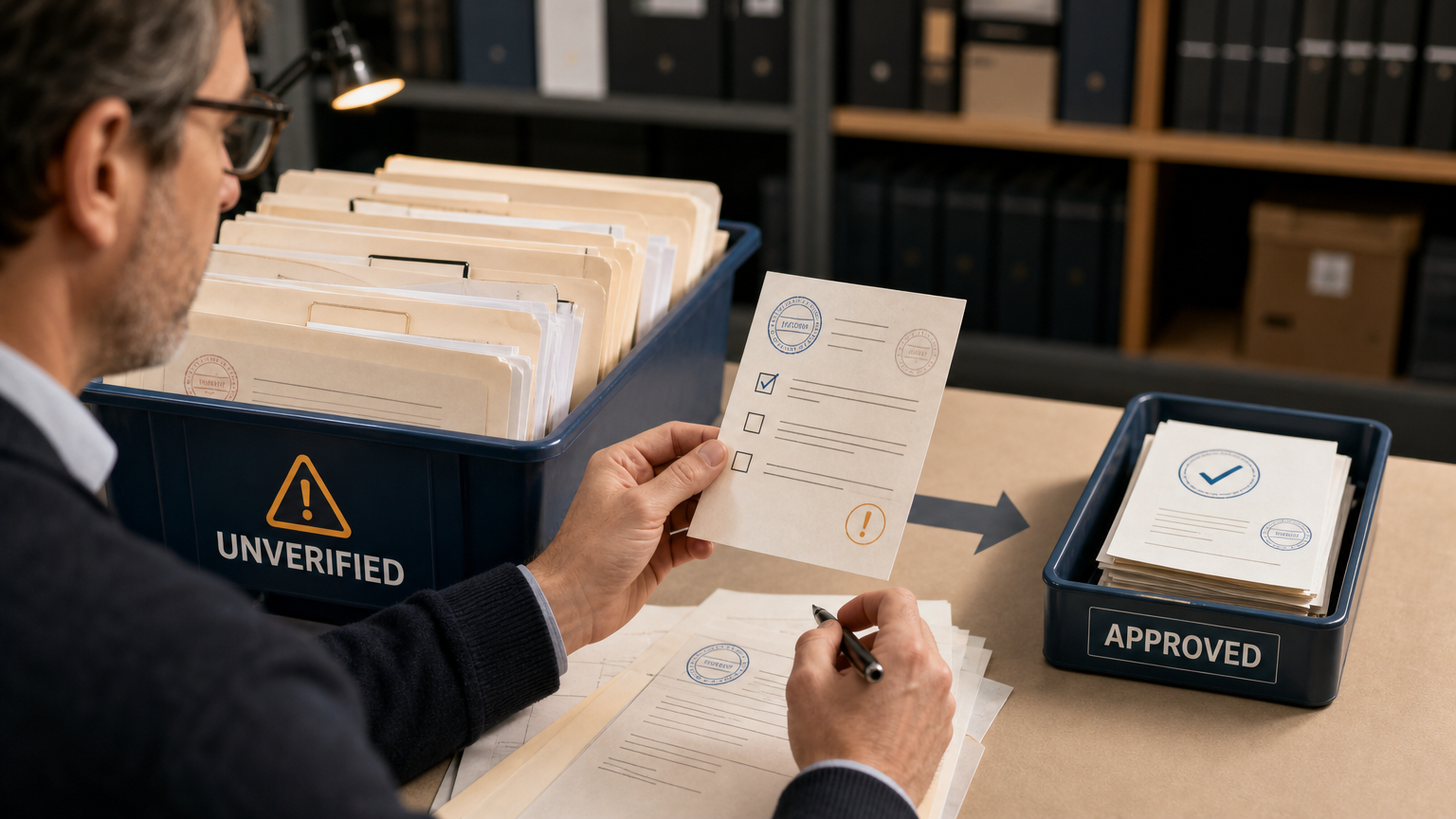
A useful review record can preserve the source location and the reviewer’s disposition: supported, revised, removed, or unresolved. “Citation present” is not, by itself, an adequate approval state.
Match approval to the consequences of error
Not every page needs the same process. A lightweight editorial correction need not receive the same review as a procedure affecting access, safety, compliance, or customer commitments.
A team might use three adaptable approval levels:
Low-risk content
A trained reviewer confirms that the text matches the identified source and does not introduce new commitments. The entry remains versioned and attributable.
Material business guidance
A subject-matter reviewer checks claims, scope, exceptions, and effective dates. The approver accepts responsibility for the final wording.
High-consequence content
The organization may require authoritative source ownership, independent review, explicit reassessment conditions, and a named business owner. If evidence is incomplete, the material can remain unpublished or clearly limited in its intended use.
The exact categories should reflect an organization’s context. The guiding principle is simple: review intensity should follow the cost of being wrong.

Use automated tools as triage, not a verdict
Automated detection and source-checking tools can be useful for prioritizing work. A suspicious pattern, a rapid submission, or repeated unsupported structure may tell a team where to look first.
But a tool result should not be treated as proof that a document was AI-generated, proof that it was not, or proof that its claims are accurate. A clean result does not replace source review, and a flagged result does not replace fair assessment by a qualified reviewer.
The approval question remains evidence-based: can the organization support the material claims and identify who reviewed them?
Make uncertainty visible after publication
Approval is not the end of governance. Knowledge-base entries benefit from a visible owner, review date, source version, and change history. Time-sensitive material can have a reassessment trigger rather than an assumption that it will remain current.
Teams may use statuses such as:
- Draft — not approved for operational reliance
- Reviewed — evidence checked on a stated date
- Approved — a named owner accepts responsibility
- Superseded — retained for history but not current guidance
- Under review — reliance is limited pending assessment
These labels can help prevent an old or uncertain answer from being rediscovered without the context that made it suitable—or unsuitable—for use.
What content teams can do next
Start with an inventory of where AI-assisted material can enter the process: briefs, support summaries, policy drafts, search indexes, meeting notes, and imported documentation. Then identify which destinations can influence decisions or be retrieved as authoritative answers.
For each path, define four things:
- The minimum provenance required.
- The claims that need source-level verification.
- The person or role accountable for approval.
- The event that triggers re-review, revision, or withdrawal.
Pilot the controls on a narrow but consequential collection rather than attempting to govern every document at once. The test is whether reviewers can understand why an item was approved, what supports it, and who should correct it when conditions change.
Takeaway
AI-assisted material should earn its place in an approved knowledge base. Record how it was produced, verify important claims against appropriate sources, scale review to business risk, and assign an accountable owner who can stand behind the final version.
A useful next step is to review one high-impact knowledge collection and ask of every entry: Could a new employee tell who verified this, what supports it, and when it should be checked again?