
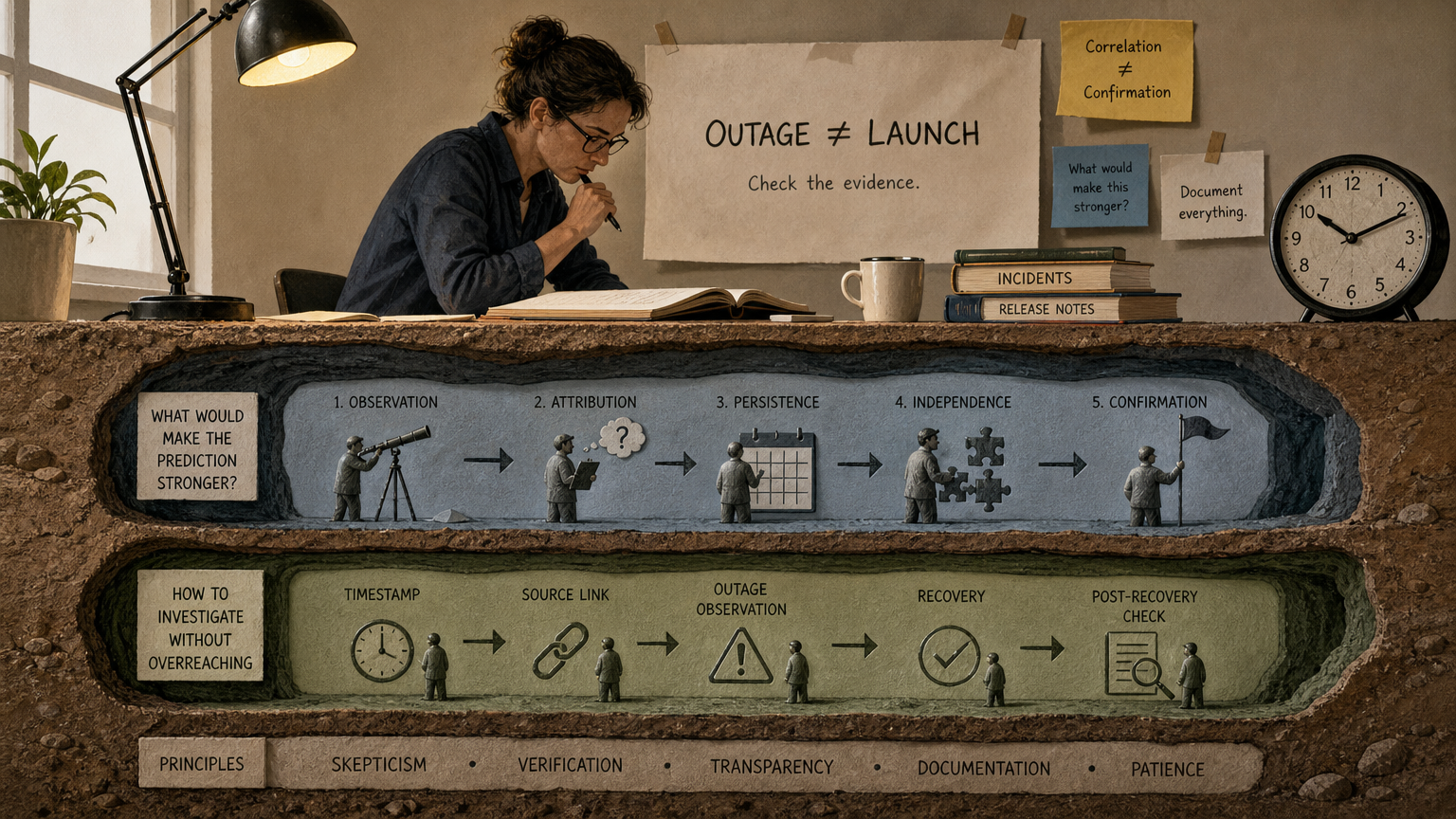
A major AI service going offline can feel like a signal. If the timing lines up with recent talk about a possible new model, it is natural to ask whether the disruption is connected to a launch.
But an outage is not, on its own, evidence that a new model is coming today. It is a clue worth monitoring—not a confirmation.
Why an outage creates launch speculation
AI products are unusually visible when they fail. A brief disruption can affect chat access, APIs, developer tools, and downstream applications at the same time. That makes an operational incident look larger than an ordinary website problem.
Timing also encourages pattern recognition. If users have been discussing a possible model release, a service interruption may appear to fit the theory. The theory could be right, but the same outage could also come from routine maintenance, an infrastructure fault, an authentication issue, a traffic surge, or an unsuccessful deployment.
The key distinction is between correlation and confirmation. An outage may happen near a launch without being caused by the launch, and a launch can occur without a public outage beforehand.
What would make the prediction stronger?
A credible prediction should be based on several independent signals rather than one dramatic event. Useful signals to check include:
- An official announcement from the company’s newsroom, blog, or verified social account.
- Changes to official model documentation, API references, pricing pages, or release notes.
- New model names or capabilities appearing in an authenticated product interface.
- Status-page updates that identify a deployment or configuration change as the cause of an incident.
- Independent testing that can reproduce a specific new model behavior, with clear timestamps and methods.
- Product changes that remain in place after service is restored.
Even these signals require care. Documentation can be updated before a public announcement, and interface changes can be experiments or limited tests. Strong evidence usually comes from multiple sources agreeing on the same explanation.
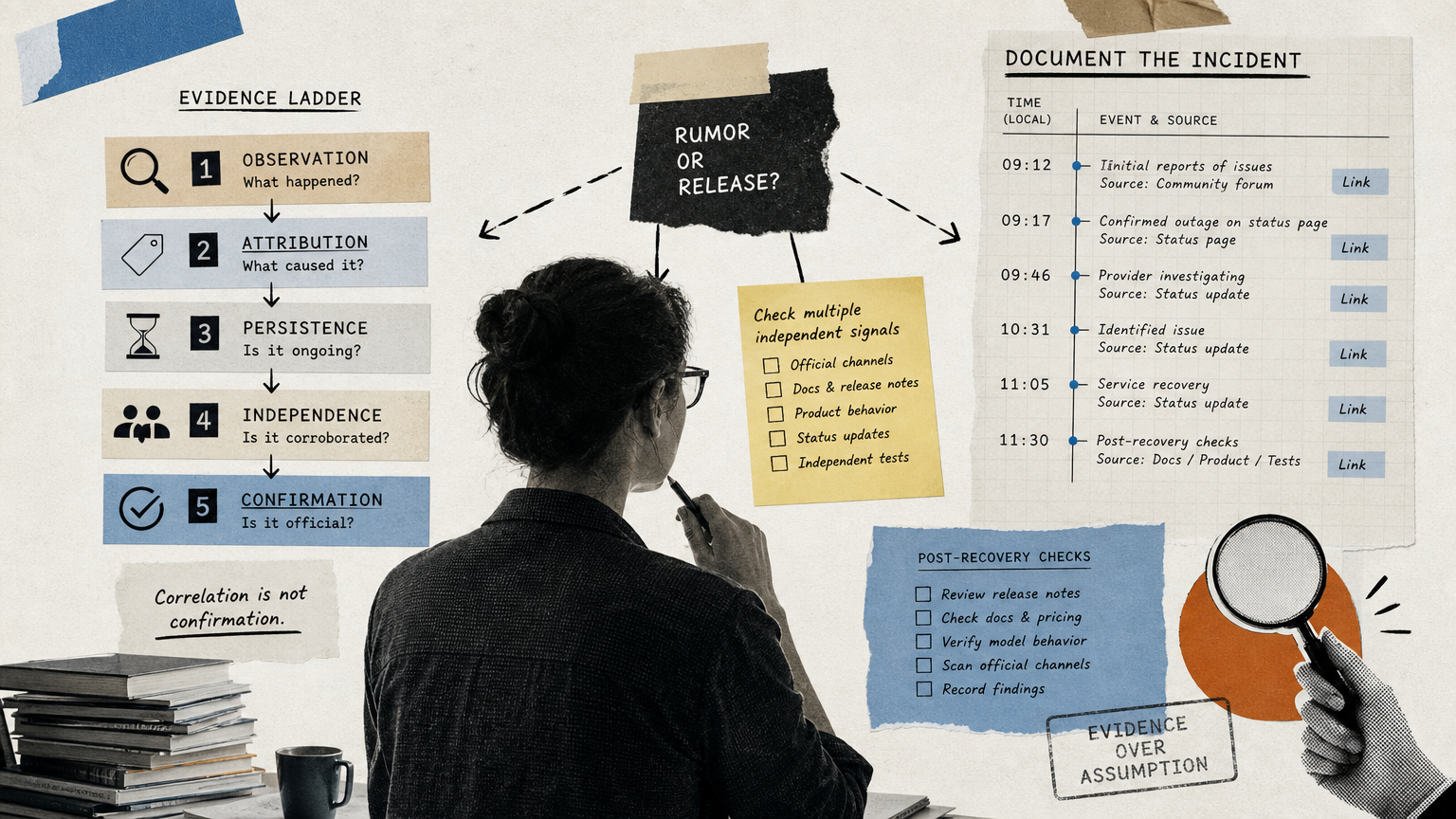
A practical evidence ladder
Use this order when evaluating a same-day model rumor:
- Observation: What can users actually verify? For example, a service is unavailable or a model selector has changed.
- Attribution: Has the provider explained the incident or change through an official channel?
- Persistence: Does the change remain after the outage ends?
- Independence: Are there separate sources showing the same development?
- Confirmation: Has the provider formally announced the model?
This keeps an exciting possibility from being presented as a fact before the evidence exists.
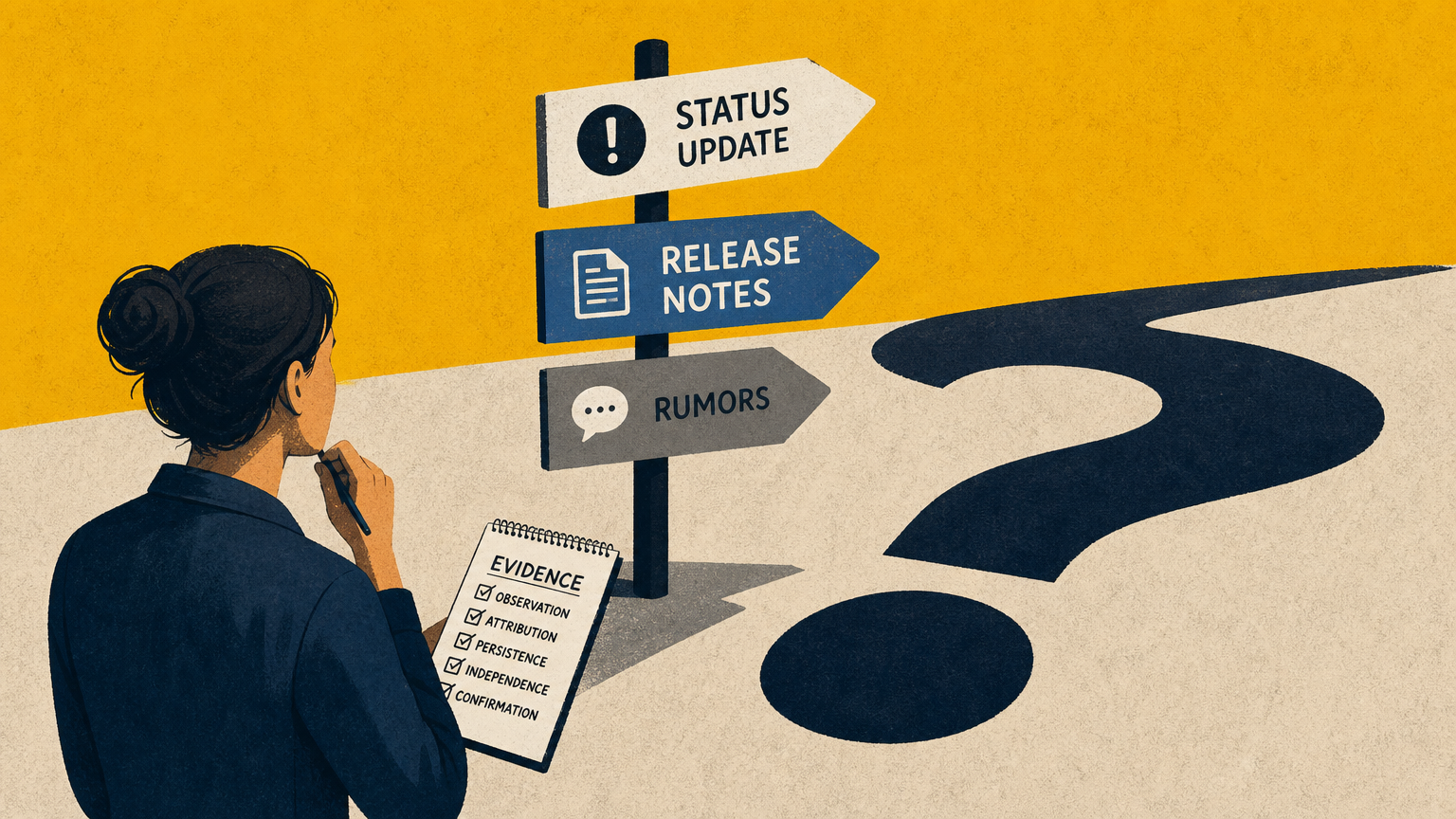
What we can responsibly say right now
The supplied context describes an apparent OpenAI service outage and a prediction that a new model may be released. It does not include a status-page link, timestamp, screenshot, official announcement, model documentation, or independently verified product change.
That means the strongest responsible conclusion is limited: a service disruption may prompt speculation about a new model, but there is not enough supplied evidence to confirm that a launch is happening today.
This is also why screenshots need context. A screenshot can show that a page or product behaved a certain way at a particular moment, but it cannot by itself establish the cause. A useful screenshot should include the time, relevant URL or product surface, visible error message, and enough surrounding context to distinguish an official status update from an individual account problem.
How to investigate the claim without overreaching
If you are checking the prediction in real time, use a simple record:
- Note the exact time and affected product or endpoint.
- Check the provider’s official status page and announcement channels.
- Compare access from more than one network or account where appropriate.
- Record whether the issue affects the website, API, mobile app, or a specific model.
- Recheck after the service recovers for persistent model or interface changes.
- Save source links and timestamps before publishing a conclusion.
Do not treat a status page that says “investigating” as confirmation of a release. Likewise, do not treat a temporary model-selection change as proof of a public launch unless the provider or reliable independent evidence supports that interpretation.
The prediction may still be worth making—if it is labeled as one
Predictions are part of technology commentary. A commentator can say that an outage appears consistent with a possible deployment or that a new model release is one plausible explanation. The editorial obligation is to label that statement as a prediction and explain what evidence would confirm or disprove it.
For Jason Sirotin’s perspective, the strongest angle is not to claim certainty or suggest that AI is literally inside his veins. It is to present the intensity of the conviction as a human reaction to a fast-moving technology cycle, while keeping the underlying claim testable.
If a new model is announced, the prediction can be revisited against the evidence: timing, official cause, product changes, and whether the outage was actually related. If no model appears, the same record can show why the original signal was insufficient.
The next step is straightforward: check official service updates and release channels, preserve dated evidence, and publish the prediction as a prediction until a verified announcement arrives.