
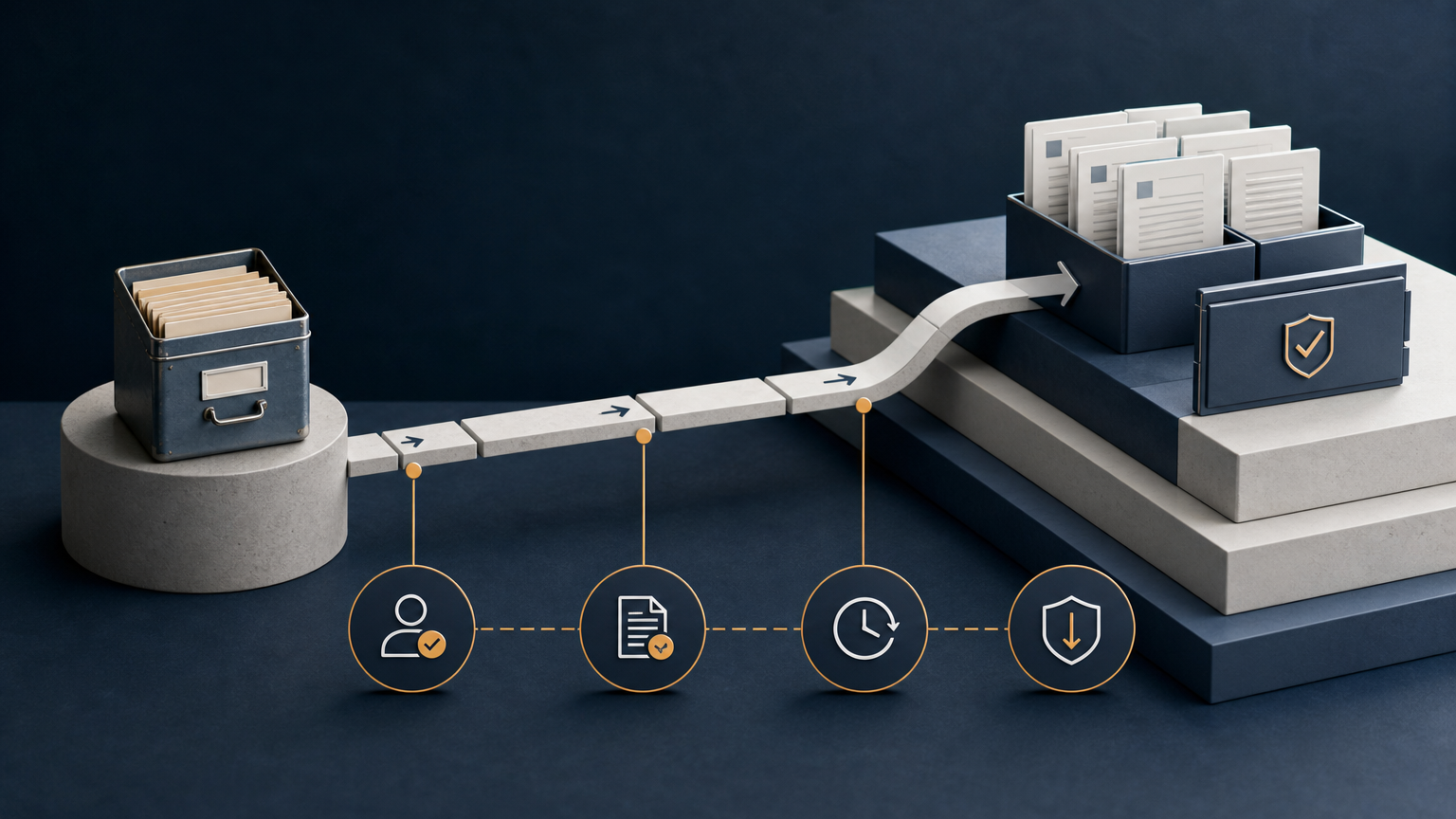
The real risk is not old technology. It is invisible dependency.
An aging workflow can look simple from the outside. It may rely on a dated interface, a manual handoff, or a storage method that no longer fits the organization’s operating environment.
But the visible technology is often only one part of the system. The workflow may also contain approval conventions, exception handling, records practices, escalation paths, and institutional knowledge that are not documented anywhere else.
That is why replacement projects can create operational gaps even when the new system works as designed. The technical migration succeeds, but a critical approval is no longer captured, an exception has no owner, or a historical record cannot be reconstructed.
Modernization is not complete when an obsolete component is removed. It is complete when the responsibility, evidence, and operating resilience around that component have been preserved.
Start with a control map, not a replacement shortlist
Before choosing a replacement, operators can document what the legacy workflow actually does.
A useful control map considers questions such as:
- Which decisions require approval?
- Who is authorized to approve them?
- What information should be available before approval?
- Which records demonstrate that a decision occurred?
- Where are exceptions recorded?
- What happens when an upstream system, person, or integration is unavailable?
- Which steps are formally documented, and which depend on experienced staff?
This exercise can reveal that the legacy system is not the whole workflow. It may be a record of activity, a routing mechanism, a source of historical evidence, or a forcing function that prevents a step from being skipped.
The replacement can therefore be evaluated against the control objective rather than against the old interface or technical mechanism.
Define what must not be lost
Modernization is easier to assess when an organization states its non-negotiables before implementation begins.
Depending on the workflow, these considerations may include:
- A complete record of who approved what and when
- Clear separation between preparation and authorization
- Retention of historical records in a usable form
- Traceability from an operational action to its supporting information
- Defined ownership for exceptions and overrides
- A way to continue essential work during an outage or migration issue
- A review path for disputed or incomplete records
These requirements are most useful when expressed in operational terms. “The new platform has audit logs” is less precise than “an authorized reviewer can reconstruct the decision, its inputs, and any exception handling.”
The distinction matters because a system can produce logs without producing meaningful accountability. Records may need to be complete, understandable, protected from inappropriate alteration, and available to those responsible for review.
Stage the migration around risk
A single cutover can appear faster, but it may be difficult to reverse when an overlooked dependency emerges after the old workflow is retired.
A staged approach can give operators opportunities to test the future process under realistic operating conditions. The exact sequence will vary, but a transition may separate:
- Discovery: Document the current workflow, dependencies, records, approvals, and exceptions.
- Control design: Define evidence, authorization, retention, and fallback needs for the future process.
- Limited operation: Test the workflow in a bounded context where issues can be detected and contained.
- Reconciliation: Compare outcomes and records between processes, with named owners for resolving differences.
- Progressive retirement: Remove legacy dependencies after agreed exit criteria have been met.
Running old and new processes in parallel can be useful for higher-consequence work, but it can also introduce duplication and reconciliation risk. If used, parallel operation benefits from a defined duration, a clear system of record, and explicit rules for resolving conflicts. Without those decisions, an organization may create two inconsistent versions of the truth.
Treat fallback procedures as part of the design
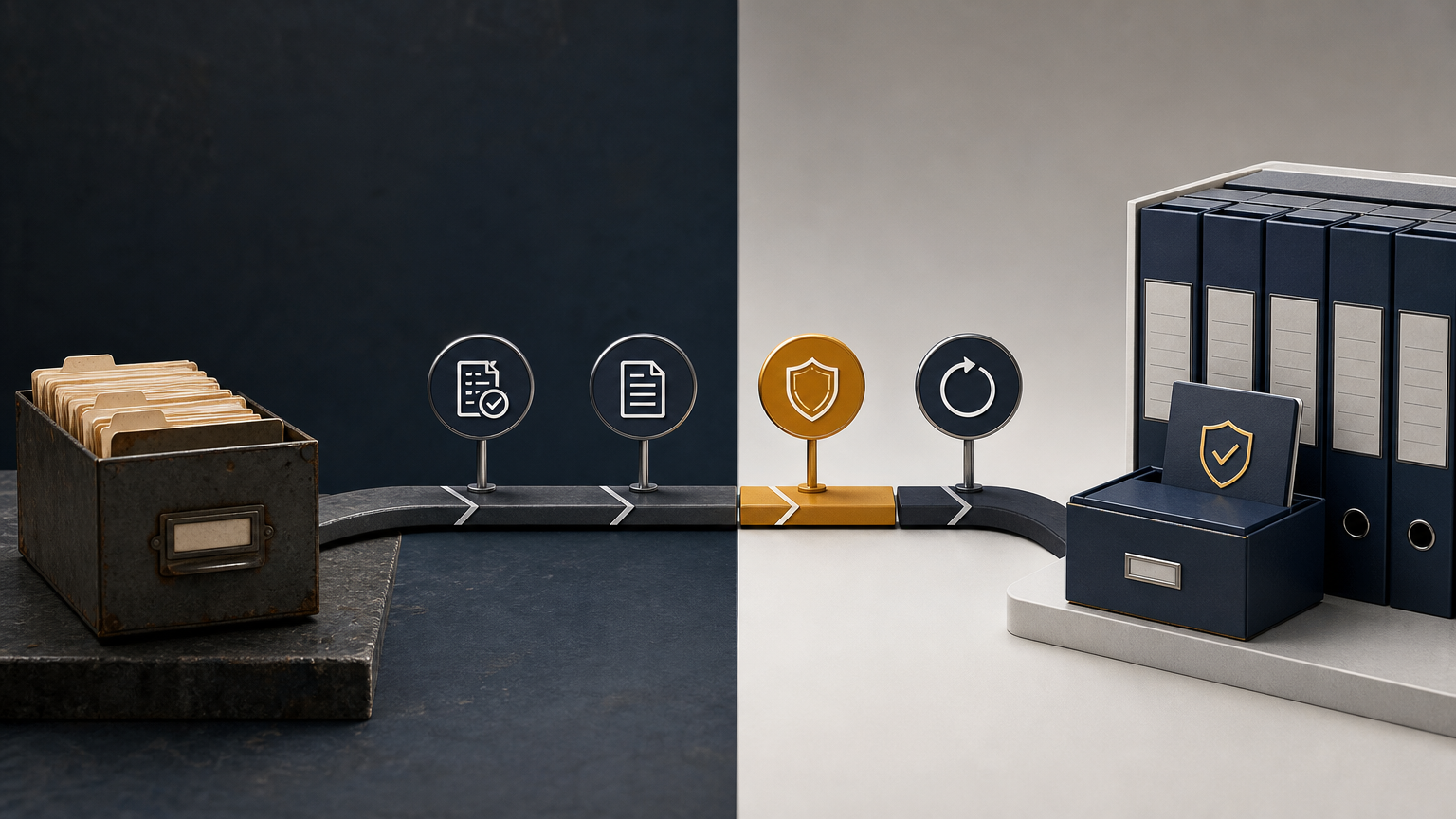
A fallback is more than an instruction to “use the old process if necessary.” A usable fallback can identify when it is triggered, who may declare it, what minimum records are captured, and how those records are reconciled after normal operations resume.
Depending on the workflow, the fallback may involve a temporary manual procedure, a retained legacy capability, or another approved operating method. The key consideration is that it is designed and exercised before the main system is retired.
Operators can also distinguish between a fallback that preserves service and one that preserves accountability. A manual workaround may keep work moving while losing approval evidence or creating duplicate records. Both continuity and control are worth testing.
Preserve knowledge before experienced people leave
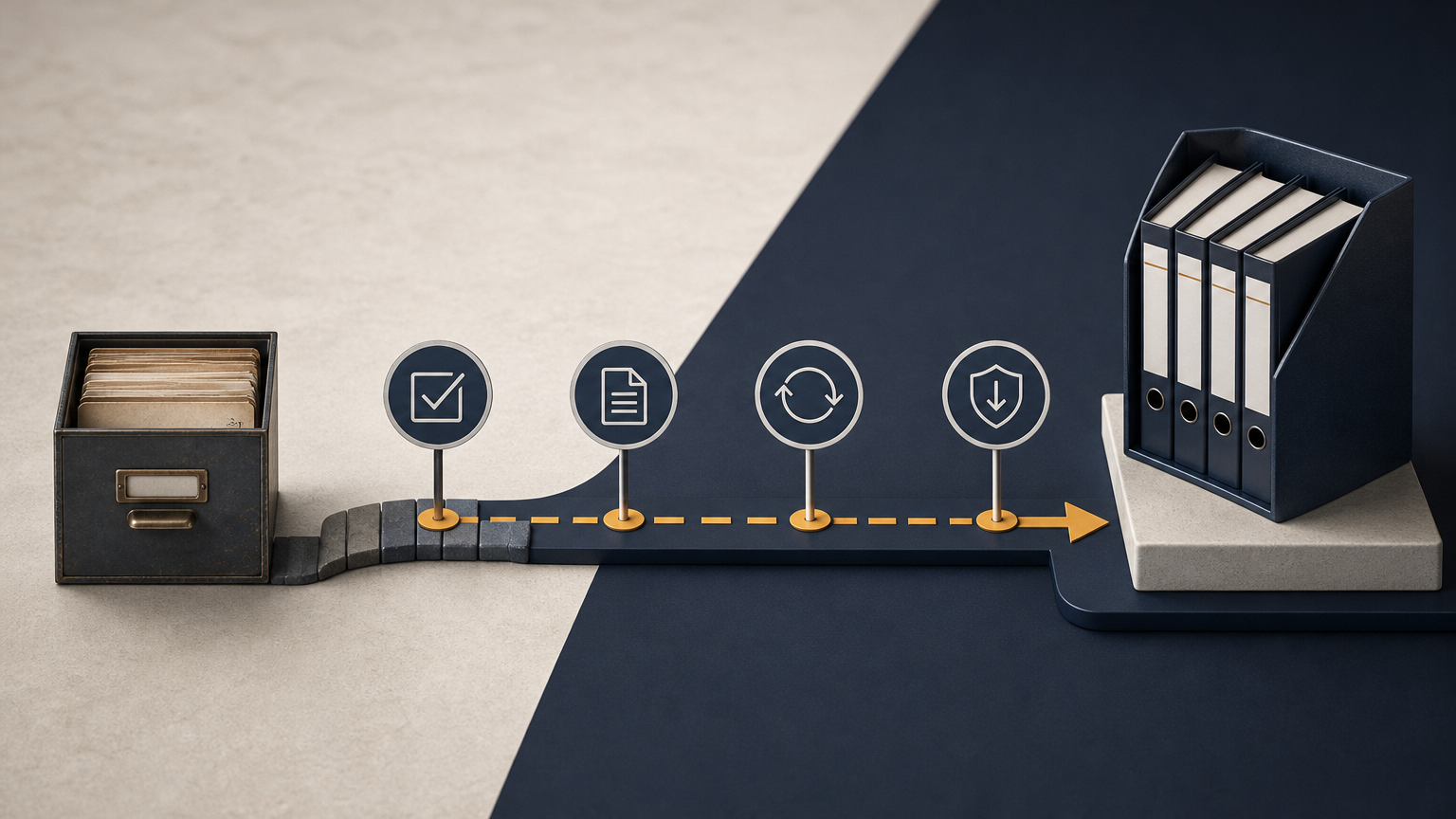
Legacy workflows often contain knowledge distributed across experienced operators rather than formal documentation. Staff may know which exceptions matter, which records are authoritative, and which apparently harmless shortcuts create downstream problems.
That knowledge can be captured as operating decisions and control requirements, not merely as screen-by-screen instructions. The question is not only “how did the old system work?” It is also “what failure was this step preventing?”
Structured interviews, exception reviews, record sampling, and scenario-based testing can reveal more than a feature comparison between products. The goal is to preserve judgment and accountability, not reproduce every artifact of the old system.
Set retirement criteria before the migration begins
A legacy system should not remain indefinitely because no one can agree that the transition is finished. Nor should it be retired only because a project deadline has arrived.
Define exit criteria in advance. Depending on the workflow, they may cover:
- Completion of required historical-record migration or access arrangements
- Successful reconstruction of representative decisions
- Validated approval and escalation paths
- Tested outage and fallback procedures
- Reconciled results from the transition period
- Prepared owners for normal operations and exceptions
- Clear support and accountability after retirement
The criteria can include evidence, not only declarations. A sign-off stating that users are trained is less informative than a demonstrated exercise in which relevant users complete an approval, handle an exception, and locate the resulting record.
What this means for operators
Modernization is a governance question as well as a technology question. The visible legacy component may be outdated, while the surrounding workflow remains operationally important.
For business and operations leaders, the practical question is not only what will replace the old system. It is what responsibilities, records, decisions, and fallback behaviors must survive the transition.
A useful next step is a disciplined review of one high-value legacy workflow: identify its control requirements, its hidden dependencies, and the conditions under which it can be changed without losing continuity or accountability.
The takeaway
Retiring obsolete technology is not the same as retiring the controls around it.
A thoughtful modernization effort maps hidden dependencies, defines the evidence that should survive, stages change according to risk, and tests human fallback procedures before the old workflow disappears. The best replacement is not simply the newest option. It is the one that helps the organization improve its operating model while retaining the ability to explain, approve, recover, and continue.