
OpenAI’s lower prices sound like an obvious win. If a model costs less to use, teams should be able to run more work for the same budget.
But price is only one part of the equation. If the cheaper path is slower, produces weaker results, or requires more retries, the practical cost may not have fallen at all. That is the concern behind this investigation: whether recent savings are being offset by changes in speed and output quality, particularly in coding workflows.
The available account is based on repeated operator observations rather than a controlled benchmark. That distinction matters. The observations are worth examining, but they do not yet prove that OpenAI intentionally reduced performance or designed pricing changes to push users toward a more expensive mode.
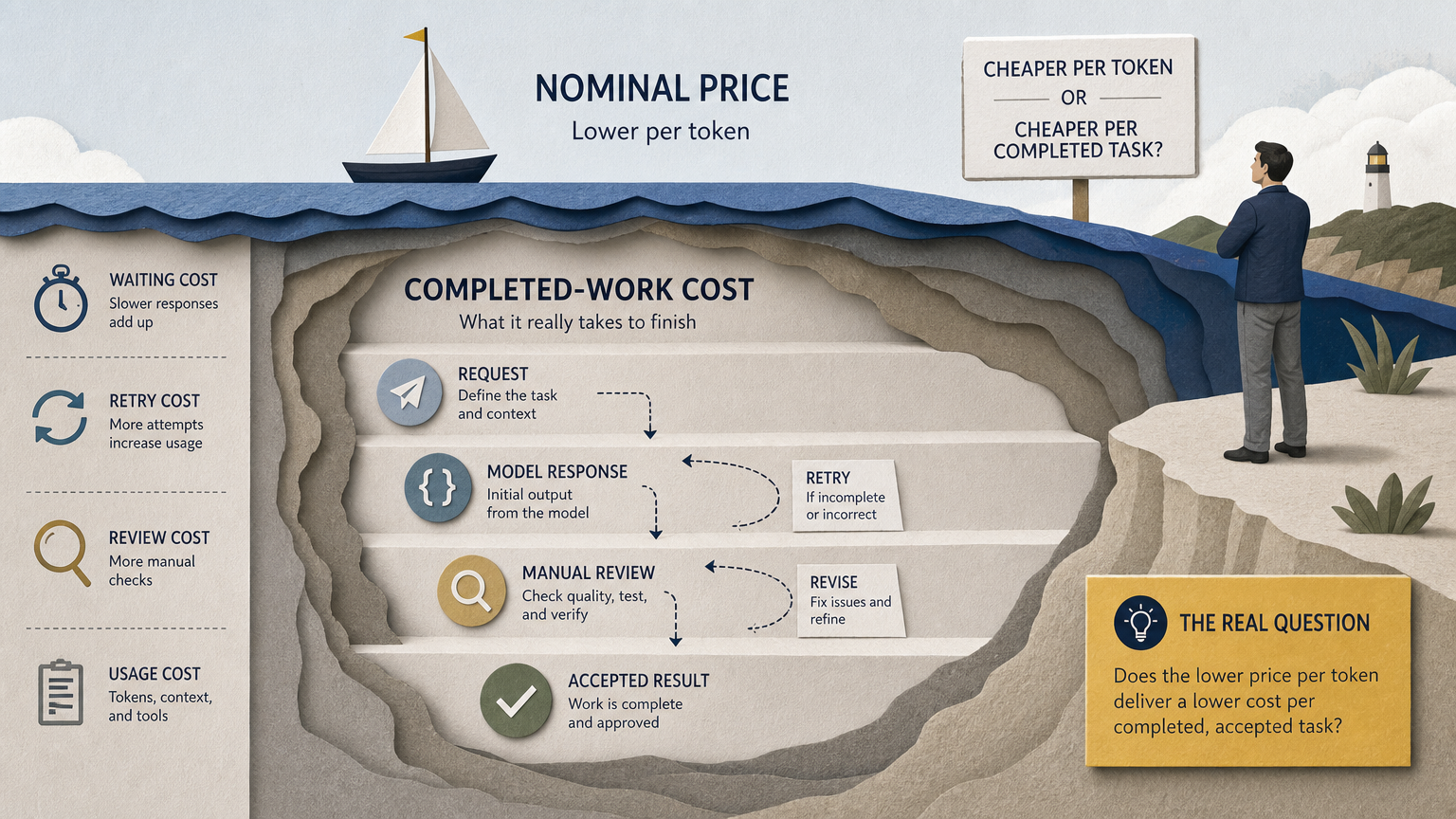
The central question: cheaper per token, or cheaper per completed task?
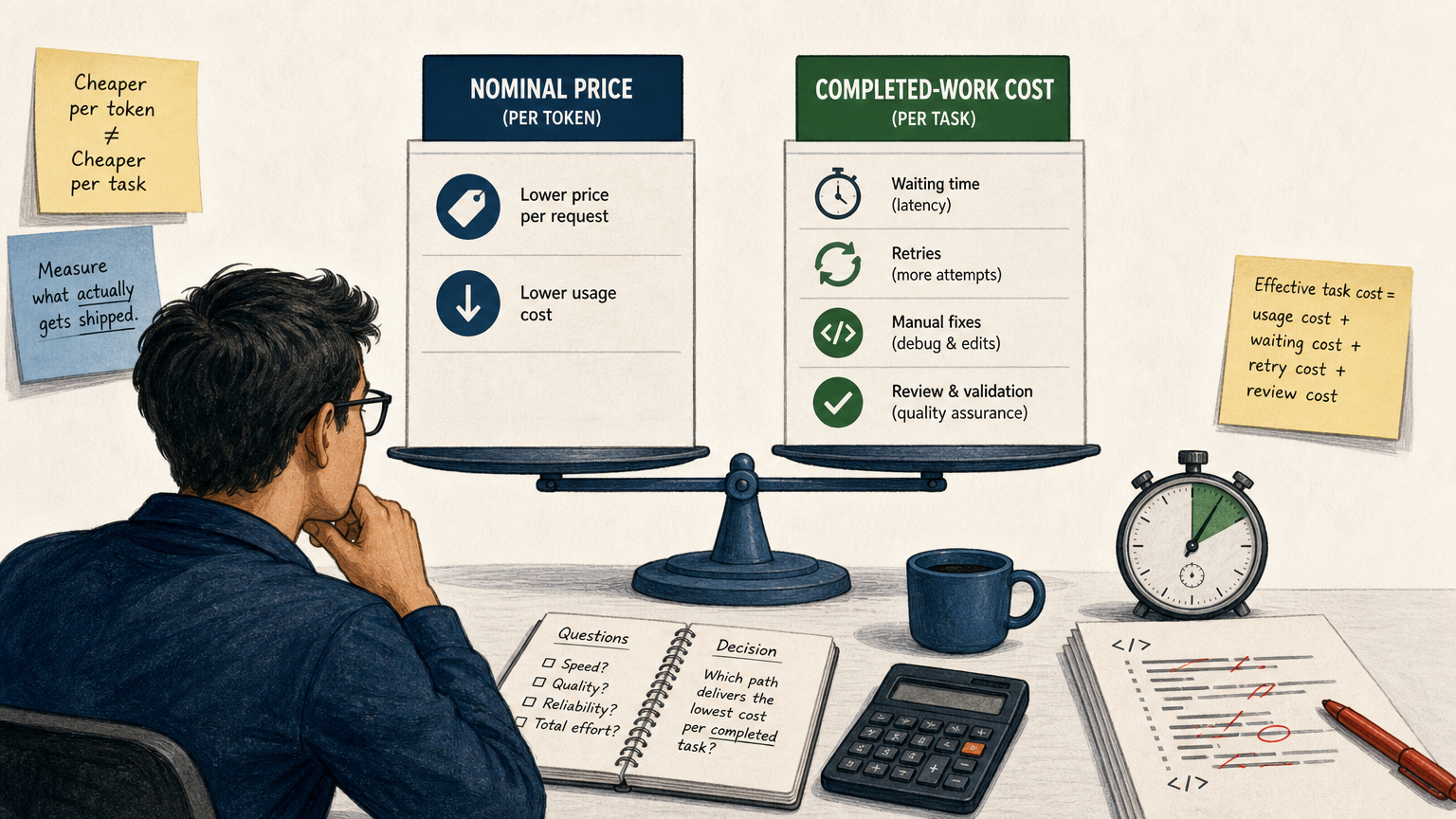
Model pricing is usually discussed in units such as input and output tokens. Buyers, however, pay for completed work. A coding task that costs less per request can still become more expensive if it takes longer, needs more context, fails more often, or requires several follow-up attempts.
A useful way to think about the issue is:
Effective task cost = usage cost + waiting cost + retry cost + review cost
The first term is the one most visible in a pricing announcement. The others are experienced by the person using the model.
Consider a simple example. A model produces a correct implementation in one pass, but a slower or less reliable workflow requires two additional prompts, manual debugging, and a final review. The nominal model price may be lower while the cost of finishing the task is higher. That does not mean the price cut is artificial; it means the headline price is not a complete measure of value.
This is the key test for the current concern. The question is not only whether a model became cheaper. It is whether the cost and time required to reach an acceptable result changed.
What users are reporting—and what that does not prove
The supplied editorial account describes two recurring impressions:
- Standard coding work appears to take roughly 50% longer than before.
- Output quality appears lower, with more work needed to reach the previous result.
It also raises a commercial concern: that users may feel pushed toward a higher-cost mode advertised or positioned as faster or more capable.
These are meaningful operator observations, especially when they come from many agent conversations and repeated workflow changes. But they remain observations until they are measured against a consistent baseline. Response time can change because of traffic, model routing, context size, tool use, rate limits, prompt structure, server conditions, or changes in the task itself. Quality can also appear to change when a coding project accumulates more files and instructions.
That does not dismiss the experience. It defines the work required to investigate it honestly.
How to test whether the trade-off is real
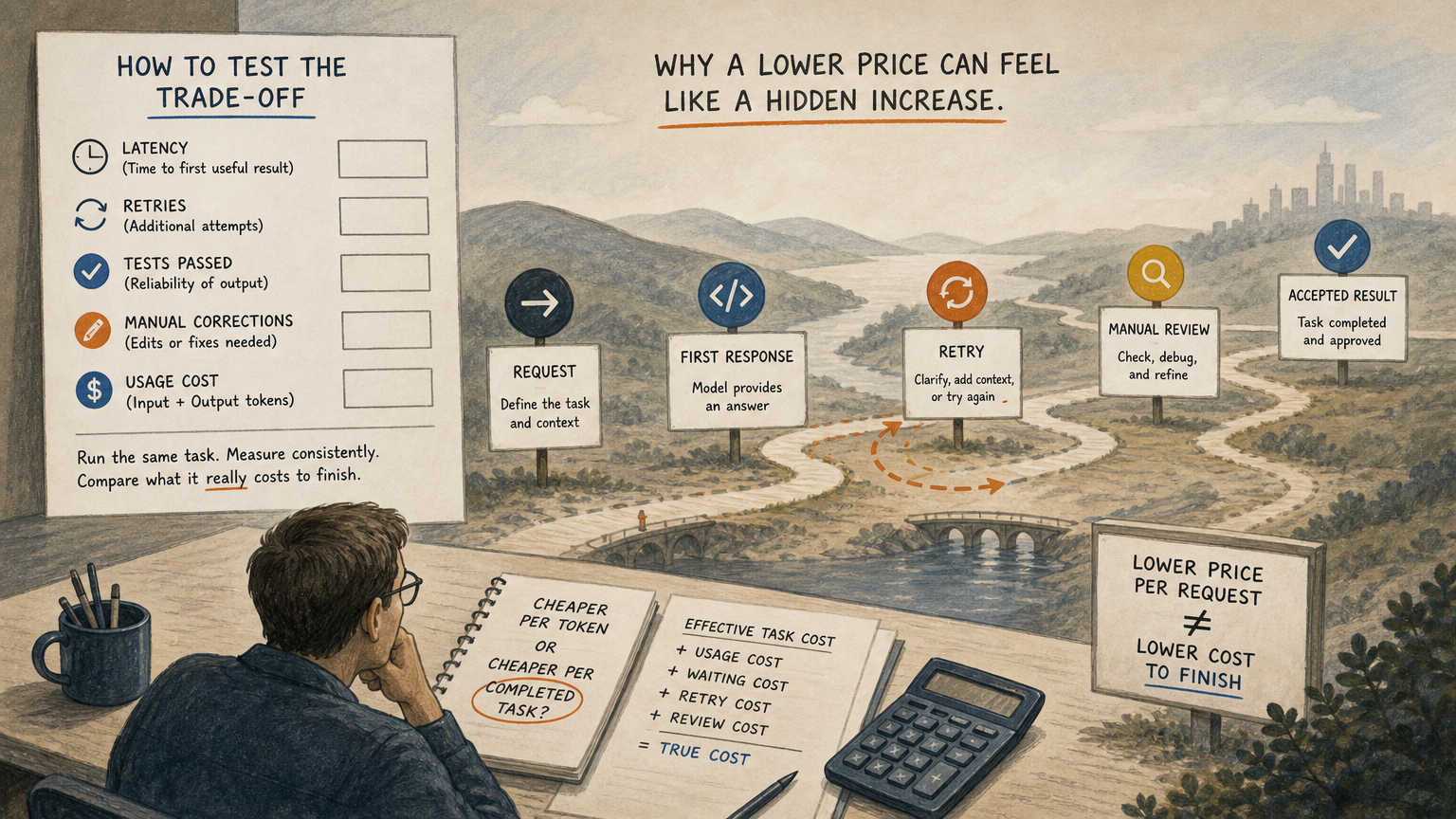
A credible comparison should hold as many variables constant as possible. Teams investigating a suspected change can record the following for the same class of tasks:
- Model and mode: Record the exact model, product surface, reasoning setting, and any coding-mode option.
- Prompt and context: Reuse the same prompt, repository snapshot, system instructions, and available tools.
- Latency: Measure time to first response and time to a usable completed result, not just the final server response.
- Quality: Score whether the code works, follows requirements, passes tests, and avoids regressions.
- Retries: Count follow-up prompts, corrections, rollbacks, and failed tool calls.
- Total cost: Include input and output usage where available, plus the cost of extra attempts.
- Date and conditions: Record when the task ran and whether the service appeared unusually busy.
A small test set is better than a vague impression, but a larger set is more persuasive. The comparison should include routine tasks and difficult tasks, because a model may behave differently on short edits, repository-wide changes, debugging, and architecture work.
The most useful result is not a single average. It is a distribution: how often the model succeeds on the first attempt, how long successful tasks take, and how often users must intervene.
A practical scorecard
For each task, a team could record:
| Measure | Why it matters | |---|---| | Time to first useful output | Captures perceived responsiveness | | Time to accepted solution | Captures the real workflow duration | | Number of retries | Shows whether lower quality raises usage | | Tests passed | Provides an objective coding signal | | Manual corrections | Captures hidden human effort | | Usage or request cost | Measures the advertised saving |
This scorecard will not identify the cause by itself. It can show whether the user experience changed and whether the change affects the economics of a real workflow.
Why a lower price can feel like a hidden increase
There are several possible explanations for the reported experience, and they should not be collapsed into one accusation.
One possibility is ordinary service variation. Latency may rise during periods of demand, or a product may route requests differently. Another is a model or configuration change that affects reasoning depth, tool behavior, or response length. A third is workload drift: coding tasks often become more complex as a project grows, even when the user feels that the workflow is unchanged.
There is also a product-design possibility. A provider may offer several modes that trade speed, capability, and price. If the less expensive mode becomes less effective for a particular task, users may rationally choose the more expensive option. That can feel like an artificial price cut if the lower price is paired with a deterioration in practical performance.
However, intent cannot be inferred from that pattern alone. Demonstrating a commercial strategy would require evidence such as documented product changes, consistent controlled results, or clear pricing and capability comparisons. Without that evidence, the responsible claim is narrower: some users may be experiencing a worse cost-to-completion relationship after the pricing change.
What would count as convincing evidence?
The strongest case would combine three kinds of evidence.
First, there would be a reliable before-and-after benchmark using the same tasks, prompts, model settings, and evaluation criteria. Second, there would be independent reports from multiple users showing a similar pattern across different accounts and workloads. Third, there would be a documented change in pricing, routing, model behavior, or product limits that plausibly explains the results.
Screenshots and anecdotes can help locate a problem, but they are weak evidence on their own. A useful report should include the model name, date, task type, response times, number of retries, and a redacted example of the quality issue. Private code, credentials, customer information, and other sensitive material should not be shared.
The distinction between price per request and cost per accepted result should remain central. If a cheaper model completes a task successfully with comparable speed and quality, the price cut is meaningful. If users need more attempts or must upgrade to preserve their workflow, the nominal saving may not reflect the actual value.
Our current assessment
Based on the supplied account, there is a credible question to investigate but not enough evidence to conclude that OpenAI deliberately created an artificial price reduction or degraded other models to force users into a 1.5x-cost mode.
The reported slowdown and quality decline should be treated as a testable operational signal. If repeated measurements show that standard coding workflows take longer, require more retries, and produce weaker accepted results while the higher-cost mode restores the previous experience, that would support the claim that users are facing a meaningful performance-price trade-off. It still would not, by itself, establish intent.
For now, the fairest position is skeptical rather than definitive: lower prices are valuable only when they reduce the cost of completing useful work. Users should measure the full workflow before deciding whether the saving is real.
If you are seeing the same pattern, share your experience with SimplSolutions through our social channels or contact us through the website. The most useful reports will include the model and mode used, the type of task, approximate response times, retries, and measurable quality differences—with private or sensitive information removed. A larger, better-documented set of observations can help distinguish a broad change from an isolated workflow issue.