
An answer layer is not a brand-new AI concept. It builds on a familiar pattern in software: preserve useful results so the system does not need to perform the same expensive work from scratch every time.
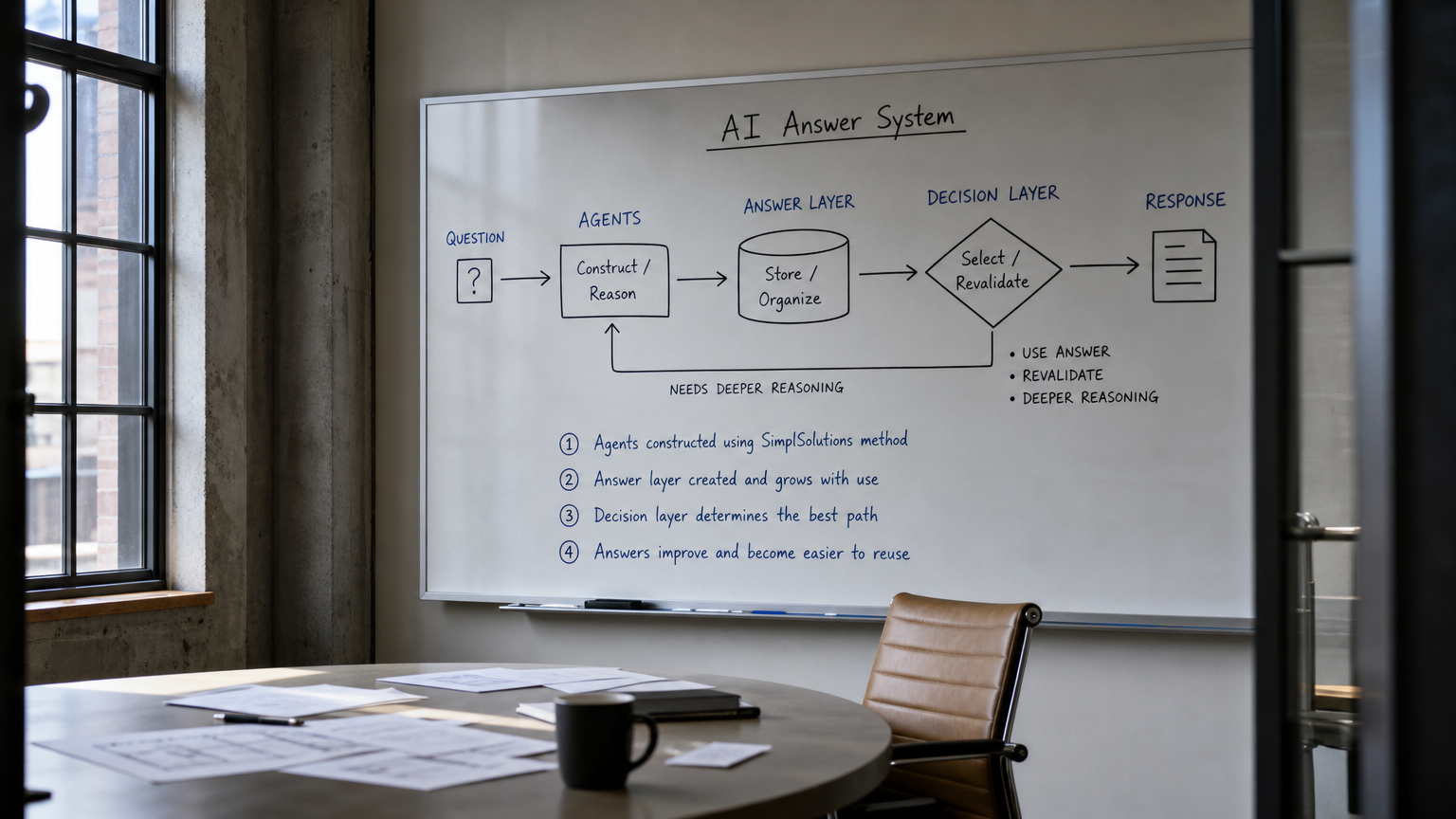
What is distinctive about the SimplSolutions approach is how the answer layer fits into an agent architecture. After agents are constructed using the SimplSolutions method, the system develops a substantial set of answers that can be read by a separate decision layer. When a question arrives, that decision layer helps determine whether an existing answer can be used, whether it should be revalidated, or whether the system needs to reason through the question more deeply.
The practical objective is straightforward: improve retrieval speed and reduce the cost of handling questions as the system is used.
A short history of the answer-layer idea
The underlying idea has existed in several forms for years. Search systems store indexes. Software applications use caches. Knowledge bases preserve resolved issues. Machine learning systems may retrieve relevant examples or documents before generating a response.
An AI answer layer applies a related principle to agent-based systems. Instead of treating every question as an entirely new reasoning task, the system can retain useful answers and make them available for future queries. This does not eliminate the need for retrieval, validation, or deeper reasoning. It changes how often those more intensive steps are required.
That distinction matters. An answer layer is not simply a transcript archive, and it should not be treated as a guarantee that every stored answer remains correct forever. Its value depends on how answers are created, organized, selected, and revalidated.
How the SimplSolutions answer layer works
The SimplSolutions model can be understood as a sequence of four stages:
- Construct the agents. Agents are created using the SimplSolutions proprietary method. The supplied direction does not specify the full construction process, so the method should be documented separately for technical review.
- Create the answer layer. As the system handles questions, useful answers are added to a persistent answer layer. Over time, this creates a growing body of available responses.
- Read the layer through a decision layer. When a new question arrives, the decision layer evaluates the available answer options and selects the best path. That may involve using an existing answer, revalidating it, or sending the question through a deeper reasoning process.
- Improve the path for future questions. When a question is new or complex, the first response may require more work. Once the answer is added to the layer, later similar questions do not necessarily require the same amount of reasoning.
This architecture separates two jobs that are often blended together: storing useful answer knowledge and deciding which answer or reasoning path should be used. That separation gives the system a clearer way to manage repeat questions without assuming that every prior answer is automatically correct.
Why retrieval can become faster
A first-time question may require the model to retrieve information, interpret context, reason through multiple possibilities, and compose a response. The supplied product direction describes this as the system needing to “think about” the question before producing an answer. For complex or previously unseen questions, that process can take longer than retrieving a response that has already been developed.
With an answer layer, a later question can follow a shorter path:
- identify a relevant prior answer;
- check whether it applies to the current question;
- revalidate the answer where necessary; and
- return the selected response.
The key word is revalidate. Faster retrieval should not mean blindly returning an old answer. Business information changes, user intent varies, and similar questions can have different requirements. The decision layer still needs a way to determine whether an existing answer is appropriate.
The result is an architecture designed to become more efficient as it encounters recurring questions. The benefit will vary by workload, question complexity, answer quality, and the rules used for validation.

Why the cost may decrease over time
Deep reasoning and repeated retrieval can consume more compute than selecting and validating a relevant stored answer. If a system repeatedly receives similar questions, performing the full process every time may be unnecessary.
The SimplSolutions answer layer is intended to reduce that repetition. The first response to a new question may require more work. After the answer is added to the layer, subsequent questions can use the prior result as a starting point. In this model, the system’s accumulated answer knowledge becomes an operational asset rather than a passive record.
This creates a simple cost curve to measure:
| Stage | Typical system behavior | Measurement to validate | |---|---|---| | First occurrence | Deeper retrieval and reasoning may be required | Response time and compute cost for new questions | | Repeated occurrence | Stored answer may be retrieved and revalidated | Response time and cost for similar questions | | Ongoing use | The answer layer grows with additional resolved questions | Cost and latency trend by question category |
The important qualification is that a larger answer layer is not automatically better. Poor answers, outdated information, or weak selection rules can reduce quality even if retrieval is fast. Any production deployment should therefore track both efficiency and answer quality.

A worked example: a recurring operations question
Imagine an internal business agent receives a question about a recurring operating process. The first version of that question may require the system to find the relevant information, interpret the user’s context, and assemble an answer. If the question is complex or has not appeared before, the process may take longer.
The answer is then added to the answer layer. When another employee asks a closely related question, the decision layer can compare the new request with the stored answer. If the context is consistent, the system may retrieve and revalidate the existing answer instead of rebuilding the response from the beginning.
If the second question introduces a changed policy or a different business unit, the decision layer should recognize that the earlier answer may not be sufficient. The system can then return to deeper retrieval or reasoning. This example illustrates the intended balance: reuse where the answer is applicable, and deeper work where the context has changed.
What architects and executives should evaluate
The answer layer should be assessed as part of a complete system, not as an isolated feature. A technical evaluation should ask:
- How are answers represented and indexed?
- What determines whether two questions are similar enough to reuse an answer?
- Which answers require mandatory revalidation?
- How are outdated or incorrect answers removed?
- How does the decision layer handle conflicting answers?
- What are the measured latency and cost differences between first-time and repeated questions?
- How are quality, accuracy, and user satisfaction tracked alongside speed?
For developers, these questions define the interfaces between agents, retrieval, answer storage, and decision logic. For marketers and business leaders, they help translate an architectural claim into measurable operational outcomes. For private equity firms evaluating an AI-enabled business, they also provide a basis for examining whether efficiency improves with usage and whether that improvement can be demonstrated with production data.
The next step: measure the system over time
The core promise of the SimplSolutions answer layer is cumulative: as the system answers more questions, it can build a reusable body of validated responses. That body of answers is intended to help the system respond faster and use fewer resources for recurring work.
The right next step is a workload-specific demonstration. If your business is looking for complete AI solutions to help run operations more efficiently and effectively, contact SimplSolutions for a demo. Ask to see how the answer layer, agents, and decision layer work together on the types of questions your organization handles most often.