
A number is not evidence by itself
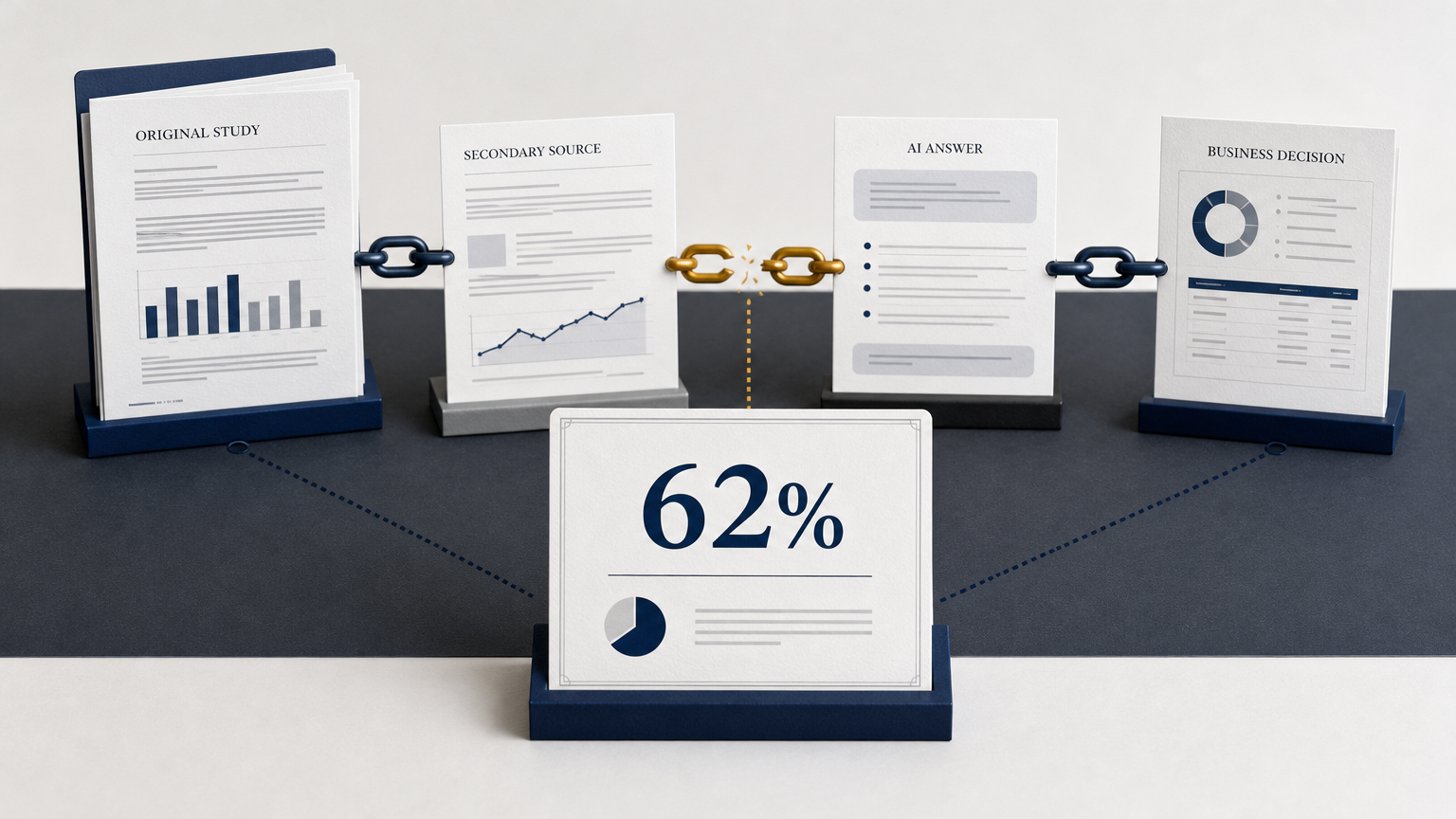
AI tools can help people find candidate statistics quickly. But a precise number, confident wording, or a nearby link does not by itself show that the number is appropriate for a business decision.
The practical question is: Can a reviewer find an accessible source that supports this exact claim in the context in which the business intends to use it?
A figure may have been copied, summarized, rounded, or applied to a different audience as it moved between documents. The number can remain familiar while important details disappear: who was measured, when the measurement occurred, what a key term meant, and how the figure was produced.
That creates a provenance problem. A team may inherit a number as a fact when it is actually an unreviewed claim.
For lower-stakes brainstorming, a rough figure may simply be a prompt for further research. For planning, forecasts, public communications, customer materials, financial commitments, employment decisions, or other consequential uses, the review should be proportionate to the potential impact.
Separate discovery from approval
AI is useful for discovery. It can suggest questions, locate possible sources, summarize long material, and flag terms that may need comparison. Those are different activities from approving a statistic for operational use.
A cautious workflow creates a boundary between the two:
- Discover: Capture the AI-generated claim without treating it as confirmed.
- Trace: Locate the best available underlying source rather than stopping at a summary or repost.
- Compare: Check whether the source supports the same claim and context.
- Record: Preserve enough detail for another reviewer to understand the decision.
- Decide: Approve, qualify, defer, or reject the statistic for the proposed use.
This boundary helps prevent an answer generated for exploration from quietly becoming an input to a dashboard, forecast, presentation, or customer message.
It also makes ownership clearer. Someone should be able to answer who reviewed a material number, what they reviewed, and why the team considered it suitable—or unsuitable—for its intended use.
Build a provenance record
A bare citation is often not enough for a consequential claim. A provenance record gives the team a compact way to preserve what the number means and where it came from.
Consider recording the following fields:
- Exact claim: Preserve the wording, value, unit, denominator, and qualifiers.
- Source: Identify the most direct source available, such as a study, dataset, filing, survey documentation, or official publication.
- Supporting location: Note the page, table, passage, or dataset field that supports the claim.
- Population and scope: Record who or what was measured, where, and under what conditions.
- Time: Separate the publication date, measurement period, and date the source was retrieved.
- Method: Capture the collection approach, sample information, definitions, and stated limitations relevant to interpretation.
- Transformation: Explain any calculation, rounding, comparison, extrapolation, or forecast applied after retrieval.
- Review status: Mark the claim as verified, qualified, indirect, unverified, or rejected.
The record can be lightweight. Its depth should reflect the decision at stake. The goal is not paperwork for its own sake; it is making the evidence and uncertainty inspectable.
Compare the claim with its source
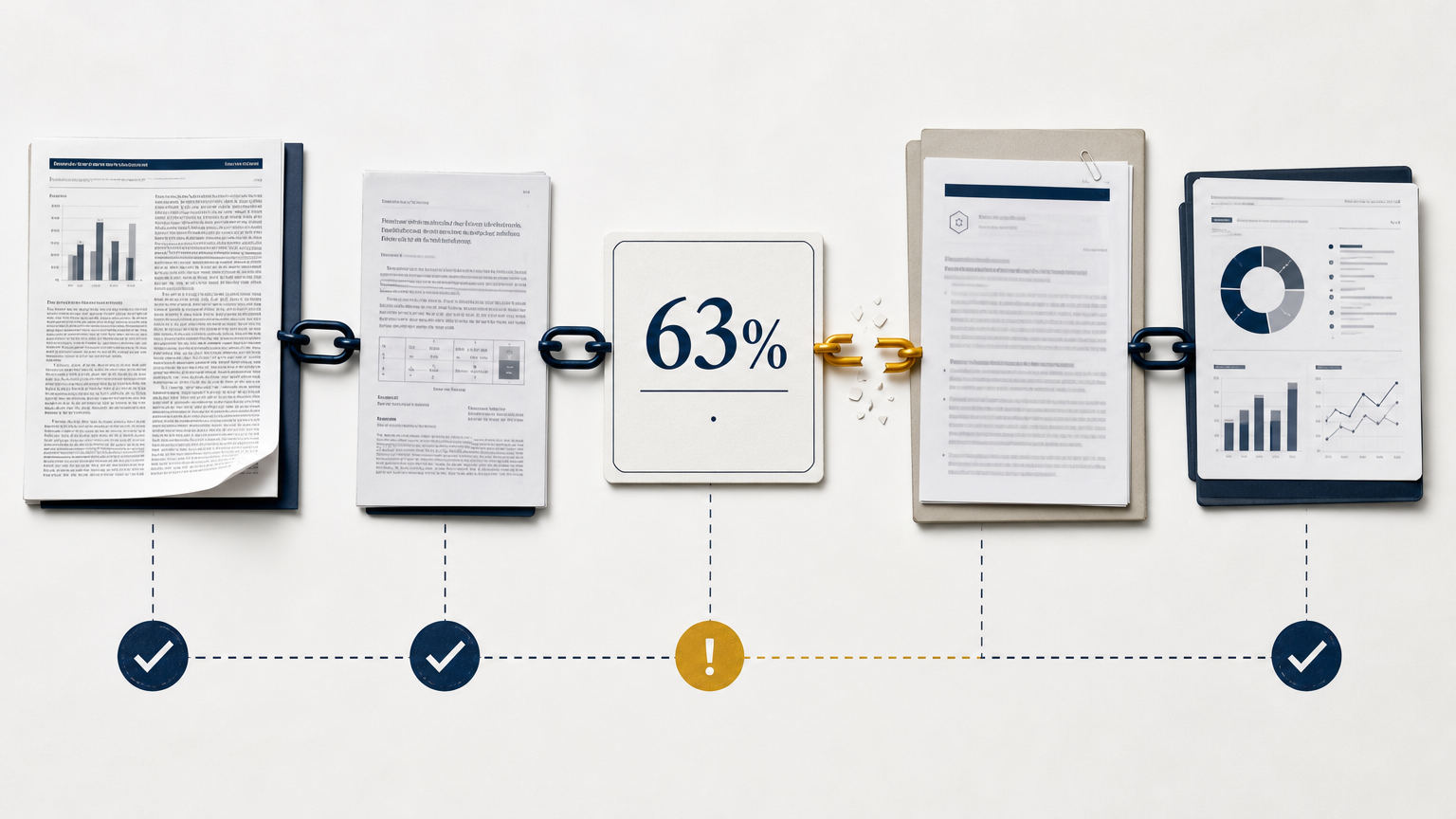
A source can be real and still fail to support the sentence built around it. Reviewers can compare the AI-generated wording with the source across five common points of drift:
- Number: Is the value, unit, rounding, and denominator the same?
- Population: Does the source cover the same customers, workers, products, markets, or events?
- Definition: Do key terms have the same meaning in both places?
- Time: Is the measurement period relevant to the decision now being made?
- Method: How was the number measured, estimated, modeled, or surveyed?
A mismatch does not always make a statistic useless. It may mean that the claim needs narrower wording or an explicit qualification.
For example, a survey of one group should not automatically become a statement about every customer. An earlier measurement may provide background without functioning as a current forecast. A percentage of respondents should not be described as a percentage of an entire population unless the source supports that interpretation.
The useful discipline is to preserve the source’s boundaries rather than letting concise business language erase them.
Use confidence labels that fit the evidence
A simple confidence label can help a team distinguish reviewed evidence from a promising lead. The labels below are adaptable considerations rather than universal rules.
Verified for the intended use
An accessible source supports the same number, definition, population, and timeframe. The method and limitations have been reviewed in relation to the decision.
Verified with qualification
The source supports the broad claim, but a material limitation should travel with it. The limitation may involve scope, age, sample, geography, or a difference in definition.
Indirectly supported
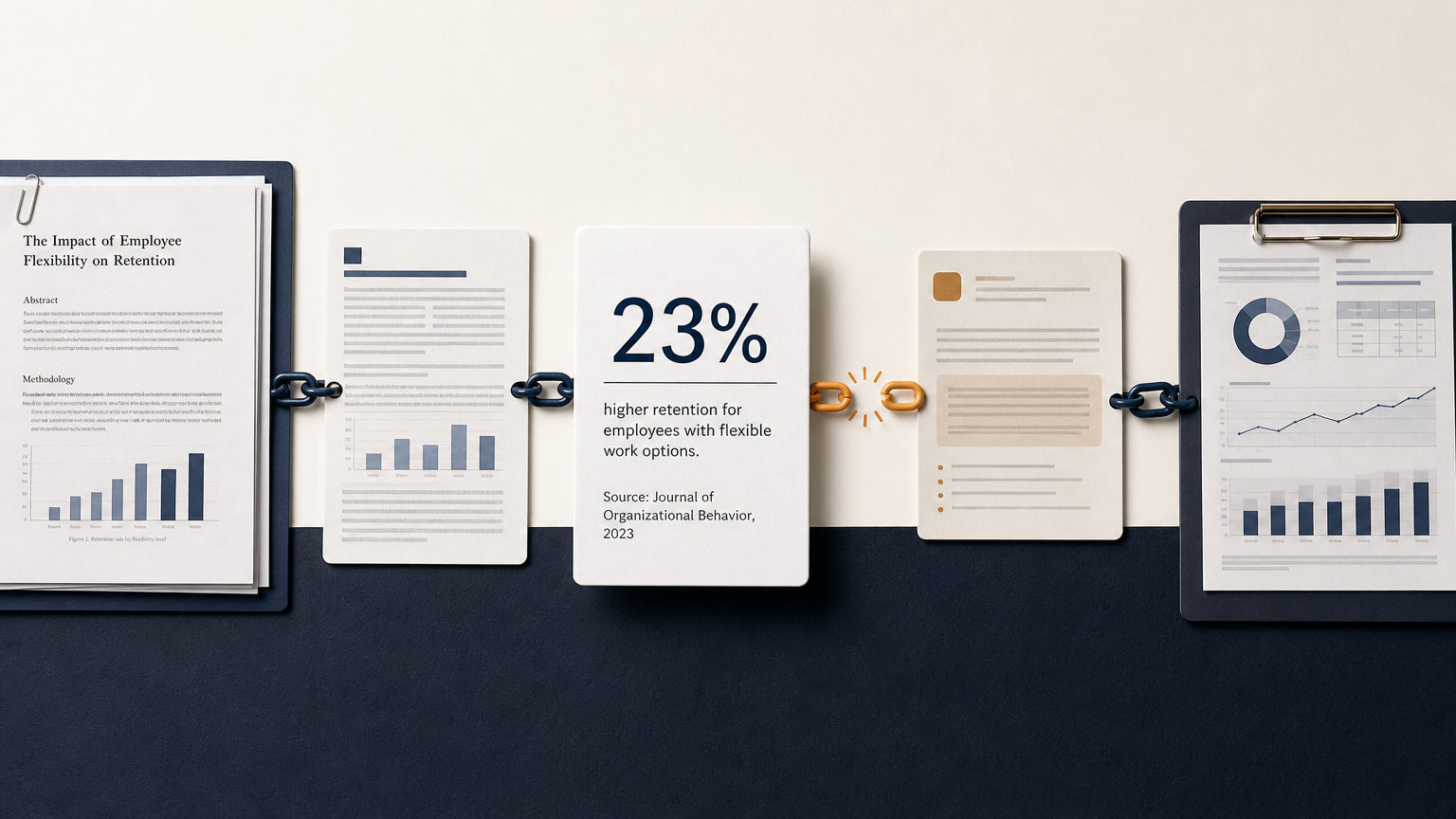
A credible secondary source reports the figure, but the underlying evidence has not been reviewed or is unavailable. This may be useful as background, depending on the circumstances, but should not silently become a firm planning assumption or external claim.
Unverified
The origin, method, supporting evidence, or relevant context cannot be established. The number may remain a research lead, but it should not be represented as confirmed.
Rejected or quarantined
The source conflicts with the claim, does not support it in context, or is unsuitable for the intended use. Keep it out of decision materials unless new evidence changes the assessment.
Confidence belongs to a particular claim and intended use, not to an AI tool in the abstract.
Make escalation proportional to impact
Not every number requires the same review process. A working hypothesis in an internal discussion may warrant a lighter check than a figure used in a board presentation, a resource plan, a customer promise, or a regulated communication.
Teams can adapt controls around the effect of being wrong. Useful questions include:
- What decision will this number influence?
- Who could be affected if it is misunderstood?
- Could the claim change spending, staffing, pricing, risk, or customer expectations?
- Is the number likely to be repeated outside its original context?
- Would a reader reasonably expect an accessible source to support it?
For higher-impact uses, consider assigning a named reviewer, retaining the supporting material, and documenting any qualification that affects interpretation. If the source cannot be accessed or the claim does not match it, choose a different measure, narrow the language, or leave the number out.
Freshness should also depend on context. Some measurements remain useful for years; others change quickly. Rather than relying on a universal age threshold, assess whether the measurement period remains relevant to the specific decision.
Questions to ask before use
Before placing an AI-generated statistic in a dashboard, plan, forecast, or communication, ask:
Can another reviewer find the source, confirm the exact claim, understand its boundaries, and judge whether it is suitable for this use?
If the answer is no, make the uncertainty visible. A clear label, a narrower statement, or the removal of a weak figure is generally more useful than unsupported precision.
A practical starting point is one recurring report. Select the numbers that influence money, staffing, risk, or customer trust. Then create a small provenance record for each. The exercise can reveal where assumptions have become facts by repetition—and where a better source, clearer qualification, or different metric would improve the decision.
The purpose is not to eliminate judgment or stop using AI for research. It is to ensure that a convenient starting point does not become institutional evidence without review.