
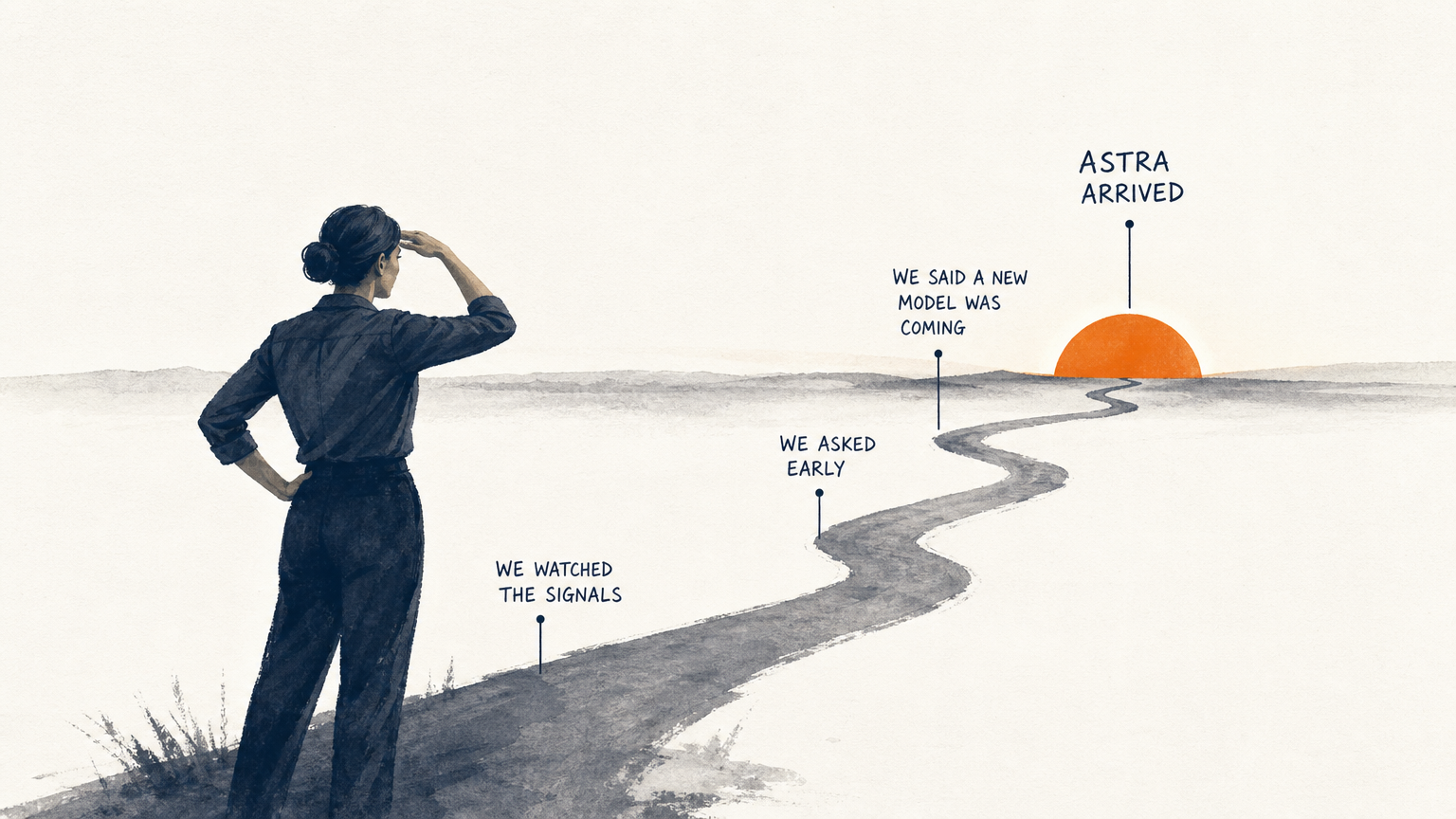
There is a particular satisfaction in asking whether a new AI model is about to appear—and then seeing one arrive.
Our last two articles explored that feeling from different angles: “Is a New AI Model Coming Today?” and “Can You Feel a New AI Model Coming?” They were not press releases, and they were not based on a leaked roadmap. They were attempts to read the atmosphere around AI: the accelerating product cycle, the steady stream of model announcements, and the sense that the next major release is often closer than it looks.
Now Astra has been released.
So, with a modest amount of editorial self-satisfaction, we can ask the obvious question: did we see the future coming?
The Nostradamus theory of AI
Let us be honest about the ego involved. Every prediction looks smarter after the event. Once Astra is available, it is tempting to reread any earlier hint of anticipation as evidence of extraordinary foresight.
That is the fun version of the story: we felt a disturbance in the AI force, listened carefully, and announced that something was coming. Then Astra appeared, right on cue.
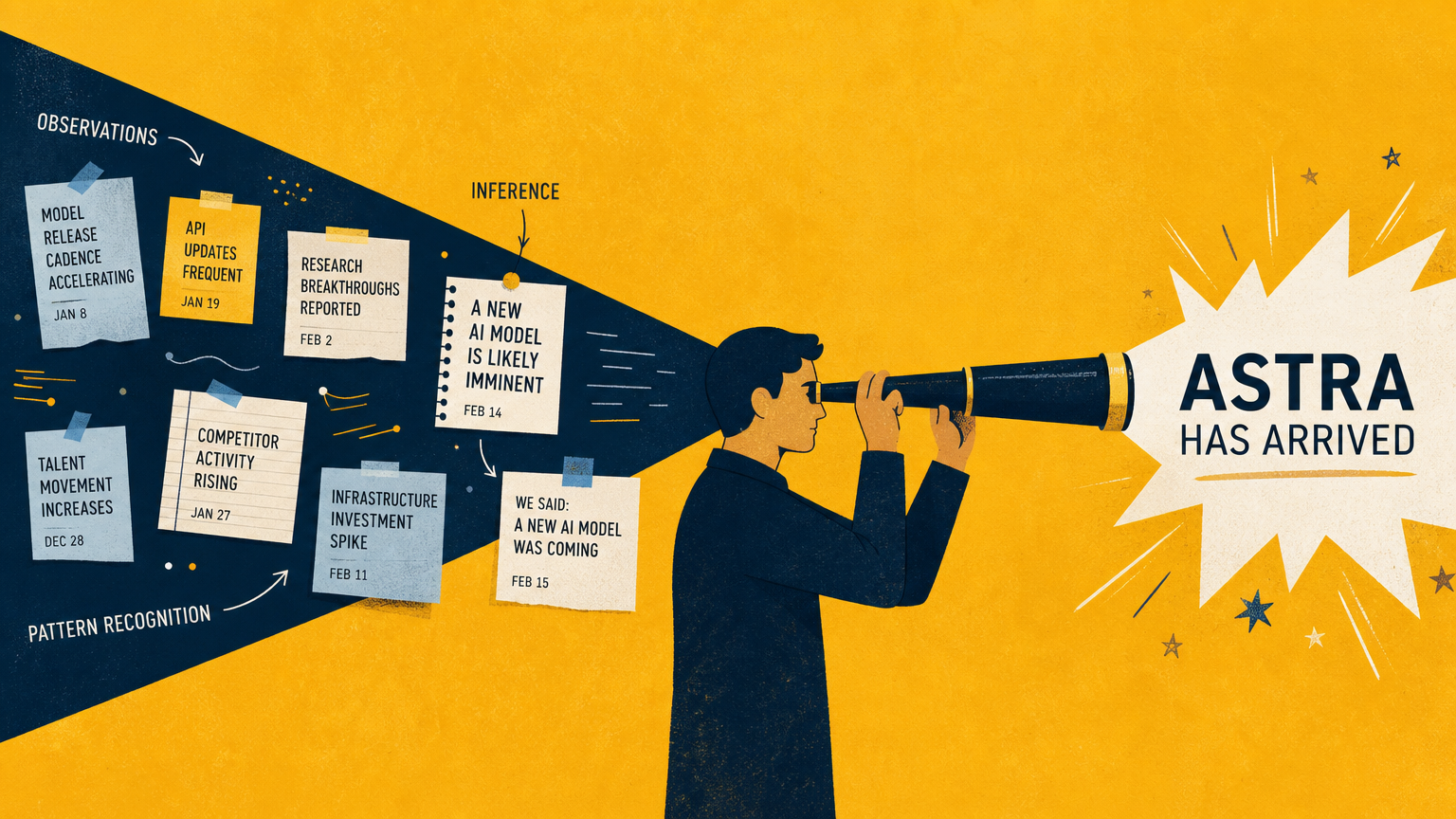
The more accurate version is less mystical and more useful. AI is moving through a period of rapid iteration. New models, product updates, and competitive announcements create a recurring pattern: people begin asking what comes next before the next release is officially named. Spotting that pattern is not the same as knowing the exact release date or specifications.
Our earlier articles should therefore be read as directional predictions, not verified forecasts. They identified a plausible near-term development. Astra’s release gives that instinct a result to examine—but it does not prove that every detail was predicted in advance.
That distinction matters, especially in AI communications. A confident tone can attract attention, but credibility comes from separating what was observed, what was inferred, and what was later confirmed.
What our earlier articles were really saying
The strongest idea behind the two earlier pieces was not simply that “a model is coming.” It was that the market often communicates change before an announcement does.
People notice shifts in how companies talk about research. Developers notice changes in tools and workflows. Users notice that familiar systems are being updated or repositioned. Communications teams notice when language becomes more careful, more ambitious, or more focused on a particular category of capability.
None of those signals, by themselves, proves that a release is imminent. Together, they can create a reasonable editorial question: is another model about to enter the conversation?
That is the useful part of the prediction. It treats AI forecasting as pattern recognition rather than fortune-telling. The prediction is strongest when it makes a clear, testable claim and remains honest about uncertainty.
In this case, the test is straightforward:
- We asked whether a new AI model might be released.
- Astra was subsequently released, according to the premise of this article.
- The exact timing, evidence, and scope of the earlier prediction still need to be checked against the original articles.
That last point is important. Without the full text of those articles, we should not pretend to know whether they named Astra, identified a date, or described specific capabilities. The broad prediction may have been right while the details remain unverified.

What is interesting about Astra now that it is here?
The first interesting thing about Astra is not a particular benchmark or feature. It is what every new model makes possible: a fresh comparison between expectation and reality.
Before release, discussion tends to be speculative. After release, the questions become practical:
- What can Astra actually do?
- Who can access it?
- How does it fit into existing AI workflows?
- Is it more useful for writing, analysis, coding, multimodal work, or communication?
- Does it improve a real task, or mainly create another object of fascination?
Those questions should guide the next stage of coverage. A model is not valuable merely because it is new. Its value depends on how reliably it helps people complete work, make decisions, communicate clearly, or explore ideas.
At the time of publication, the supplied material does not include verified information about Astra’s architecture, benchmark results, pricing, availability, context window, integrations, or specific capabilities. We should not fill those gaps with assumptions. The responsible editorial move is to test Astra directly and document what happens.
A simple way to evaluate the release
A useful first review could examine Astra through three lenses.
Capability: Give it representative tasks rather than novelty prompts. For a communications audience, that might include turning rough notes into a clear briefing, comparing two drafts, extracting a decision list from a long document, or adapting technical material for a nontechnical reader.
Reliability: Check whether the output is accurate, consistent, and transparent about uncertainty. A fluent answer is not automatically a dependable one.
Workflow fit: Ask whether Astra saves meaningful time or improves the quality of the work. A strong model still has to fit the tools, review process, and risk tolerance of the people using it.
This approach turns excitement into evidence. It also gives readers something more useful than a release-day reaction.
Being right is less important than being testable
There is a temptation, after a prediction appears to come true, to make the story entirely about being right. That is where the Nostradamus comparison becomes dangerous. It can turn a reasonable observation into a performance of certainty.
A better story is that we asked a timely question and now have an opportunity to investigate the answer.
That is how AI coverage should work. Prediction opens the conversation. Testing earns the conclusion. The release itself is not the end of the analysis; it is the point at which analysis can become concrete.
Astra may turn out to be a major step forward, a specialized tool, an incremental improvement, or something whose importance depends on how it is integrated into real products. We do not yet have enough supplied evidence to choose among those descriptions.
What we can say is that the arrival of Astra makes our earlier instinct worth revisiting. We sensed that the AI landscape was moving toward another model release. Now the task is to find out what that release changes.
The next prediction should come with a test plan
If we want to keep playing the role of AI Nostradamus, we should improve the method. The next prediction should state:
- What we think is coming.
- Which signals led us there.
- What would count as being right.
- What remains uncertain.
- How we will evaluate the result after release.
That structure keeps the personality without sacrificing editorial discipline. It lets us enjoy the occasional “we told you so” moment while making clear how much was genuinely known beforehand.
Astra’s release is therefore both a punchline and a starting point. Yes, we can take a little credit for asking the question early. But the more valuable achievement will be explaining what Astra can actually do, where it helps, and where the excitement outruns the evidence.
Follow SimplSolutions on our social platforms for future AI coverage, and reach out to us if you would like a demo or want help evaluating how a new model could fit into your communication workflow.