
Start with the work, not the technology
AI governance can become abstract quickly. Teams debate models, policies, and future capabilities while employees are trying to complete ordinary tasks: organize notes, prepare a draft, compare supplied materials, or make sense of a large body of information.
A more useful starting point is the work itself. What is the task? What information is involved? Who will use the output? What could happen if the output is wrong, incomplete, or shared in the wrong place?
Those questions help separate low-stakes assistance from uses that deserve more deliberate design. An AI-generated starting point for internal brainstorming is not the same as an output that shapes an external communication, updates a business record, or influences a meaningful decision.
This article offers an editorial framework for making that distinction. It does not treat any one vendor report, product, or usage study as evidence for universal workplace patterns.
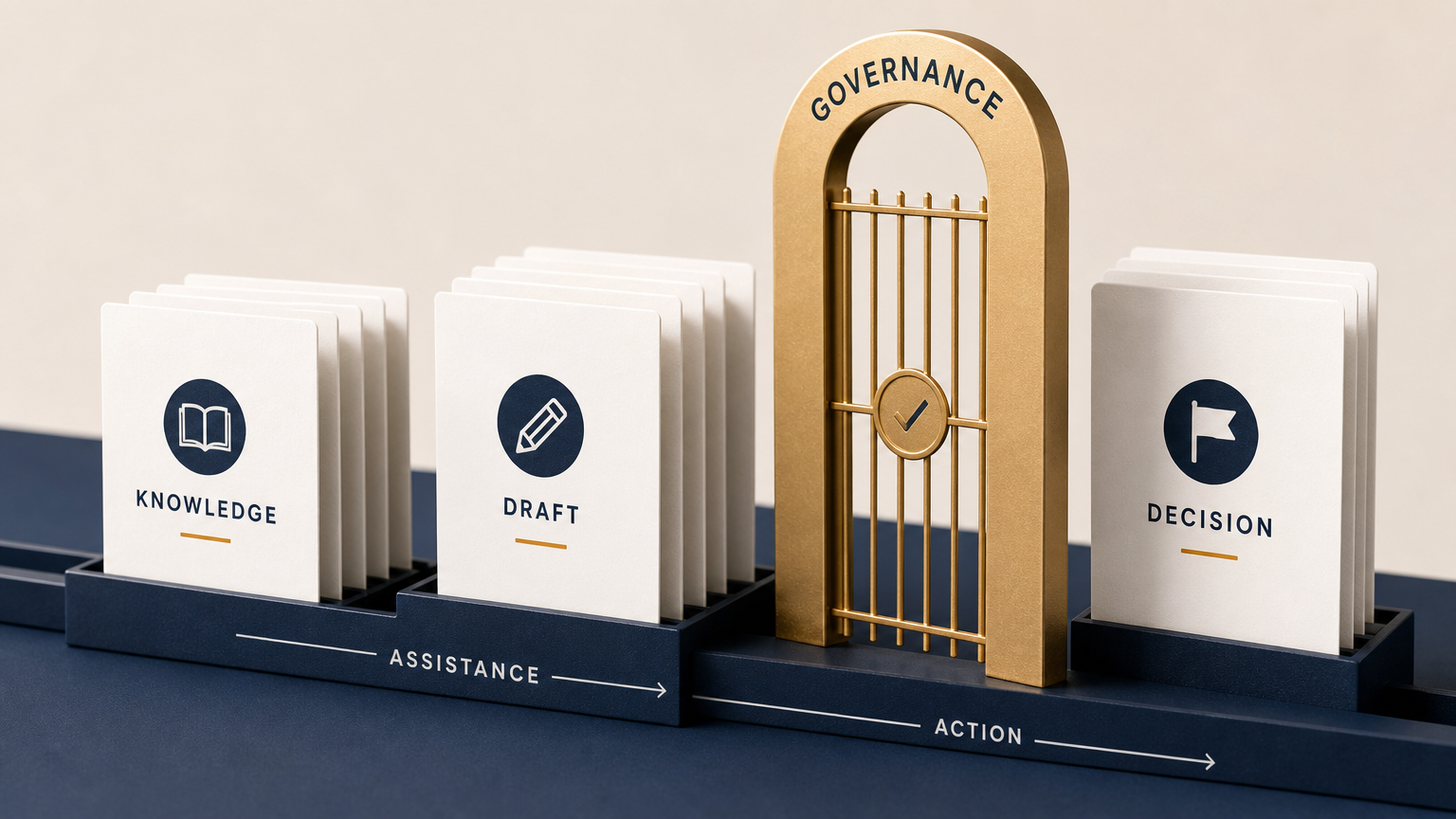
Separate assistance from action
The most important distinction is often whether AI is assisting a person or affecting an operational process.
Assistance can include helping a person organize supplied information, produce a first draft, rephrase content, or develop questions to investigate. The employee remains responsible for deciding whether the output is accurate, useful, and appropriate.
Action begins when an output has a downstream effect: it is sent externally, used to update a record, routed into a workflow, treated as an authoritative answer, or used to support a decision with meaningful consequences.
This is not a binary line. A draft may become an action when someone relies on it without adequate review. A workflow may retain a human approval point and remain easier to control than one that proceeds automatically. The point is to make the transition visible rather than assume all AI use carries the same risk.
Five dimensions to assess for each use case
A short use-case assessment can reveal where governance should be strongest. The following dimensions are adaptable considerations, not a substitute for legal, regulatory, contractual, security, or sector-specific requirements.
1. The purpose of the task
Define the job to be done in plain language. Is the system helping someone explore ideas, summarize supplied material, prepare a draft, classify information, or take part in a recurring process?
A precise purpose limits scope creep. It also gives the team a basis for judging whether the tool is helping. “Use AI for productivity” is too broad to own or measure. “Help a team prepare a first draft from approved internal notes” is a use case that can be evaluated.
2. The information involved
Identify what a user may submit and what information the output may draw upon. This can include public material, internal working documents, customer information, personal information, confidential plans, credentials, or material subject to contractual restrictions.
The practical question is not whether all information has the same label. It is whether the intended use has clear boundaries that employees can understand and apply.
For example, a team might decide that a particular exploratory use is limited to non-sensitive, approved material. A different use involving restricted information may require a separately designed process, access controls, and review by the appropriate internal stakeholders.
3. The consequence of an error
Consider the plausible effect of a wrong, incomplete, misleading, or inappropriately shared output. A weak internal outline may create minor rework. An incorrect statement to a customer, partner, employee, or public audience can carry a different consequence.
Higher-consequence work generally calls for clearer source requirements, more capable review, and a defined path for stopping or correcting the process. The appropriate level of control depends on the organization, the use case, and the context in which the output will be used.
4. The degree of workflow impact
Ask whether the output stays with the person who requested it or changes what happens next.
A suggestion that remains visible for a person to assess is different from an output that triggers a message, changes a queue, populates a record, or becomes an input to another system. As a use case becomes more embedded in a workflow, teams should be more explicit about permissions, handoffs, exceptions, and recovery when something goes wrong.
5. Ownership and accountability
Every scaled use case needs a person or team that owns the business outcome. Technical teams may manage access, integrations, or security controls, but the business owner should remain clear about the task’s purpose, acceptable performance, and decision to pause, revise, or retire the use.
If no one can explain who is accountable for the output in practice, the use case is not yet well defined.

Five operating controls to consider
The assessment above helps a team choose controls that match the use case. These are practical operating considerations rather than a universal checklist.
Define approved sources and inputs
For work that depends on factual accuracy, decide what materials are considered authoritative. That may mean a defined document set, a maintained knowledge base, or a designated system of record.
A useful output is not automatically a reliable one. When the result will inform an important communication or action, the user should be able to compare it with the underlying material rather than rely on fluency alone.
Set understandable data boundaries
Policies need to be usable in the moment. Employees should know what kinds of information are permitted for a particular use, what is not permitted, and where to go when the answer is unclear.
General warnings to “use good judgment” leave too much to interpretation. Clear categories, examples tailored to the organization, and an escalation route are more likely to support consistent decisions.
Design review around the actual consequence
Review is meaningful when the reviewer has sufficient context, time, and authority to challenge the output. A nominal approval step does not solve a poorly designed process.
For a routine internal draft, review might focus on factual accuracy, tone, and completeness. For work that carries greater consequence, a team may need to define who reviews it, what evidence they examine, what changes require escalation, and when the output should not be used.
Make exceptions and failures visible
A workable process anticipates imperfect outputs. Teams can decide in advance what happens when source material is missing, an answer conflicts with available information, a user identifies an error, or the system is unavailable.
This is less about predicting every failure than about avoiding silent failure. Users need a practical way to flag problems, and owners need a way to learn whether those problems are isolated or recurring.
Measure the outcome, not just activity
Usage can show interest, but it does not establish value on its own. A team should identify the result it hopes to improve and choose a measure that relates to that result.
Depending on the use case, that may be completion time, rework, quality checks, error patterns, response consistency, or another internally meaningful measure. The measure should be interpreted alongside context: a faster process is not necessarily better if quality or appropriate review declines.

A simple prioritization exercise
Teams do not need to govern every possible use at once. They can begin by creating a short inventory of current and proposed AI-assisted tasks.
For each task, record:
- The purpose: What problem is the use intended to address?
- The inputs: What information may be used?
- The output: Who sees it, and what may they do with it?
- The consequence: What is the plausible effect of an error?
- The workflow impact: Does it remain a suggestion, or does it influence a process?
- The owner: Who is responsible for the outcome?
- The measure: How will the team judge whether the use is helping?
This inventory does not need to be elaborate to be useful. Its value is that it makes informal use visible and creates a shared language for deciding where additional controls are warranted.
Questions leaders can ask before expanding a use case
Before moving from an experiment to a recurring process, leaders can ask:
- Is the task narrow enough that people can explain its intended purpose?
- Are the permitted inputs and authoritative sources clear?
- Does the review process match the consequence of an error?
- Can a user stop, correct, or escalate a problematic output?
- Is there a named owner who can assess performance and make changes?
- Are we measuring an outcome that matters, rather than simply counting activity?
The answers may show that a use case is ready to proceed, needs redesign, or should remain exploratory. That is a more constructive result than treating AI governance as either an automatic approval or a blanket prohibition.
The takeaway
AI-assisted work is easier to govern when organizations focus on the work surrounding the output.
Define the task. Set boundaries for information. Match review to the consequence. Make ownership clear. Plan for exceptions. Measure whether the process improves the outcome it was intended to improve.
The goal is not to impose identical controls on every use. It is to make deliberate, proportionate choices as AI moves from an individual aid toward a repeatable business process.