
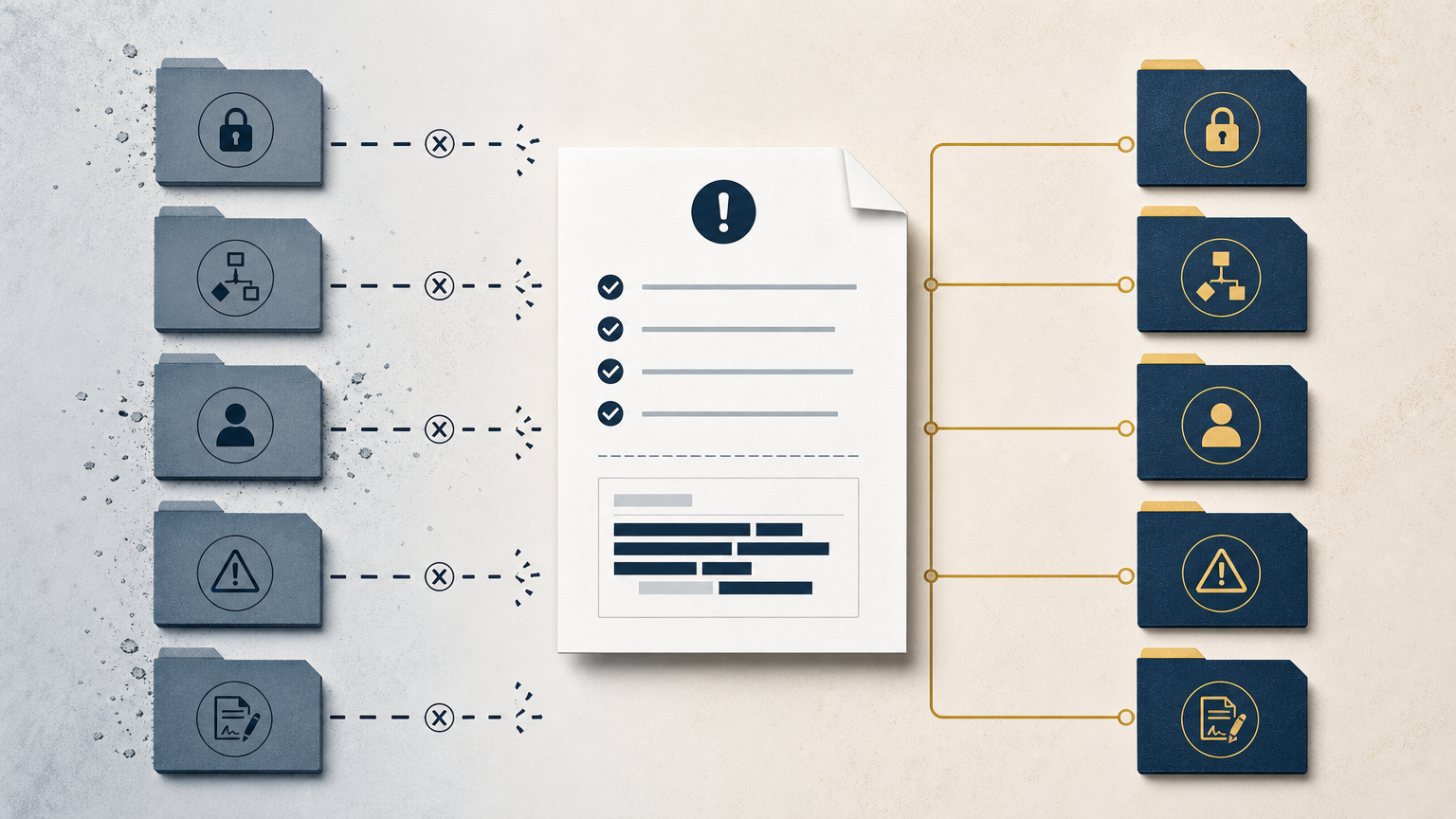
Start with the operating question
The first question is not simply whether the vendor’s service is available again. It is: what could the potentially exposed access material reach, and what evidence has the organization reviewed?
A configuration value may be low sensitivity, but it may also function as a service token, database credential, webhook secret, or other access mechanism. The appropriate response depends on what the value could enable in the organization’s environment.
A vendor notification can be an important input to triage. It is not, on its own, a complete account of an individual organization’s exposure, downstream activity, or business impact. Those questions require an internal record that separates known facts, reasonable assumptions, and unresolved issues.
This guide offers a vendor-neutral documentation framework. It is an operational consideration, not a universal legal, regulatory, or technical rule.
Record the potentially affected access material
Begin with an exposure register. For each potentially affected variable, token, key, or credential, consider recording:
- Credential type and owning system
- Relevant environment, such as production, staging, or development
- Associated account, tenant, project, or service identity
- Permissions available at the time of review
- Creation, rotation, and expiration status where available
- Containment status, such as revoked, replaced, restricted, or under review
- Evidence supporting the recorded status
Do not place live secret values in a broadly accessible incident record. Use identifiers, locations, owners, and status labels, while keeping sensitive evidence in an approved restricted location.
If the inventory is incomplete, say so directly. “No evidence of exposure” is not the same as “evidence of no exposure.” That distinction helps teams avoid closing an investigation based on an absence of information.
Map access material to workflows and destinations
A credential inventory can miss the operational dependencies that create business risk. Map each potentially affected item to the workflows that might read or use it.
For each workflow, the record may include:
- Business purpose and accountable owner
- Trigger source and downstream destinations
- Data categories handled or moved
- Production and non-production variants
- Schedules, retries, queued work, and alternate execution paths
- Existing human review points
- Teams, customers, or partners dependent on the workflow
- Current status: paused, restricted, operating under containment, or restored
This mapping turns a technical event into an operational assessment. A single credential may support multiple automations, and an apparently routine workflow may write to a higher-impact destination.
Useful evidence can include deployment records, workflow ownership records, vendor activity history, and logs from downstream systems. Avoid relying only on memory or a system name as a substitute for dependency mapping.
Contain access and check the old path
Rotation or revocation may be an appropriate containment measure, but it does not by itself establish that all risk is resolved. A usable record identifies what changed and what was checked afterward.
Consider documenting:
- The credential or access path replaced, revoked, or restricted
- The person or role that approved the change
- When the change took effect
- Workflows and systems updated to use the replacement path
- Queued jobs, retries, alternate environments, or fallback paths reviewed
- Evidence that the prior path can no longer be used, where testing is appropriate
A successful workflow test can show that a replacement path works. It does not necessarily show that an older credential is invalid everywhere, that replacement access is appropriately limited, or that no downstream activity occurred before containment.
The goal is to make the previous route unusable where possible and to document the basis for that conclusion.

Review reachable systems independently
Where credentials could provide access to other systems, their owners may need to review available evidence independently. The appropriate scope depends on the credential, systems involved, logging available, and the organization’s risk posture.
Possible review areas include:
- Authentication and authorization events
- Unusual access times or source patterns
- Newly created or changed resources
- Data reads, writes, exports, or deletions
- Permission changes or newly issued credentials
- Unexpected workflow runs, retries, or webhook activity
- Events during the relevant period and shortly afterward
Record both findings and meaningful limitations. For example, “no suspicious activity found in the available logs” describes the review more accurately than a broad claim that no compromise occurred.
If relevant logs are unavailable, incomplete, or retained for a shorter period than needed, record that limitation along with any compensating action. Clear uncertainty is more useful than unsupported certainty.

Document operational and customer impact
An incident record should explain potential business consequences, not only technical details. Impact should be assessed from workflow behavior, data classification, downstream evidence, and applicable organizational obligations.
Potential record fields include:
- Teams, customers, partners, or users potentially affected
- Data categories involved, if known
- Failed, delayed, duplicated, or unauthorized workflow outcomes
- Manual work created by pausing, rerunning, or restricting automation
- Contractual, regulatory, or notification considerations relevant to the organization
- Communications sent, their owner, and timing
- Open questions, each with a named owner and target review point
Do not infer customer impact merely from the possibility of credential exposure. Conversely, do not treat restored service as proof that there was no impact. The record should distinguish confirmed outcomes, plausible risks, and questions that remain open.
Make resumption an explicit decision
Resuming an integration is best treated as a recorded operating decision rather than an informal status update. The decision record can identify:
- Incident owner and technical reviewer
- Business or operations owner
- Workflows and environments covered by the decision
- Completed containment actions
- Remaining unknowns and their significance
- Monitoring planned after restart
- Conditions that would trigger a rollback or pause
- Next review date or event
For higher-impact workflows, a named human approval may be a sensible control before production execution resumes. This does not require manual inspection of every routine run. It means an accountable owner has reviewed the available evidence and accepted the remaining risk under stated conditions.
A phased return can also be considered: restore lower-impact workflows first, limit destinations, increase monitoring, and reassess before expanding operation. The right sequence is organization-specific and should be adapted to the workflow, data, and control environment.
Build a record that survives the handoff
A durable record should allow another operator to answer five questions without reconstructing the event from scattered messages:
- What may have been exposed?
- What could it reach?
- What evidence was reviewed?
- What impact occurred or remains possible?
- Who approved the next operating state, and under what conditions?
This record also supports stronger vendor governance. Organizations can ask vendors about notification practices, credential-handling boundaries, available logs, customer evidence, and recommended containment actions before an incident occurs.
Connected automation is an operating dependency, not a black box. When potential credential exposure is reported, preserve evidence, contain access, map possible business consequences, and make resumption an accountable decision. A one-page exposure and workflow register is a practical place to begin: assign an owner to every unknown and attach the evidence behind every closure decision.