
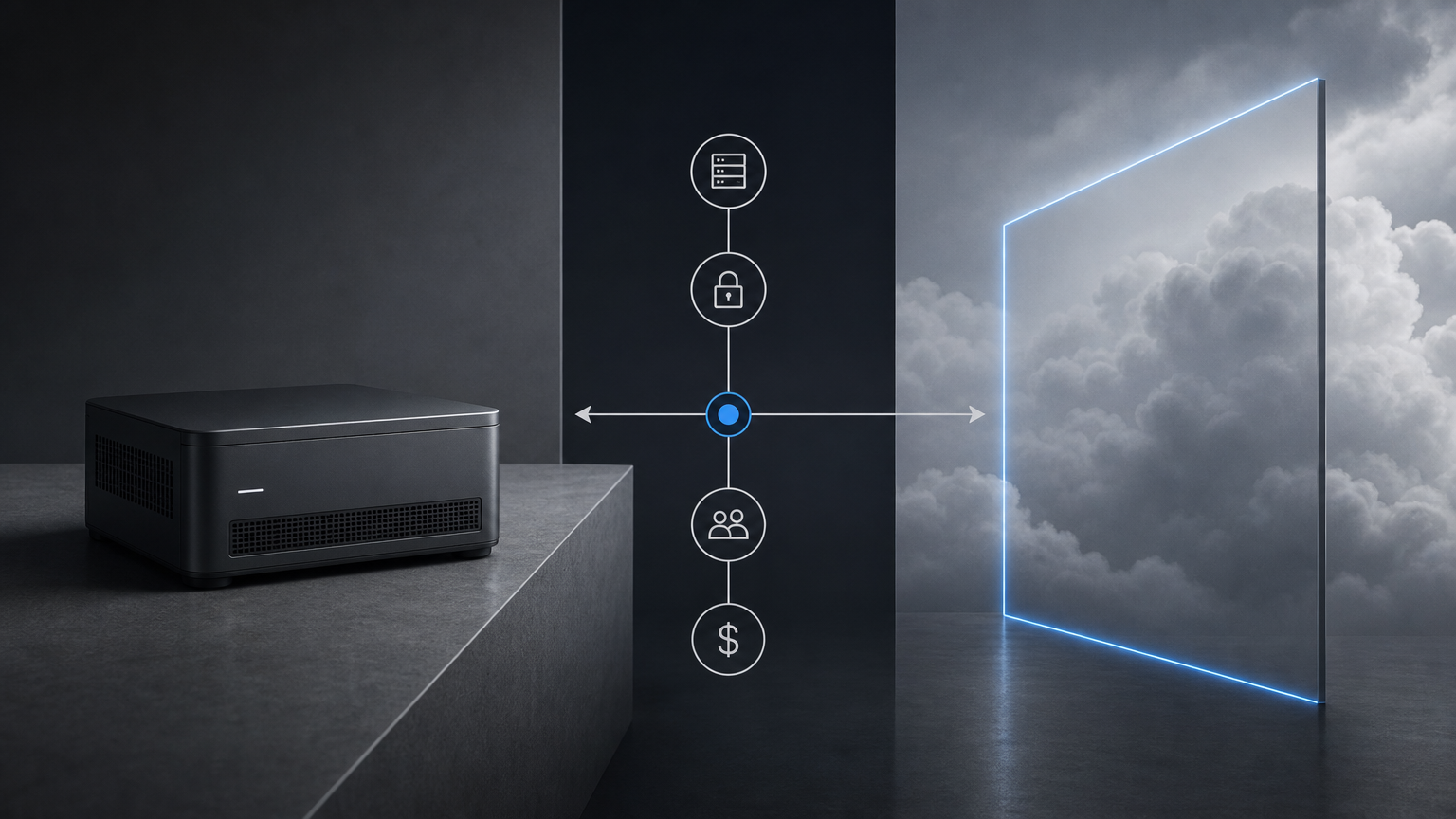
The hardware question starts with the workload
A business considering local AI infrastructure is usually asking the wrong first question: Which machine should we buy?
The better question is: Which workload cannot be served reliably, securely, or economically through our current cloud tools?
That distinction matters because local capacity creates more than a capital expense. It also creates responsibility for physical security, access management, patching, model updates, data handling, monitoring, support, and eventual replacement. A powerful workstation may be useful. It may also become an expensive island that few people can safely use.
Local AI capacity is not automatically the right answer for every workload. Demand for a class of hardware, a compelling demonstration, or a preference for owning equipment does not establish a business case. The case should begin with the work to be improved and the conditions under which it must operate.
Why local AI capacity can be attractive
Local infrastructure can be worth considering when a workload has requirements that cloud tools do not meet well enough.
Sensitive data needs a defined control boundary
Some organizations handle customer records, internal research, regulated information, or commercially sensitive documents that may require clear contractual, technical, and governance controls before they are processed by an external model service.
Local execution may reduce one category of exposure. It does not automatically make the workflow secure. Sensitive data can still be copied to unmanaged devices, exposed through weak permissions, retained in logs, or accessed by an overly broad group. The control environment matters as much as the hardware location.
The workload is frequent and predictable
Cloud usage can be flexible, but repeated high-volume inference or processing may produce operating costs that are difficult to forecast. A local system may be easier to justify when demand is steady enough to keep the capacity usefully occupied.
That calculation should include more than the purchase price. Consider electricity, administration, backup, storage, support, downtime, security work, model maintenance, and staff time. Compare the full operating picture with a realistic cloud baseline rather than with a single usage invoice.
Response time or availability is operationally important
A local system may reduce dependence on an internet connection or an external service's availability. That can matter for a site with unreliable connectivity, a time-sensitive internal process, or a workflow that needs a defined continuity option.
But local capacity can also create a new single point of failure. When one machine serves an important process, the organization should consider recovery, backups, replacement capacity, and an escalation path appropriate to the workflow.
The organization needs controlled experimentation
A contained environment can help a team evaluate models and workflows without immediately committing every use case to a shared external platform. This approach is most useful when the experiment has a defined owner, limited data scope, access controls, and a decision date.
Experimentation should not become a permanent reason for unmanaged systems. A pilot benefits from a clear next decision: expand, redesign, use a managed service, or stop.
Why buying hardware too early is risky
The strongest argument against premature investment is not that local AI is ineffective. It is that hardware can arrive before the operating model is ready.
A business may discover that:
- The intended model does not fit the available memory or performance profile.
- The data has not been classified or approved for the proposed workflow.
- Nobody owns user access, security updates, incident response, or support.
- Employees use the machine for unapproved purposes.
- The workflow changes before the equipment reaches useful utilization.
- A cloud service already provides acceptable results with less operational overhead.
- The organization cannot measure whether the AI process improves a business outcome.
Procurement and lifecycle conditions also matter. Before designing a process around a particular device, consider supply, warranty, replacement time, support expectations, and retirement requirements. A constrained component or delayed replacement can turn a small pilot into a long-lived dependency.
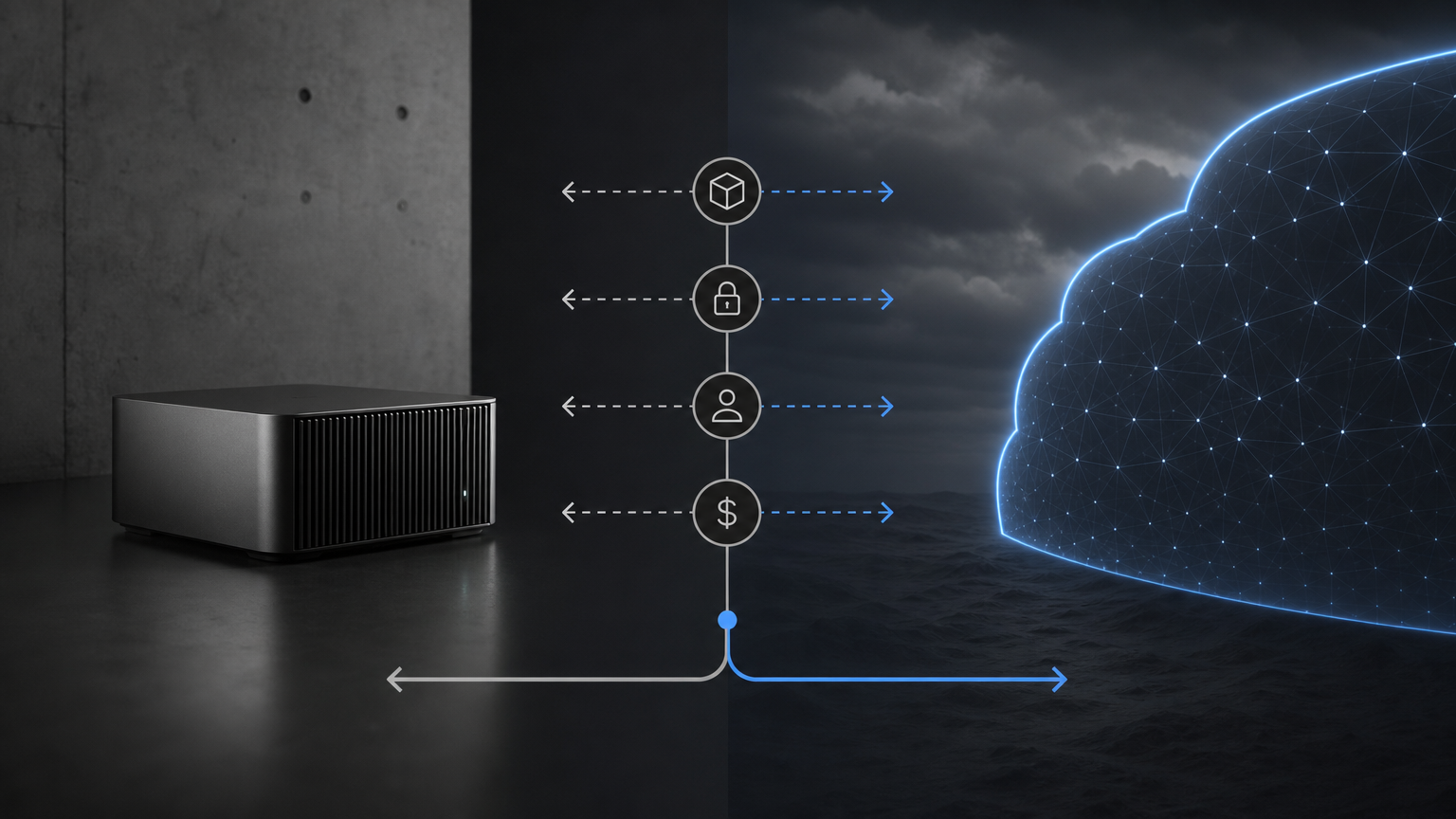
A responsible decision framework
Before approving local AI capacity, operators can document five areas.
1. The business outcome
Define the process being improved and the result that matters. Is the goal faster document review, more reliable classification, lower service cost, better privacy, offline continuity, or something else?
If the outcome cannot be measured, the hardware decision may be driven more by technical enthusiasm than by operating need.
2. The workload profile
Record the expected input types, frequency, concurrency, response-time requirement, model size, retention needs, and acceptable failure behavior. Test representative work rather than a favorable demonstration.
A workload that works for one analyst at a desk may not work for a department with simultaneous users. Conversely, a small internal process may not justify shared infrastructure at all.
3. The governance boundary
Decide what data may be processed, who may access the system, what gets retained, and how activity is reviewed. Establish ownership for permissions, updates, incident handling, and decommissioning.
Local hardware should fit into the organization's existing security and compliance approach. It should not create a parallel exception simply because it is physically nearby.
4. The cost and service comparison
Compare local, cloud, and hybrid options using the same workload assumptions. Include acquisition, support, energy, administration, downtime, replacement, and the cost of adapting the workflow.
The answer may be a mixed model. For example, an organization might keep sensitive preprocessing under tighter local control while using a managed service for approved, less sensitive tasks. This is an adaptable design consideration, not a universal pattern; it still requires explicit data boundaries and monitoring.
5. The operating and exit plan
Assign a named owner and define what success looks like after the pilot. Consider how the system will be backed up, monitored, updated, supported, and retired.
If the team cannot explain how it will stop using the hardware safely, it may not be ready to purchase it.
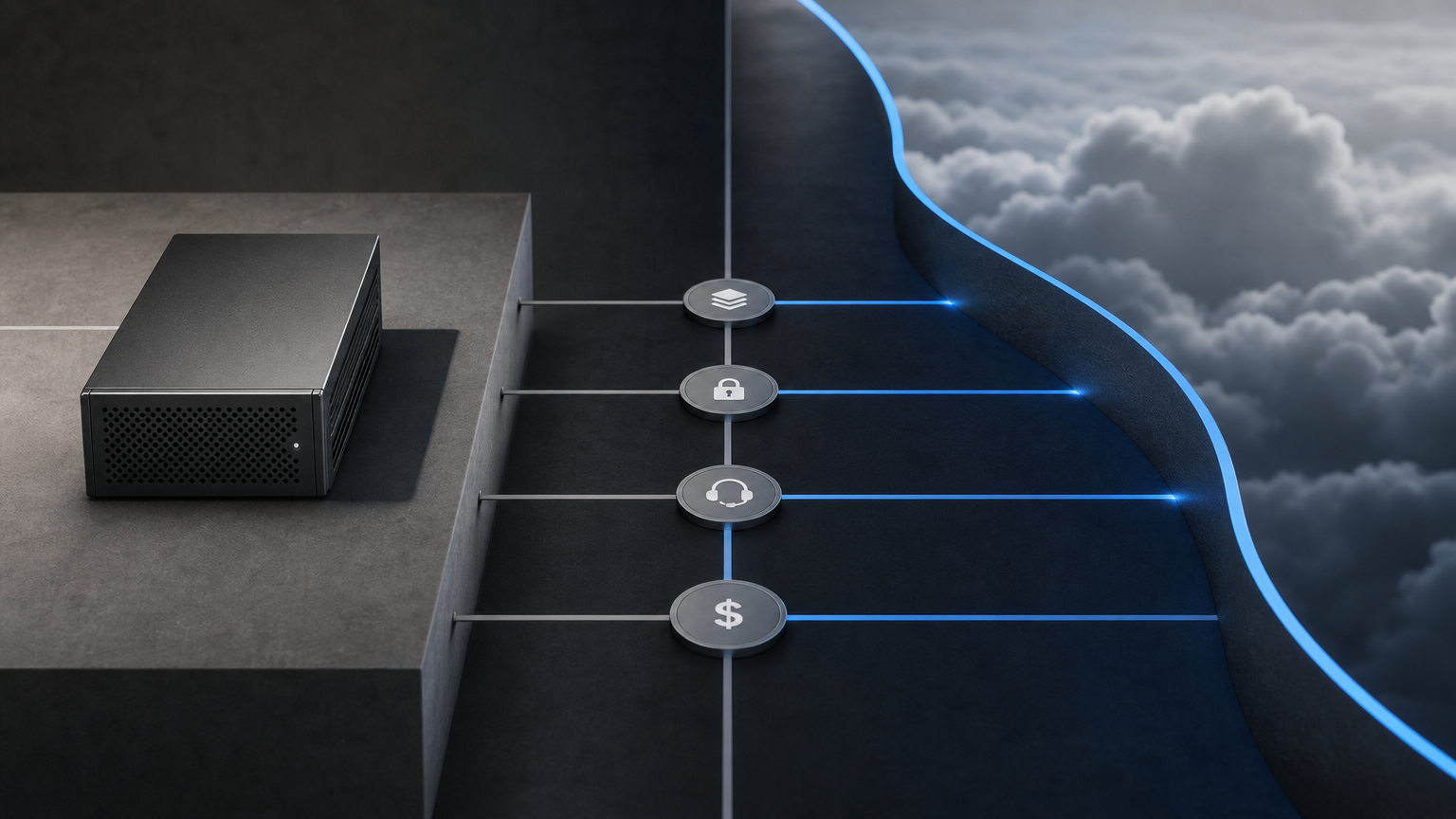
Choosing between local, cloud, and hybrid capacity
The relevant choice is rarely between a universally good local option and a universally good cloud option. Each approach trades control, flexibility, operational effort, and dependency differently.
Local capacity may be appropriate when a specific workload benefits from a controlled environment, predictable performance, or continuity planning. Cloud capacity may be appropriate when demand changes quickly, specialized infrastructure is needed only occasionally, or internal operations capacity is limited. A hybrid model may be worth assessing when different stages of a workflow have different data, performance, or availability requirements.
These are decision prompts rather than rules. The appropriate option depends on the workload, the organization's control environment, and its ability to operate the chosen approach over time.
The practical next step
Start with one bounded workflow and create a decision record before buying equipment. Measure the current cloud or manual process, classify the data, define service requirements, and compare local and cloud options against the same success criteria.
The goal is not to own more AI hardware. It is to make a workflow more useful, controlled, and supportable.
If you would like to discuss the questions raised by this assessment, contact SimplSolutions.