
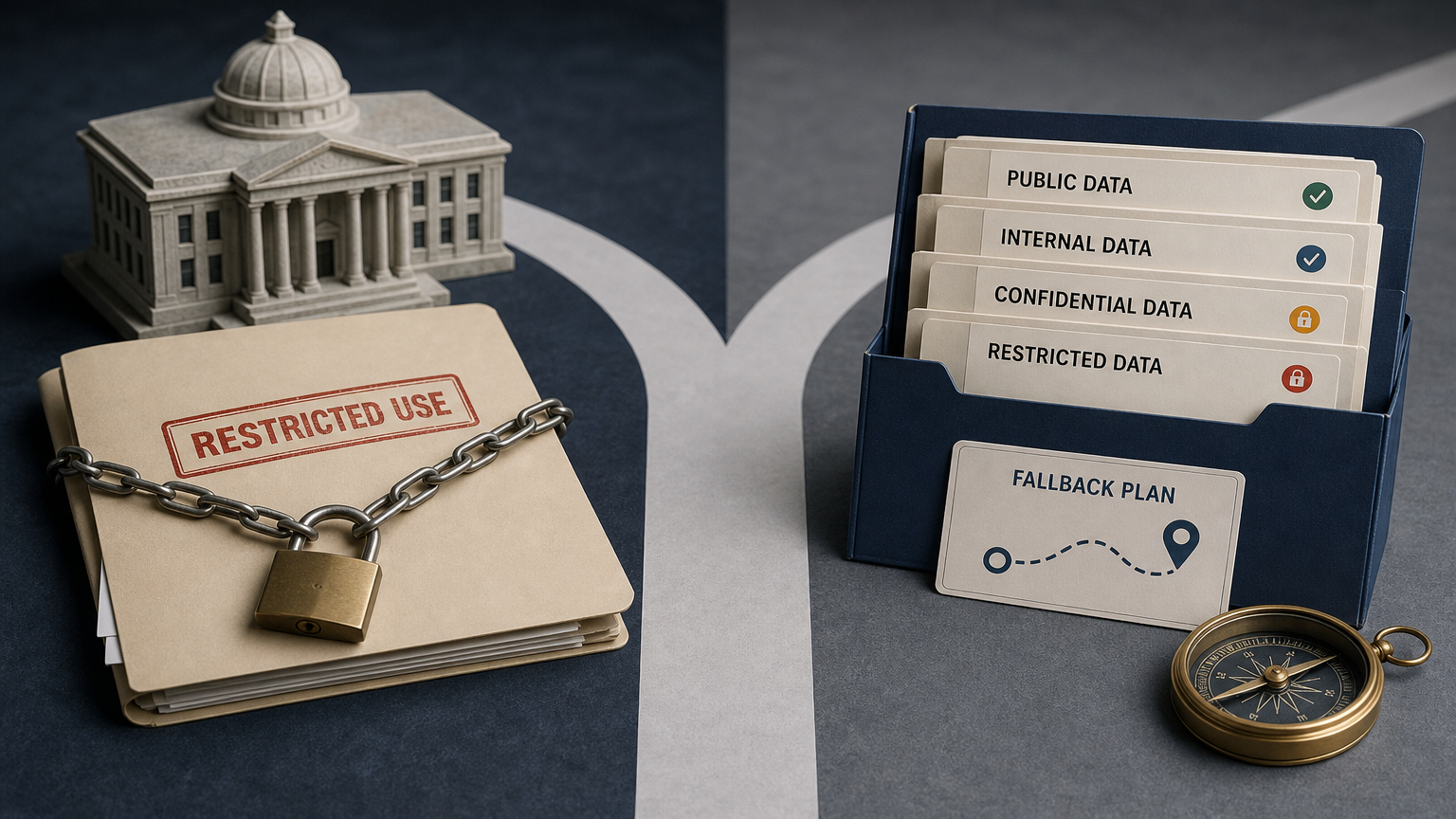
The real question is not whether a tool has generated concern
A new risk signal about an AI vendor can create pressure for an immediate yes-or-no decision. For a business operator, the more useful question is narrower and harder:
Can we justify using this system for this workload, under controls we can enforce, with a fallback we can actually operate?
A report, policy change, security concern, contractual change, or shift in vendor circumstances is not a complete risk assessment. It is a reason to begin one.
The signal may matter because it raises questions about data access, jurisdiction, procurement exposure, security assurance, or the practical difficulty of governing a vendor at scale. But the organisation still needs to assess its own use of the service: what work it supports, what information enters it, which controls are available, and what would happen if access changed.
What a changed risk profile should trigger
Treat a material signal as a vendor-governance review, not as a social-media verdict. The review should answer six questions.
1. Who controls the vendor and the service?
Map the vendor’s legal entity, operating jurisdictions, hosting locations, subcontractors, and support access where this information is relevant to the intended use.
The question is not whether any particular nationality makes a system unsafe. The question is whether the organisation understands which legal and operational actors can influence the service, access its data, or change its terms.
If those answers are unclear, record the uncertainty as a risk rather than filling the gap with assumptions.
2. What happens to your data?
Review the full data path for each intended use case:
- What information enters the system?
- Is it retained, logged, reviewed, or used for model improvement?
- Which employees, contractors, affiliates, or subprocessors can access it?
- Can the vendor change these practices without meaningful notice?
- Can the organisation delete or retrieve its data if the relationship ends?
A tool that may be suitable for public marketing copy may be unsuitable for customer records, confidential strategy, regulated information, source code, or internal credentials. “The tool is approved” is too broad a control. Approval is more useful when it attaches to a workload, data classification, and operating boundary.
3. Could contractual or legal exposure change?
A changed risk profile can affect more than technical security. Customers, partners, insurers, auditors, or regulators may ask different questions about a vendor relationship. The change may also require review under contractual commitments, privacy obligations, export controls, sanctions requirements, or sector-specific rules that apply to the organisation.
Do not speculate about legal consequences from incomplete information. Identify the obligations that apply to the business and route the issue to the appropriate legal or compliance owner.
4. Can access be limited and removed?
Governability depends on more than a vendor’s assurances. The organisation should be able to control who uses the system, which data they can submit, and what happens when an employee changes role or leaves.
Depending on the risk level and available controls, useful review areas can include identity management, administrator ownership, logging, approved use cases, data-loss prevention measures, and the process for suspending access. If a vendor cannot support the controls a workload requires, the problem is operational—not merely theoretical.
5. What evidence supports the vendor’s claims?
Separate evidence from marketing language. Ask what is independently documented, contractually committed, technically observable, and current.
Relevant evidence may include security assessments, privacy terms, incident-notification commitments, subprocessor disclosures, service-level commitments, data-deletion terms, and a clear explanation of model and data-handling practices. The evidence needed will vary with the workload.
A missing document does not prove that a vendor is unsafe. It does mean the organisation should avoid representing the risk as fully understood.
6. How quickly can you substitute the system?
A fallback plan is part of vendor risk management. It should cover the business process, not just the model name.
Identify which activities depend on the tool, who owns those activities, what quality level is acceptable, and how work would continue if access changed. A fallback may be another approved service, an internal process, a temporary reduction in automation, or a human review queue.
The important test is whether the business can keep operating without hurriedly moving sensitive data into an unreviewed replacement.
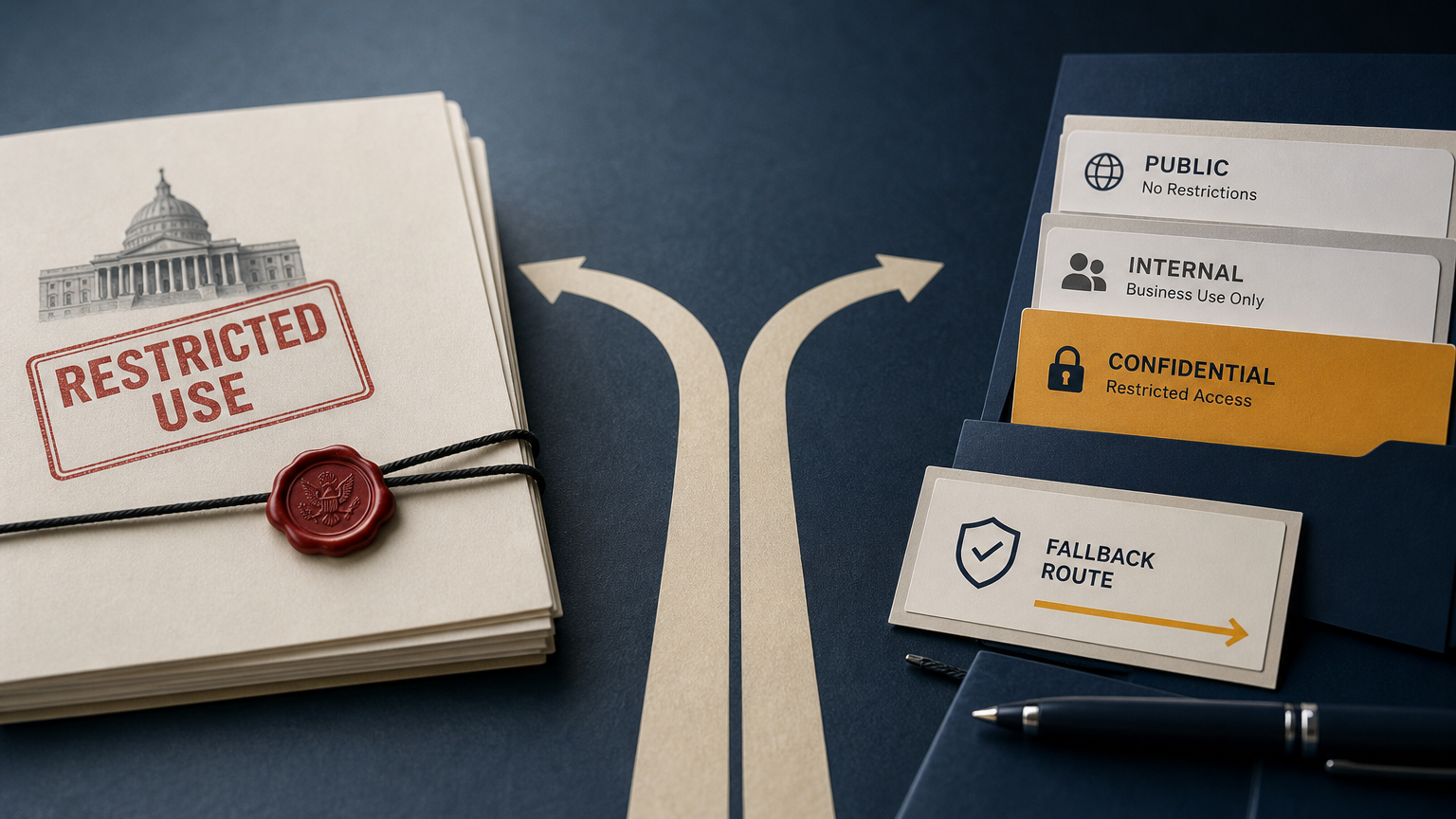
Use a decision matrix, not a binary label
A practical review can classify each use case across four dimensions:
| Dimension | Lower-risk position | Higher-risk position | |---|---|---| | Data | Public or low-sensitivity information | Confidential, regulated, or identifying information | | Control | Strong access, logging, and deletion controls | Limited visibility or weak administrative control | | Evidence | Current, specific, and contractually supported | General assurances or incomplete documentation | | Continuity | Tested fallback exists | Critical process depends on one vendor |
This is not a universal scoring formula or a substitute for applicable legal and compliance obligations. It is a way to expose trade-offs, assign ownership, and distinguish low-consequence use from work that needs stronger controls.
A higher-risk workload may warrant suspension while a lower-risk workload continues within tighter boundaries. The conclusion should be based on the organisation’s documented use, obligations, and available controls—not on a label applied to the product as a whole.
The decision should also have an expiry date. Vendor ownership, policies, infrastructure, contractual terms, and external conditions can change. A review that was adequate six months ago may no longer be adequate today.

What to do when the risk profile changes
When new information appears, two mistakes are common: continuing unchanged because the system is embedded, or stopping every use without understanding the business impact.
A more controlled response can include:
- Pause new use cases and expansion while the review is underway.
- Identify current users, data types, integrations, and dependent processes.
- Reassess the highest-sensitivity workloads first.
- Preserve relevant records and review contractual notification terms.
- Move sensitive work to an approved fallback where necessary.
- Document the decision, owner, conditions, and review date.
- Communicate clearly what is changing and what is not.
The objective is controlled continuity. The business should be able to reduce exposure without losing track of where the system is used or why it was approved.
Make governance operational
AI governance is strongest when it is attached to real operating decisions: which work is allowed, which data may be used, who can access the system, what evidence is required, and how the organisation exits.
A changed vendor risk profile is therefore best understood as a trigger for disciplined review. It is not, by itself, a complete commercial risk determination. It should, however, prompt an organisation to test whether its existing approval remains defensible.
The next step: choose one AI tool your organisation currently uses and document its approved workloads, data boundary, evidence, access owner, review date, and fallback. If those fields cannot be completed confidently, limit the tool to lower-consequence work until the operating boundary is clear.