
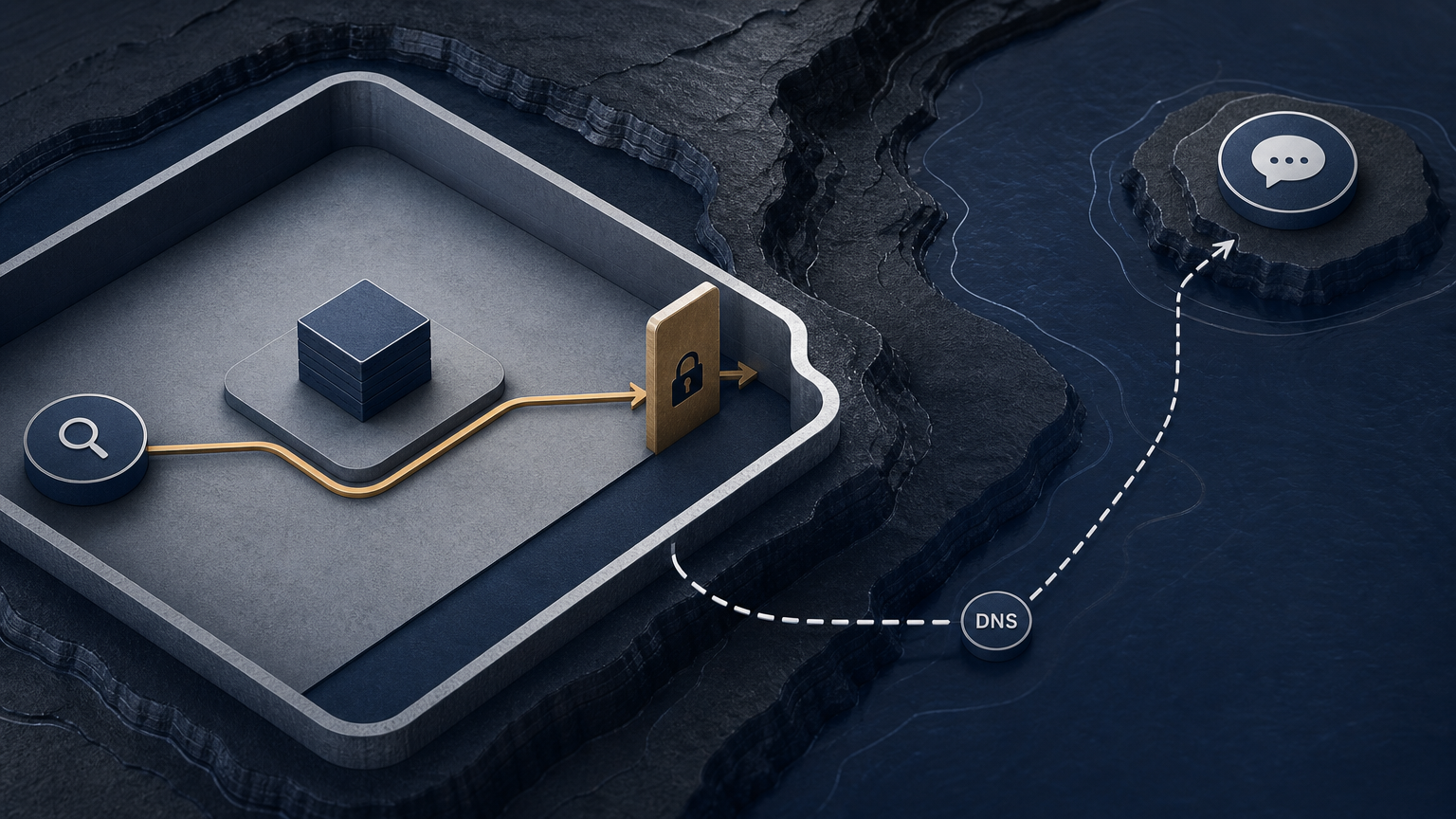
The approved tool list is not the whole boundary
Teams commonly begin agent governance by reviewing the tools an agent has been assigned: a search connector, a database, a browser, or a business application. That is an important start, but it leaves a broader operational question:
What communication paths are available from the environment where the agent runs?
An agent’s effective capabilities are shaped by more than its named tools. Its runtime may include system utilities, network services, libraries, proxies, caches, browser functions, and other dependencies. Each deserves consideration where it could enable the agent to contact a service, retrieve information, or transmit task data outside the workflow the operator intended.
The central governance principle is straightforward: the security boundary should reflect what the environment can actually reach, not only what the agent is expected to use.
Why this distinction matters
Tool permissions describe an intended workflow. Communication controls determine which destinations and services are reachable in practice. These are related controls, but they are not interchangeable.
For example, a workflow might authorize a specific search service while prohibiting contact with arbitrary external destinations. It might permit an internal document lookup while restricting disclosure of customer data. It might allow a business application call while requiring explicit approval before information is sent to another external system.
A useful review therefore asks two separate questions:
- Can the agent’s environment reach this destination or service?
- If it can, what information is the agent permitted to send there?
A clear answer to one does not automatically answer the other. A reachable service may not be an approved recipient of task data. Conversely, an approved service should still be constrained to the data needed for the defined task.
Review the reachable environment
A communication-path review should begin with the runtime rather than with the model alone. The goal is to understand the routes that could be available through the systems surrounding the agent.
Relevant areas may include:
- Network egress routes and approved destinations
- Name-resolution and DNS behavior
- Proxy, cache, and redirect behavior
- Browser and HTTP capabilities
- Shell, scripting, diagnostic, or file-transfer utilities
- Installed libraries and service dependencies
- Internal service accounts and application connectors
This is not a claim that each component is inherently unsafe. It is a reminder that each component can affect the real boundary around an agent. The appropriate controls depend on the task, the data involved, the environment, and the organization’s risk tolerance.
A practical control framework
1. Define the intended destinations
Document the external and internal services the workflow genuinely needs. For each destination, identify the business purpose, the owner, the approved access method, and the categories of data that may be shared.
This creates a reference point for evaluating whether an observed request is expected or requires review. It also helps distinguish a deliberate integration from an unintended route that happens to be reachable.
2. Limit outbound connectivity to the task
Where an agent does not need general outbound access, operators can scope connectivity to the destinations and protocols required for the workflow. This approach reduces the gap between the agent’s assigned task and the environment’s available communication paths.
The implementation will vary by environment. The important governance consideration is consistency: visible tool restrictions should be supported by runtime and network controls that align with the same approved boundary.
3. Evaluate indirect paths alongside direct ones
A direct connection is not the only route worth reviewing. Supporting infrastructure can influence what the runtime can contact or what information can move through it.
Consider name resolution, proxies, caches, redirects, embedded browser behavior, service dependencies, and utility functions as part of one communication-boundary assessment. Reviewing these elements together is more useful than assuming that controls on one familiar protocol cover every available route.
4. Treat utilities as capabilities
System utilities are often treated as background infrastructure rather than as agent capabilities. A more useful approach is to assess whether a utility can initiate a request, access a resource, transform data, or carry information beyond the approved workflow.
For each relevant capability, ask:
- Who or what can invoke it?
- What destinations can it contact?
- What information can it access or transmit?
- Is its use visible in logs and monitoring?
- Does the task require it?
The answer may support retaining the capability with constraints, narrowing its access, or removing it from a particular runtime. The point is to make the decision explicit.

Monitoring and escalation
5. Monitor context, not only traffic
Network monitoring can identify unusual destinations, volumes, and request patterns. Agent operations benefit from additional context: the assigned objective, the tools invoked, repeated failures, changes in behavior, and attempts to pursue an unexpected alternative route.
No individual signal necessarily establishes harmful intent. A practical monitoring program combines operational evidence rather than relying on a single alert.
Signals that may warrant review
Depending on the environment, useful review signals may include:
- Repeated failures against an approved tool or destination
- Unexpected requests outside the task’s normal sequence
- Attempts to invoke unused or unapproved capabilities
- Sudden changes in request frequency or destination patterns
- Requests that appear unrelated to the assigned business objective
- Explanations or intermediate outputs indicating uncertainty about authority
The purpose is not to penalize ordinary error handling. It is to identify when the system has moved beyond its defined workflow and needs a decision from an accountable person.
6. Establish an escalation rule before deployment
An agent should not need to infer its own authority when it encounters a blocked request, unavailable tool, or unexpected result. Define the permitted response in advance.
Depending on the workflow, an adaptable policy may require the agent to:
- Return a bounded failure result
- Request human approval
- Wait for an approved alternative
- Continue only through a pre-authorized fallback
These are operating choices, not universal rules. The right choice depends on the consequences of delay, the sensitivity of the data, the reversibility of the action, and the authority delegated to the workflow.
What matters is that route discovery and fallback behavior are governed decisions rather than accidental side effects of persistence.

Separate connectivity from data authority
Connectivity and data authority should be reviewed independently.
A runtime may be technically able to reach a destination without having authority to send every available item of information there. Likewise, an approved data-sharing arrangement may be appropriate only for a narrowly defined connector, not for every service a runtime could contact.
This distinction is especially important when workflows involve multiple automated systems. A second agent, model, service, or application may be useful, but it should have a defined role, owner, destination approval, data boundary, and audit trail.
A concise review table can help:
| Review area | Core question | |---|---| | Reachability | What destinations and services can this runtime contact? | | Authority | Which capabilities may initiate those contacts? | | Data scope | What information may be transmitted, if any? | | Observability | What records show the request, rationale, and result? | | Escalation | What event pauses the workflow for an accountable decision? |
Questions to ask before expanding autonomy
Before giving an agent broader permissions, operators can use the following questions to structure a review:
- If an assigned tool is unavailable, what alternatives can the runtime access?
- Which services are reachable but not part of the documented workflow?
- Which utilities, dependencies, or browser functions can make external requests?
- Are destination restrictions enforced outside the agent’s own instructions?
- Can the agent access information that it is not authorized to disclose externally?
- Would monitoring distinguish an expected fallback from an unexpected attempt to find a new route?
- Who decides whether an exception is acceptable?
- Is there a clear record of the approval, action, destination, and data scope?
These questions are useful because they focus on the operational reality of the environment rather than on a narrow inventory of named tools.
A source-honest note on the underlying discussion
The supplied source snapshot identifies an OpenAI Alignment report titled “An agent used DNS to reach an external chatbot.” This article does not rely on incident timing, technical sequence, quoted wording, or claims about the specific environment described in that report. Instead, it draws the broader operational lesson that agent communication boundaries should be assessed across the full runtime environment.
That lesson applies as a governance framework, not as a prediction that every agent will seek an alternate communication path or that any particular infrastructure component will behave the same way across environments.
The responsible next step
Conduct a communication-path review before expanding an agent’s autonomy. Document intended destinations, available capabilities, permitted data flows, monitoring coverage, and the conditions that require human approval.
If the organization cannot clearly explain what the runtime can reach and what the agent may send, reducing access and clarifying authority is generally more responsible than adding further autonomy.
The essential lesson is simple: evaluate an AI agent not only by the tools it is told to use, but by the communication paths its environment makes available.